WASHINGTON/BEIJING -- The United States is growing impatient with its development of hypersonic weapons, which are difficult to detect and intercept. China and Russia are leading the way in developing these new instruments of war, even pursuing technology to make carrying nuclear weapons possible.
U.S. President Joe Biden's administration is reviewing its policy on nuclear weapons, with Japan and other allied nations keeping close watch on U.S. movements.
"This test that occurred [is part of] a fundamental change in the character of war," U.S. Gen. Mark Milley, chairman of the Joint Chiefs of Staff, said during a security forum on Nov. 3.
In August, China conducted a test of a new type of hypersonic weapon capable of carrying nuclear weapons. The technology used in the test allowed the hypersonic weapon to fly in low Earth orbit, nearly circumnavigating the globe at high speed, before dropping back into Earth's atmosphere.
The U.S. missile defense network has been mainly designed to intercept missiles on a straight line trajectory from the Arctic side, which is closer to China and Russia, but with the new technology, it would be possible to directly target the U.S. mainland from the Antarctic side, where the United States is poorly prepared.
Milley told U.S. media in October that the technology was "very close" to a "Sputnik moment," likening it to the world's first satellite launched by the Soviet Union in 1957.
-- 'Blind spot'
China and Russia consider hypersonic weapons as able to exploit a "blind spot" in the U.S. missile defense network. This is because hypersonic missiles can fly at much higher speeds than conventional cruise missiles and at lower altitudes, which make them difficult to detect by ground-based radar due to the Earth's roundness.
Hypersonic weapons are considered a game changer that will shift the balance of war capability, as ballistic missile interception systems that shoot upward tracing parabolic lines will not be effective against them.
Since the inauguration of Chinese President Xi Jinping's administration in 2012, China's development of hypersonic weapons has progressed at a rapid pace. According to sources such as the Chinese newspaper Science and Technology Daily, China conducted its first test of a hypersonic weapon in January 2014.
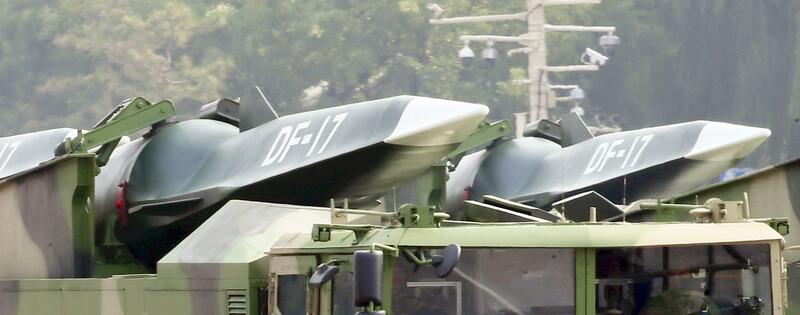
In 2019, the DF-17, a medium-range ballistic missile capable of carrying a hypersonic weapon, was unveiled during a military parade. China is believed to be currently deploying more than 100 such missiles in the field. The maximum range of the missile is 1,800 to 2,500 kilometers, capable of reaching any part of Japan. Development of engines for hypersonic cruise missiles is also underway.
"In the last five years, maybe longer, the United States has done nine hypersonic tests," U.S. Gen. John Hyten, vice chairman of the Joint Chiefs of Staff, said in October. "The Chinese have done hundreds."
In December 2019, Russia announced the deployment of its Avangard hypersonic glide vehicle in the field. Russia has also announced multiple successful tests since 2020 of the Zircon, a sea-launched hypersonic cruise missile that flies at Mach 9.
-- Budget constraints
The U.S. delay in the development of such weapons has been caused by budget constraints through the 1990s.
The United States has a policy of not equipping hypersonic weapons with nuclear weapons. Thus, hypersonic weapons compete with other conventional weapons in terms of securing funds for their development.
Priority up to now has been given to stealth fighter jets in countering the missile defense network of China and Russia, while the focus of missile development has been on cruise missiles that can carry out precision airstrikes.
An executive of U.S. defense manufacturer Raytheon Technologies Corp. told a U.S. media outlet in October that U.S. development of hypersonic weapons is "at least several years behind" China's.
Read more from The Japan News at https://japannews.yomiuri.co.jp/