BEIJING _ Plans by Beijing to impose new national security legislation in Hong Kong are likely to incite protesters at a time when China is attempting to tighten its grip and stem dissent from again exploding in the former British colony.
"National security is the bedrock underpinning the stability of the country," said Zhang Yesui, a spokesman for China's National People's Congress, which began its annual meeting Thursday. "Safeguarding national security serves the fundamental interest of all Chinese, our Hong Kong compatriots included."
The decision sent shockwaves through Hong Kong, where past calls for national security legislation were shelved after mass protests. Many fear that new laws passed will suppress dissidents and endanger freedom of speech, destroying Hong Kong's longtime status as a cultural and political refuge for those who would be persecuted in China.
Zhang said the National People's Congress, China's rubber-stamp legislature, would exercise constitutional power to "establish and improve" a legal framework for enforcing national security in Hong Kong.
The move could bypass Hong Kong's own legislature by altering a part of the region's quasi-constitution without going through usual lawmaking process. Such direct intervention might compel the United States to declare as invalid "one country, two systems," the understanding that Hong Kong should retain its semiautonomous status until 2047.
Such a prospect would further aggravate U.S.-China tensions, already at a breaking point over the coronavirus pandemic, which the Trump administration blames on Beijing. The two sides have been trading testy exchanges _ some have called it the beginnings of a new Cold War _ over each other's shortcomings in handling the deadly disease.
Zhang said China's intentions in Hong Kong were "highly necessary" in light of "new circumstances," alluding to more than six months of anti-government protests that rocked the special administrative region last year. Chinese President Xi Jinping saw the uprising as a threat against the Communist Party.
What began as peaceful resistance last year to a bill that would have allowed extradition of suspected criminals to mainland China evolved into a citywide movement against police brutality and Beijing's influence over the former British colony. More than 7,000 people were arrested for involvement with the protests, including children as young as 11.
Beijing regards the protests as U.S.-fomented separatism, a view made clear in a propaganda film titled "The Other Hong Kong" that state channel CCTV released on Wednesday night.
Ominous music played over footage of a burning city, with black-clad protesters throwing Molotov cocktails as police hunkered in defense.
The film repeatedly called protesters "violent, rioting criminals." It accused the U.S. government of funding the demonstrations through democracy activists and independent media owners in Hong Kong, and claimed that protesters were naive youth being manipulated to destabilize China.
It is a view Beijing has promoted with great success at home _ where there is little support for Hong Kong's protests _ but failed to push abroad. The protests drew global attention, challenging the Communist Party's desired image of a wealthy nation of unified, thankful people, and disrupting China's 70th anniversary celebration.
Now, with the world preoccupied by the coronavirus, Beijing is moving to assert control over Hong Kong's institutions. In the legislature, pro-Beijing parliamentarians took over a legislative committee on Monday by force, after security guards removed 15 opposition lawmakers from the room.
In the media, local broadcaster RTHK was forced on Tuesday to suspend a program after it made jokes about the police. In the courts, the central government's representatives in Hong Kong recently asserted their right to "supervise" the law.
Schools have also been targeted. Beijing officials are pushing for reform to replace liberal studies, which taught critical thinking and which they blame for encouraging students to protest, with "patriotic education."
Many Hong Kongers are looking to upcoming legislative elections in September to express their will, as they did in an overwhelming victory for pro-democratic candidates during district-level elections in November. But their choices might be limited. Hong Kong has begun arresting opposition lawmakers and activists who participated in last year's protests.
What's left is the streets, where Hong Kong's police have been empowered to use force against protesters after a government report investigating police conduct in last year's protests recently vindicated the police. All five foreign experts hired to ensure objectivity in the report resigned in December over complaints of lack of independence.
The report by the Independent Police Complaints Council was widely criticized for failing to hold police accountable for incidents including the night last July when police stood by while "triad" gang members stormed a subway station, beating protesters, journalists and bystanders with metal rods.
The IPCC report said there was "room for improvement" for the police, but described protesters' behavior as "violence and vandalism verging on terrorism."
Hong Kong's police have also denied requests for gathering, citing the need for social distancing due to the coronavirus. The city's annual June 4 vigil, the only mass commemoration of the Tiananmen Square massacres on Chinese soil, has been forbidden.
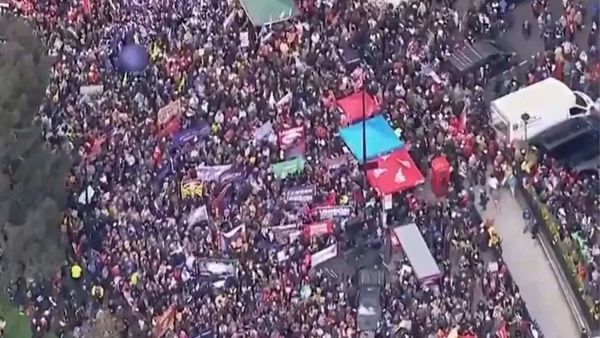
Protests have began and are likely to escalate.
This kind of direct lawmaking is "destruction" of Hong Kong's Basic Law, said Johannes Chan, law professor at the University of Hong Kong, in an interview with local media. "It's increasingly difficult to believe that 'one country, two systems' can still exist."