European markets fall amid doubts about Greek bailout deal
Although it is the middle of Europe’s summer holiday season, it’s been a fairly busy day for economic and financial news - you can read our full summary here.
Since then, European markets have closed in negative territory.
- Germany’s DAX is down 3.27% at 10,924 points;
- France’s CAC40 has fallen 3.2% to 4,925 points;
- The FTSE100 is down 1.4% at 6,571 points;
- The Athens stock exchange is down 1.9% at 691 points.
Tomorrow promises to be no less eventful, as European parliaments prepare to vote on Greece’s latest bailout deal.
We’ll be tracking all the build-up to the votes.
That’s all for now. Thank you for following and commenting.
Never mind scepticism in Germany about Greece’s new bailout deal, there’s plenty in Greece too, says Jon Henley in Athens, who draws my attention to this interesting article in Kathimerini.
Commentator Alexis Papachelas writes that the new bailout deal will share the fate of those that came before, becoming an “orphan memorandum” that will never be implemented.
It will cause a storm of reactions, it will be voted on, and then it will remain for the most part a dead letter.
When Tsipras openly rejects ownership of the memorandum, how are people expected to believe its implementation is a national goal?
This deal will be simply voted through parliament so that Greece can pay back the ECB and the IMF ... [It] will fall through, or it may not even actually be put to work. It will remain an orphan memorandum, that will share the fate of those that went before it. No government has succeeded in building its own ‘Greek’ memorandum – a plan that could mobilise the state as well as the people.
You can read the full article here
Let’s take a break from Greece to the look at the biggest deal of the day. As has been widely reported, the Economist Group has been sold by education publisher Pearson for £469m.
John Foley of Breaking Views has been looking over the small-print and concludes the Economist have a lot of faith in their own self worth.
According to Foley the company is valued at £957m, rather more than the group’s in-house assessment of £730m.
The company includes the Economist Intelligence Unit analysis unit, Washington-based newspaper Roll Call, as well as the eponymous magazine that likes to call itself a newspaper.
As Foley writes:
The price, like the magazine, is elite. It represents the group’s EBITDA [earnings] for the year ending March 2015, where European media outlets trade on just over ten times, according to Thomson Reuters Eikon data. The Economist is profitable, but that profit isn’t growing.
The deal also means that the group will have to sell its brutalist HQ near St James’s Park with fine panoramas over Westminster.
Greek bailout deal will be reviewed in October
Greek crisis-watchers can now put October in their diaries.
In this month Greece’s creditors will be checking on how well the government in Athens is implementing promised reforms.
As one EU source tells Reuters:
There will be a strong first review of the implementation of measures in October.
Greece’s eurozone creditors insist they not be discussing bailout relief before October, with no promises on how soon any easing of Greece’s debt burden might come.
Angela Merkel’s returned from her holidays just in time.....
... via Reuters bureau chief for Germany.
The Greek bailout deal will fail - Varofakis
Greece’s former finance minister Yanis Varoufakis doesn’t have a lot in common with Germany’s Wolfgang Schäuble, but both are deeply sceptical about the Greek bailout deal.
Speaking on the BBC’s World at One, Varoufakis said the deal wouldn’t work.
He added that he had seen the “finance minister of Germany [Schäuble] go to the Bundestag and effectively confess this deal is not going to work”.
Varoufakis was forced to resign last month and replaced by Euclid Tsakolotos.
Speaking on Wednesday, he said:
The International Monetary Fund... is throwing up its hands collectively despairing at a programme that is simply founded on unsustainable debt... and yet this is a programme that everybody is working towards implementing.
Ask anyone who knows anything about Greece’s finances and they will tell you this deal is not going to work.
Varoufakis also reminisced with an old friend - Lord Lamont, who was Conservative chancellor when Britain was forced out of the Exchange Rate Mechanism in 1992, although Lamont has denied “singing in his bathtub” about the exit.
Germany has serious doubts about the bailout deal - Bild
First the deal, then the questions. The latest chapter of Greece’s eurozone bailout drama does not depart from that script, with a report in Bild suggesting that the German government has little faith in what has been agreed in Athens.
Germany’s biggest-selling newspaper says that Berlin has three main concerns:
- Participation of the International Monetary Fund. As Die Zeit reported earlier Germany is anxious to keep the fund involved in the process and would like the EU to step in and offer to protect the IMF’s losses.
- Greece’s debt sustainability. Greece’s financial needs were “higher than expected” according to a German government paper seen by Bild and debt sustainability remains an outstanding issue.
- Privatisation fund: how quickly can it get up and running? Not soon enough, according to the German government paper seen by Bild.
The German government is also worried that the agreement does not include a clear timetable on Greece’s reform and austerity programme.
The response from the German finance ministry to the Bild story: No Comment.
Summary
China’s move to push its currency lower for the second day running has sent global stock markets tumbling. The central bank decision follows some weak factory output and retail sales figures, and had the desired effect of weakening the yuan.
Perhaps too much, with reports the central bank intervened to sell dollars late on in the trading session to limit the falls in the Chinese currency.
A press conference by the Peoples Bank of China tomorrow could provide some further clarity, but meanwhile US Federal Reserve member William Dudley said the devaluation had huge implications.
Meanwhile Albert Edwards of Societe Generale warned of a”tidal wave” of deflation following the Chinese move.
Elsewhere details of the Greek bailout agreement emerged, including a €25bn buffer for the country’s banks and details of privatisations. A review of how well Greece is doing - assuming the deal goes ahead - could come as soon as October.
Greek prime minister Alexis Tsipras said he was optimistic about an agreement - it will be voted on in the Greek parliament on Thursday and examined by the Eurogroup of finance ministers on Friday. But he warned of people putting obstacles in the way, although he refrained from naming them.
Germany said the offer of a bridging loan was still on the table, to give more time to iron out an agreement and still allow Greece to pay €3.2bn to the European Central Bank on 20 August.
On the economic front Eurozone industrial production fell in July, while in the UK average earnings grew more slowly than expected while unemployment rose for the second month running.
Wall Street has opened sharply lower, with the Dow Jones Industrial Average currently down 203 points or 1.18% in the wake of the uncertainty caused by China’s further moves to weaken its currency.
European markets remain sharply lower, with the FTSE 100 down 1.39%, Germany’s Dax down 2.67% and France’s Cac off 2.91%.
EU says negotiations underwent "sea change" when Varoufakis left - report
EU sources have said negotiations on the €85bn bailout for Greece underwent a “sea change” when former finance minister Yanis Varoufakis was out of the picture, Reuters reports.
The agency said the mood changed when Varoufakis was replaced as finance minister by Euclid Tsakolotos. An EU source told Reuters:
There was a sea change in the negotiations with the Greek authorities in recent weeks. The new Greek finance minister has an absolutely different attitude in the talks than the previous one. Talks were very constructive.
(We await comment on this from Varoufakis...)

US Federal Reserve member William Dudley said the events in China had huge implications.
In a question and answer after a speech to the Rochester Business Alliance, he said it was too early to judge the impact of the yuan devaluation and said he would not comment on China’s currency policy.
But according to ForexLive he added:
Everyone has gotten a bit frothy about China devaluing but you have once central bank cutting and it’s economy slowing (China) and another whose economy is (supposedly) picking up and a central bank ready to hike (the US). That there would be some currency divergence is FX 101.
Fed's Dudley Q&A: What happens in China has huge implications http://t.co/wBV60F6YLQ
— ForexLive (@ForexLive) August 12, 2015
And here’s a link to the full memorandum:
#Greece - #ESM draft MoU (english version) → https://t.co/gxKmwiin8q
— Yannis Koutsomitis (@YanniKouts) August 12, 2015
Tsipras optimistic about a deal, but warns of obstacles
Greek prime minister Alexis Tsipras said a deal with its lenders would end economic uncertainty in the country, but warned some people were trying to put obstacles in the way (now who could that be?). Reuters reports:
“Despite the obstacles that some are trying to put into our path, I’m optimistic we will get to an agreement, loan support from the European mechanism, which will put a final end to economic uncertainty,” Tsipras said during a visit to the Greek infrastructure ministry in Athens.
It was the leftist leader’s first comments after lenders and Greece reached a deal on Tuesday in a new bailout accord worth up to €86bn. He did not specify who was attempting to scupper the accord.
Tsipras said his government would spearhead a fight against tax evasion and corruption, saying that was partly responsible for the crisis the country found itself in.
#Tsipras says that it is a political pledge for the govt to institutionalize new rules for transparency & new mechanisms to fight red tape.
— The Greek Analyst (@GreekAnalyst) August 12, 2015
#Tsipras says that the fines & penalties will be extremely hard on whatever entities are found to be tax-evading. #Greece
— The Greek Analyst (@GreekAnalyst) August 12, 2015
#Tsipras talks about a new 'code of values' that the Greek society needs, and the former status quo refrained from creating. #Greece
— The Greek Analyst (@GreekAnalyst) August 12, 2015
Alibaba results disappoint
Chinese e-commerce company Alibaba has disappointed investors with its first-quarter results, sending its US shares down 6% in premarket trading.
The company’s net income more than doubled to 12.34m yuan, while revenues rose 28% to 20.25m yuan ($3.27bn), compared to expectations of $3.32bn.

Updated
Chinese steel producers have already cut export prices following the devaluation of the yuan, according to Reuters.
Meanwhile Chinese cars sales fell by 6.6% in July following a 3.4% decline in June.
Updated
But here’s a hopeful sign:
Eurozone source confirms eurogroup mtg on #Greece deal around 3pm Fri Brussels. "Will be a short one...no indications it will be difficult"
— Tony Connelly (@tconnellyRTE) August 12, 2015
The Greek memorandum of understanding is a substantial result, says German government spokesman Steffen Seibert, but it is important that the International Monetary Fund is part of any bailout.
*GREECE MOU GOES IN RIGHT DIRECTION - TOO EARLY FOR FULL ASSESSMENT OF GREECE MOU SEIBERT SAYS
— Stavros Kallinos (@StKallinos) August 12, 2015
And a German finance ministry spokesman said bridge financing for Greece - which would allow the country to make the payment it owes to the European Central Bank while a deal is hammered out - was not off the table (according to Reuters). But:
German Finance Ministry spox denies #Germany is weighing EU guarantee for #IMF's loans to #Greece.
— Yannis Koutsomitis (@YanniKouts) August 12, 2015
That is a reference to a story earlier in Die Zeit.
Updated
A major review of how Greece is implementing the reforms agreed for a third bailout will take place as soon as October, Reuters reports. (Assuming the €85bn deal goes ahead, of course).
Any discussion of debt relief will come at a later stage, according to EU sources.
Under the terms of the deal, Greek banks will receive €10bn of new capital immediately, with a further €15bn before the end of the year. The initial aid will be placed in a special account, says Reuters, and will be dependent on an approved business plan and the results of stress tests.
The confusion over the Chinese actions is summed up by Connor Campbell at Spreadex:
The yuan situation only got more complicated this Wednesday, with reports suggesting that the Chinese government, after devaluing its currency, was now propping it up by ordering its state banks to sell the dollar. If true it is an utterly baffling move, one that reflects a worryingly lack of clarity and/or sense in the decision making process at the top of the Chinese period, something that in itself that could have disastrous ramifications down the road.
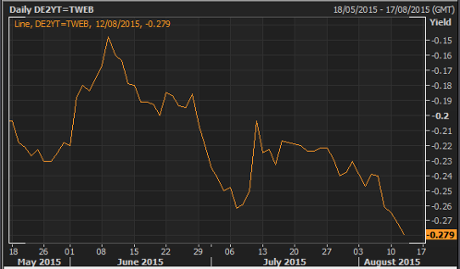
German two year bond yield hits record low
One of the repercussions of the turmoil caused by China’s currency move is that investors are looking for havens such as German bonds.
So the yield on German two year bond yields has hit a record low, edging down below -0.29% (yes, that’s a negative rate).
Perhaps we’ll get some clarity on China’s thinking tomorrow - the Peoples Bank of China is reportedly holding a press conference, according to Bloomberg.
PBOC to hold a briefing tomorrow at 01.15 GMT http://t.co/JCjUMAIeoi
— ForexLive (@ForexLive) August 12, 2015
PBOC briefing tomorrow to explain 3rd lower fix tonight? Trying to wave magic Yuan and calm market vol? Not devaluing - all for IMF SDR?
— Mike van Dulken (@Accendo_Mike) August 12, 2015
Prepare for tidal wave of deflation after Chinese devaluation - SocGen's Edwards
The Chinese devaluation could unleash a “tidal wave” of deflation, according to Albert Edwards at Societe Generale. He writes:
Renminbi devaluation has been one of my big non-consensus calls of the past few years. I can tell you that 18 months ago, when it was becoming increasingly clear that this was the end game in the currency war and I articulated this view in meetings to clients, I would get so much pushback I was almost jet-propelled out of the door. Anyway, now the die has been cast, what next? This is only just the beginning. Investors should prepare for a tidal wave of deflation from Asia...
Make no mistake, this is the start of something big, something ugly. For while the west has been heaving a sigh of relief over the past few months that deflation pressures have abated somewhat – especially at the core level – we have been emphasising that deflation has only been intensifying in Asia and that like any pus-filled boil, this deflationary pressure would soon need to be lanced.

We have long believed that we are only one misstep from outright deflation in the west with core inflation in both the US and eurozone at just 1%. We expect the acceleration of emerging market devaluations to send waves of deflation to the west to overwhelm already struggling corporate profitability and take us back into outright recession. As investors realise yet another recession beckons, without any normalisation of either interest rates or fiscal imbalances in this cycle, expect a financial market rout every bit as large as 2008...
The key thing here is that Tuesday’s devaluation is not just a one-off – you will see persistent weakness from hereon in. For although the Peoples Bank of China said the move was a one-time adjustment to reflect changes in the way it calculates the daily fix, it also said that the price would be set “in conjunction with demand and supply conditions in the foreign exchange market and exchange rate movements of the major currencies”. To all but the most PollyAnna’ish of observers that means this is the start of a major renminbi devaluation because of the massive downward market pressure the currency is under via the balance of payments deficit.
Meanwhile the Wall Street Journal is also hearing that China is moving to halt the yuan slide:
China's central bank intervenes to prevent yuan from tumbling, instructing state banks to sell dollars. http://t.co/vF4pOxlo9p
— WSJ Breaking News (@WSJbreakingnews) August 12, 2015
Task Force to be set up on Greek privatization fund by Oct. #Greece to implement task force recommendations on privatization fund by Mar2016
— Holger Zschaepitz (@Schuldensuehner) August 12, 2015
More from the Greek memorandum of understanding, courtesy Reuters:
The memo calls for “irreversible steps” to sell its regional airports, privatise the electricity transmission company by October 2015 unless an alternative scheme with equivalent results is presented, and announce binding bid dates for the sale of Piraeus and Thessalonika ports by the end of October.

The timing of any vote in the Greek parliament on the bailout terms is uncertain, reports AP Financial, thanks to an intervention by speaker Zoe Konstantopoulou, an opponent of the bailout. The agency says:
Prime Minister Alexis Tsipras called an emergency session of parliament, asking the assembly’s speaker for the bill to go through committee level Wednesday, ahead of a full debate and vote by the end of Thursday.
However, the exact timings remain unclear.
Parliament Speaker Zoe Konstantopoulou, a dissenter within Tsipras’ left-wing Syriza party and vociferous bailout opponent, reportedly scheduled the parliamentary procedure to start only Wednesday night. That would delay the process and meaning a vote would likely be held in the pre-dawn hours of Friday.

More confusion over China’s actions, following earlier reports Chinese state-owned banks had been selling dollars.
Now China trying to intervene the other way? Asking Banks to limit USD purchases? What the hell are they up to? Overdone it already?
— Mike van Dulken (@Accendo_Mike) August 12, 2015
3 day yuan chart is fun pic.twitter.com/FiINfa8RLK
— Joseph Weisenthal (@TheStalwart) August 12, 2015
Eurozone industrial production falls
Eurozone industrial output fell by more than expected in June, following declines in activity in Germany, France and Italy.
Output dropped by 0.4% month-on-month in June compared to expectations of a 0.2% dip. But it was still 1.2% higher year on year.
Euro area industrial production -0.4% in June 15 over May 15, +1.2% over June 14 #Eurostat - http://t.co/h80VdKAXFt pic.twitter.com/FFT9PvJ4r3
— EU_Eurostat (@EU_Eurostat) August 12, 2015
Updated
Germany looking at Greek guarantees for IMF - report
Germany is looking at whether the European Union could provide guarantees to the International Monetary Fund about Greek debt, in order to keep the fund as part of the bailout process and avoid the need for major debt relief, Reuters is reporting citing German newspaper Die Zeit.
The paper said the idea meant “if Greece ran out of money, the Europeans would jump in and the IMF would suffer no losses. In return the fund would no longer demand extensive debt relief.”
Meanwhile Reuters says the draft memorandum of understanding for Greece sees a buffer of up to €25bn to recapitalise viable banks and resolve costs of non-viable banks.
The memo expects privatisation proceeds, excluding bank shares, of €1.4bn in 2015, €3.7bn in 2016 and €1.3bn in 2017.
Updated
Standard and Poor’s agrees the China move is not the start of a currency war. In a new report the ratings agency says:
China’s surprise move to allow for more exchange rate flexibility makes good economic sense and is not the start of a currency war or an attempt to jump-start growth....The move is more likely to be due to a relatively benign “technical correction” aimed at improving market functioning or an effort to comply with IMF conditions to get the yuan included in the special drawing rights (SDR) basket sooner rather than later.
“The argument that China is trying to spur growth by weakening its currency to spur exports does not strike us as very convincing,” said Standard & Poor’s chief economist for Asia-Pacific Paul Gruenwald. “Exports are more a function of foreign demand, with the exchange rate playing a secondary role. There is no reason for that relationship to have changed.”
Standard & Poor’s doubts that the move was driven by weak July trade data since these have been soft for some time--the trade surplus has been trending at a high level.
“We see the timing as opportune. This is because China can now say that by moving to a more market-determined rate it is delivering what the IMF and US Treasury have been asking for. And since the pressure is now on the yuan to weaken, having more exchange rate flexibility is palatable to the Chinese authorities,” said Mr. Gruenwald.
Back with China, and the country could be seeking a devaluation of the yuan of up to 10%, writes Fergus Ryan in Beijing:
China’s central bank is under pressure to further weaken the yuan in a bid for aid the country’s struggling exporters, Reuters reports.
Citing sources involved in the policy making process, the report claims that “powerful voices inside the government” are pushing for the yuan to devalue even further.
According to the news agency, the comments suggest there is pressure inside government circles for an overall devaluation of almost 10%.
Changes in the UK labour market - in one handy chart. Unemployed - up. Inactive - also up. pic.twitter.com/5z0HGRzgkI
— RBS Economics (@RBS_Economics) August 12, 2015
The UK jobs data still suggests a rate rise in February, according to James Knightley at ING Bank:
The UK jobs report is pretty close to expectations with some softish headlines. It is likely that the election timing has played its part given these are three month rolling numbers so the uncertainty generated by the politics in April/May – whether it would be a Labour-SNP coalition government for example – led to firms being less keen to hire workers and invest aggressively.
In terms of the headline numbers. Employment fell 63,000 versus expectations of a 55,000 drop with the three month rolling average for the unemployment rate remaining at 5.6%. Pay rates excluding bonuses remained at 2.8% year on year in the three months to June while including bonuses they slipped to 2.4% from 2.8%.
We are expecting better numbers in coming months as the election effects fade and the underlying strength of the UK economy continues to push employment and pay higher.
If we look deeper into the tables at individual monthly data we see than the unemployment rate for June fell to 5.5% from 5.8% in May while private sector pay recorded the fourth consecutive annual increase in excess of 3% (public sector pay is being restrained by government spending limits to 1.3% year on year). Consequently, we expect medium term domestically generated inflation pressures to continue to rise, but in the near term CPI will remain depressed by falling energy prices and sterling strength. As a result we still favour a February date for the first Bank of England rate rise.

For Apr-Jun 2015 wages up 2.4% on a year earlier including bonuses, & 2.8% excluding bonuses http://t.co/AMrsZwZOa5 pic.twitter.com/glS7hFO3g3
— ONS (@ONS) August 12, 2015
#Unemployment rate 5.6% Apr-Jun 2015, up slightly on Jan-Mar, down from 6.3% year earlier http://t.co/B0H6zORFTm pic.twitter.com/PUUB4a4Xke
— ONS (@ONS) August 12, 2015
UK wage growth slows, unemployment rises for second month in a row
UK average earnings growth was lower than expected in July, while the unemployment rate held steady at 5.6% but jobless numbers rose.
Weekly wages grew 2.4% year on year in the three months to June compared to 3.2% in the three months to May and forecasts of 2.8%.
The unemployment rate of 5.6% was in line with expectations, while the number of people out of work rose 25,000 quarter on quarter to 1.852m, the second monthly rise in a row.
Sterling has hit a one month low against the euro following the wage data.
Updated
Here’s something to put the Chinese economy in context as regards the UK:
NB China is still only the UK's 6th biggest export destination. Not much bigger than Belgium/Luxembourg... pic.twitter.com/5Zsu7mOmAu
— Ed Conway (@EdConwaySky) August 12, 2015
Some talk of a cut in China’s reserve requirement ratio:
RRR cut rumours in China...would make sense to stabilise liquidity but won't help CNY
— econhedge (@econhedge) August 12, 2015
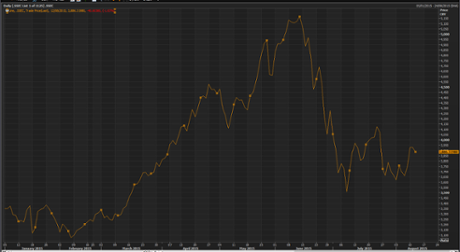
Here’s the performance of the Shanghai composite this year:
Meanwhile the global stock market sell-off is accelerating.
The FTSE 100 is now down 1.86% or 124 points. Germany’s Dax is down 1.95%, France’s Cac has fallen 1.7% and Italy’s FTSE MIB is down 2.33%.
In Greece the Athens market - which bucked Tuesday’s downward trend with a 2.1% rise - is now down 0.38%.
In China the Shanghai composite lost 1.03%, while the Nikkei fell 1.58% or 327.98 points.

As for the US, ADS Securities is forecasting the Dow Jones Industrial Average will open down around 173 and the S&P down 21 points.
Updated
The International Monetary Fund has welcomed China’s move towards greater exchange rate flexibility, suggesting it was a helpful step towards the yuan being included in its currency basket. An IMF spokesperson said:
The new mechanism for determining the central parity of the Renminbi announced by the PBC appears a welcome step as it should allow market forces to have a greater role in determining the exchange rate. The exact impact will depend on how the new mechanism is implemented in practice.
Greater exchange rate flexibility is important for China as it strives to give market-forces a decisive role in the economy and is rapidly integrating into global financial markets. We believe that China can, and should, aim to achieve an effectively floating exchange rate system within two to three years. Regarding the ongoing review of the IMF’s SDR [special drawing rights] basket, the announced change has no direct implications for the criteria used in determining the composition of the basket. Nevertheless, a more market-determined exchange rate would facilitate SDR operations in case the Renminbi were included in the currency basket going forward.
Merkel "sceptical" about Greek bailout deal
The proposed Greek bailout deal may yet run into problems with Germany, reports Jon Henley in Athens:
An early note of caution following yesterday’s optimism around a new €85bn bailout deal between Greece and its creditors – the country’s third financial rescue in five years.Ekathimerini is reporting that the punishing reforms-for-aid package, which the Greek parliament has been recalled from its summer recess to ratify on Thursday, may yet run into opposition from Germany at a planned summit of eurozone finance ministers on Friday.
“The Greek government’s greatest concern is that German finance minister Wolfgang Schäuble will reiterate his opposition to a deal and insist Greece should instead be granted a bridging loan” to allow it to meet its €3.2bn euro debt payment to the ECB on August 20, the paper said, citing government sources.

It added that the German Chancellor, Angela Merkel, had made similar noises on Tuesday in a conversation with Greek prime minister Alexis Tsipras, saying Germany was “sceptical” about the agreement and proposed a bridging loan instead of a full agreement, which she suggested required “more detailed discussion”. The AFP news agency also quoted an EU source as saying it was still not certain the deal would be finalised by August 20 - meaning Athens might need emergency funding to pay its ECB debt. “We might need a few days’ bridge (funding),” the source told AFP. “In that case, we need all the member states” to approve the loan.
Updated
More on Greece:
Draft law for #Greece's 3rd bailout has been submitted to Parliament as two articles. Due to be voted on Thursday under emergency procedure
— MacroPolis (@MacroPolis_gr) August 12, 2015
Up until now it had seemed highly probable that the US Federal Reserve would lift interest rates in September, judging by recent data and comments from the central bank’s members. But could the Chinese devaluation change that? M&G’s retail bond team say the chances are receding:
The implied probability of the Fed hiking in September fell from 52% to 38% yesterday as result of China RMB devaluation.
— Bond Vigilantes (@bondvigilantes) August 12, 2015
European markets open lower
As forecast the latest Chinese moves to devalue its currency have sent European markets lower.
The FTSE 100 is down 71 points or just over 1%, with commodity companies under particular pressure. Fears of a slowdown in China - a key consumer of commodities - have pushed the likes of Glencore, Rio Tinto and BNP Billiton down around 3% after hefty falls on Tuesday.
Germany’s Dax has dropped 1.3%, Spain’s Ibex is 1% lower and Italy’s Ibex is off 0.7%.
One of the problems with the Greek economy which needs to be tackled as part of its reforms is the issue of tax evasion. But this is no simple matter according to the government. Greek newspaper Kathimerini reports:
Alternate Finance Minister Tryfon Alexiadis has described the issue of tax evasion in Greece as complex in an interview with the Belgian newspaper L’Echo, while stressing that he will be judged on his ability to collect taxes.
Asked why collecting taxes seems so hard in Greece, Alexiadis pointed to a lack of political will to ensure a working system and interventions by politicians and others.
He noted, however, that during the last 5,300 tax inspections he had not received any calls for intervention, showing a public awareness that this government’s higher officials are very different.

After five years of tax rises, Alexiadis noted that the situation is tense. Last week tax collectors on Rhodes were roughed up by business owners and citizens while conducting spot checks.
“These reactions are the start of fascism,” he said. “Citizens cannot attack officials for doing their job.”
He added that Greece has one tax inspector for every 1,100 inhabitants, much lower than other European countries, out-of-date computers and no access to X-ray machines such as in Albania, Bulgaria and Romania, greatly reducing the effectiveness of controls.
Updated
Back with China, and the central bank moves seem to be having the desired effect, with the yuan at a four year low against the dollar:
Message sent, received and understood. Chinese yuan spot rate -1.95% today, down even more than yesterday's fall pic.twitter.com/As8EhY5bQu
— Jamie McGeever (@ReutersJamie) August 12, 2015
#China Yuan drops in ‘vicious cycle.’ Sets for biggest 2day drop since 1994. http://t.co/bMUCu63bR4 pic.twitter.com/VeFKY7kA7O
— Holger Zschaepitz (@Schuldensuehner) August 12, 2015
But Capital Economics says - despite much talk of it - that China is not declaring a currency war but is more about financial reform.
Capital economics says china not declaring a "currency war", move about reform pic.twitter.com/v9NzIqfFSW
— Bill Bishop (@niubi) August 12, 2015
Angus Campbell, senior analyst at FX Pro said:
The renminbi has been one of the most highly controlled currencies in foreign exchange and had a quasi-peg against the dollar for some time, but just as we saw from the Swiss National Bank earlier in the year, when economic conditions shift, action has to be taken to adjust the value of a currency to take it to a fairer value. Such moves are usually in the interest of your own domestic economy and since China has been slowing rapidly for years against the backdrop of a slower global economy, it’s little wonder the data has been disappointing and the PBOC has been upping the ante on the monetary stimulus front.
These fundamentals would cause any free floating currency to fall in value, so it should not come as a surprise to see the devaluation occurring and further weakness could follow as China attempts to give provide its exporters with a more competitive environment. This move is impacting risk assets due to the unpredictability of the PBOC’s action and as it will have a knock on deflationary impact for China’s big trading partners.
The FTSE 100 is due to open lower by some 50 points and at the time of writing the Dow Jones is being called to open over 100 points in the red as companies that are reliant on revenues from China will be shunned by investors for the second day in a row.
Updated
In the UK there are unemployment and average earnings figures due later. Economics editor Larry Elliott says:
Fresh jobs and wages data for the UK will be closely scrutinised by the Bank of England and the City for evidence that the surprise jump in unemployment reported last month was a blip.
With the economy growing strongly in the second quarter, the latest figures for the labour market are expected to show a modest improvement in employment and annual earnings growth running close to 3%.
His full preview is here:
Michael Hewson at CMC Markets said:
The unemployment rate is expected to stay at 5.6%, while the increase in average earnings of 3.2% that we saw in May is expected to moderate slightly to 2.8%, still well above the headline and core rates of CPI inflation.
Greek parliament to discuss bailout
Elsewhere today, Greek parliamentary committees are due to discuss the proposed third bailout deal which will give the beleaguered country access to around €85bn of new funds, ahead of a 20 August deadline to make a €3.2bn payment to the European Central Bank.
Greek prime minister Alexis Tsipras wants lawmakers to examine the proposals, with a view to a vote in parliament on Thursday.
The eurogroup of finance ministers is set to consider the proposals on Friday.

Here are IG’s opening calls for European markets:
Our European opening calls: $FTSE 6627 down 38 $DAX 11175 down 119 $CAC 5065 down 34 $IBEX 11061 down 91 $MIB 23523 down 176
— IGSquawk (@IGSquawk) August 12, 2015
Introduction: China weakens yuan again
Good morning, and welcome to our rolling coverage of the world economy, the financial markets, the eurozone and business.
A day after the Chinese authorities surprised markets by devaluing the country’s currency, the People’s Bank of China lowered its guidance rate for the yuan by 1.6% compared to the previous close. The move reinforced fears about the country’s slowing economy, and sparked further fears of a currency war.
And new data showed why the country’s authorities are trying to drive down the currency to boost its flagging economy.
Factory output rose 6% in July, a three month low and below expectations of 6.6% growth. Fixed-asset investment rose 11.2% in the first seven months of the year, comparred to forecasts of 11.5%.
Meanwhile retail sales grew 10.5% year on year in July, which was down from the 10.6% growth seen in June. Economist Louis Kuus at RBS Hong Kong told Reuters:
The output number is bad. This kind of data will only accentuate the negative outlook that everyone has about the economy. Many people were expecting an improvement and there is no improvement.
In retrospect they probably saw this data before yesterday’s devaluation. I’m not suggesting the data triggered yesterday’s move but it could have been a factor.
According to Reuters, Chinese state-owned banks have been sellling dollars on behalf of the central bank to keep the yuan at around 6.43 to the US currency.
The Chinese moves sent global markets lower yesterday, with commodity companies in particular falling sharply on worries about the outlook for the world’s second largest economy, a key consumer of metals and oil.
The Nikkei is currently down another 1.58%.