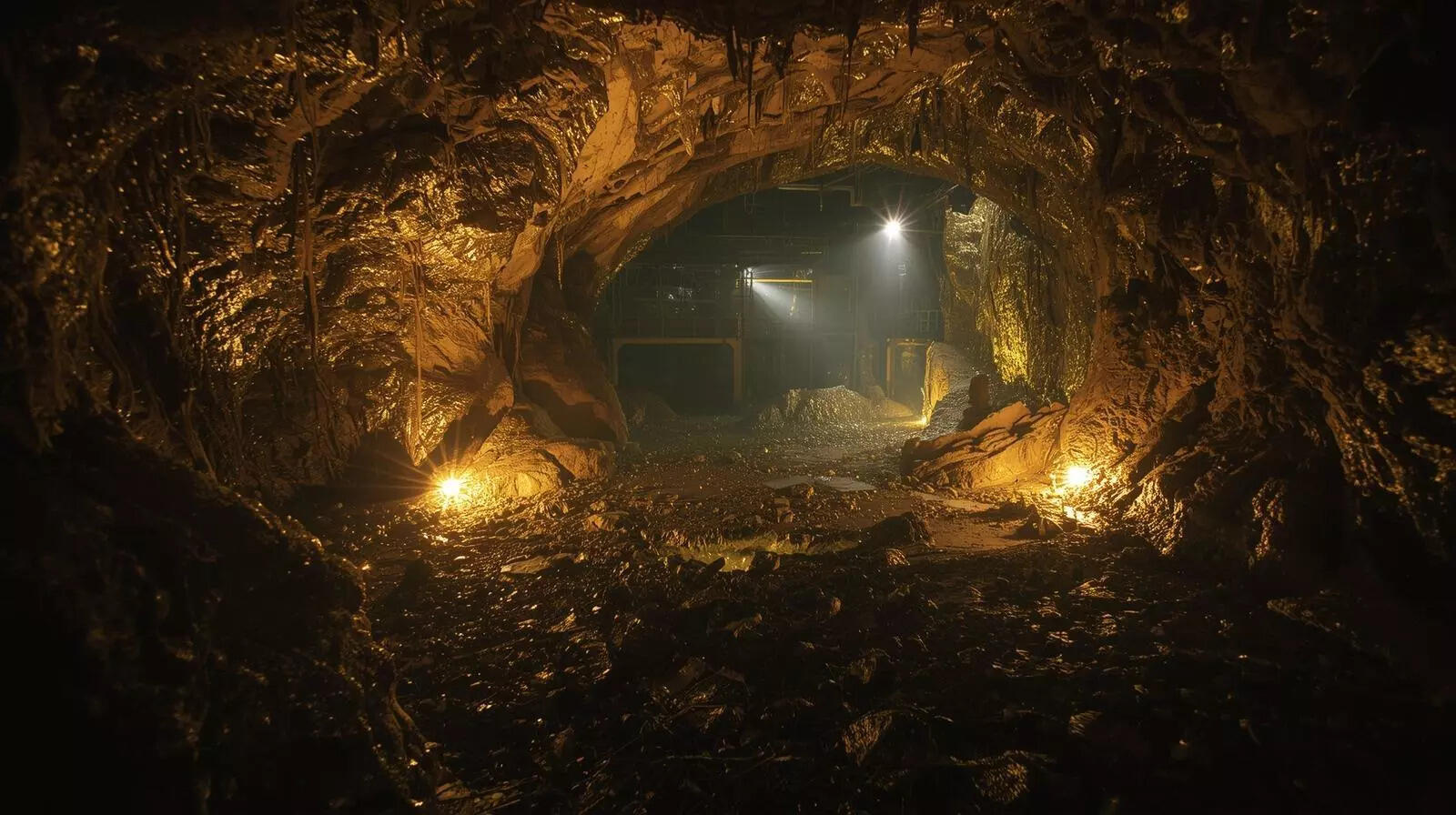
China's geological officials are reviewing findings indicating exceptionally substantial gold deposits in the country's northeast and central regions. Exploration work has reignited interest in Liaoning province's Dadonggou gold deposit, as well as another large site in Hunan. Early estimates suggest that these deposits could be among the largest ever discovered in China, while the results are subject to verification. The discoveries are the result of years of painstaking mapping, drilling, and laboratory study, not a single breakthrough moment. While headlines have concentrated on headline numbers, experts emphasise that reserve size, quality, depth, and extraction circumstances are all important. For the time being, the findings provide insight into China's intricate gold geology and spark cautious interest among scientists, planners, and the mining industry throughout the world.
Geologists uncover signs of a massive gold system beneath Dadonggou in Northeast China
According to the research “Discovery and geological significance of ultra-large low-grade gold deposit in Dadonggou, Liaoning Province”, the Dadonggou gold deposit sits at the western edge of the Liaodong section of the Jiao-Liao-Ji Paleoproterozoic orogenic belt. It is hosted mainly in carbonaceous sericite phyllite within the Gaixian Formation of the Liaohe Group. What draws attention is not high gold content, but scale. The ore shows a relatively even gold distribution, commonly between 0.3 and 1.0 micrograms per gram. Some samples reach slightly higher levels, but the deposit remains low grade by conventional standards. Its size, however, changes how that grade is viewed in economic and geological terms.
Geological setting shapes an unusual gold system
Gold mineralisation at Dadonggou is controlled by broad, gently inclined shearing structures rather than narrow veins. This has produced a wide belt of altered rock carrying gold across a large area. The structure appears layered, with later hydrothermal activity modifying earlier features. Researchers describe the deposit as having strong stratigraphic control combined with later transformation. This mix is not common in nearby mining districts. Because of these traits, some geologists have begun referring to it as a Dadonggou-style deposit, suggesting it may represent a distinct model within the wider Liaodong gold province.
Resource estimates point to enormous potential
Current drilling and modelling estimate gold resources exceeding 1,000 tonnes at a depth of around 3,000 meters. At current prices, this has been valued at roughly 600 billion yuan, or about 83 billion US dollars. These figures are preliminary and depend on further verification. They also assume technical and economic conditions that may not fully materialise. Even so, the numbers place Dadonggou among the most significant gold discoveries reported in China in recent decades, at least in terms of contained metal.
Similar discoveries raise national interest
Dadonggou is not the only site drawing attention. In Hunan province, the Wangu deposit has also been reported as holding potentially vast gold resources. Together, the two deposits could contain more than 2,000 tonnes of gold. If confirmed, the find would mark the largest combined gold resource discovery in the country. Analysts note, however, that mining history is full of early estimates that later shrink. Applying technical limits, costs, and environmental factors often results in significantly lower recoverable reserves.
Economic promise balanced by geological caution
Despite its low grade, Dadonggou has features that support further interest. The ore body is relatively shallow, the gold minerals show simple occurrence states, and early tests suggest favourable processing characteristics. These factors can offset low grades in large-scale operations. Still, researchers stress restraint. Gold in the ground is not the same as gold produced. For now, the deposit offers more certainty to geologists than to investors. Its longer-term value may lie as much in what it teaches about gold formation as in what it yields.