BEIJING _ Watching. Observing. Waiting.
That's China's stance as U.S. President Donald Trump's new administration works on crafting its trade policy, according to Commerce Minister Zhong Shan.
The world's two biggest economies will engage directly at a global forum for the first time since Trump's inauguration when the Group of 20 finance ministers and central bank governors meet in Germany's spa resort of Baden-Baden beginning on March 17.
Almost two months after Trump was inaugurated, Zhong still has few clues as to what exactly he will face from the new U.S. administration. But he expressed confidence over the weekend that the two governments will make the "correct assessment" on bilateral economic ties.
Fears of a full-blown trade war appear to be easing as more moderate voices take their places within the Trump administration. Trump adviser Steve Schwarzman said Sunday that the president was likely to temper his criticism of China as he advances along the learning curve.
"It's impossible to tell which Trump camp will emerge as the winners," said Michael Every, head of financial markets research at Rabobank Group in Hong Kong. "At the moment, the suggestions are that the 'business as usual' trade faction might be in the ascendancy. If that stays the case remains to be seen. China will thus play it's cards very, very carefully this week."
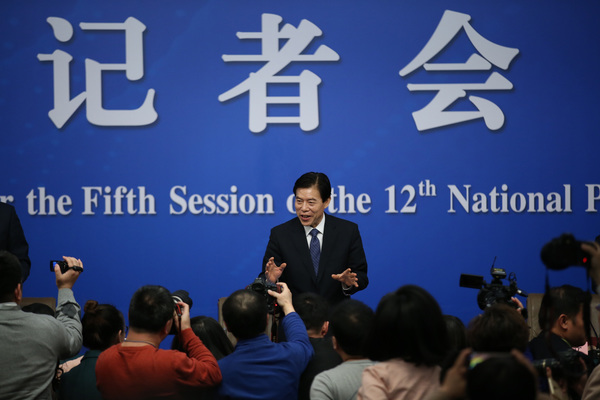
Zhong, who was named to his position in February, was all smiles at a press briefing Saturday on the sidelines of an annual gathering of the nation's legislature. The U.S. depends on trade with China as much as China depends on the U.S. market, he said, noting that U.S exports to China have expanded 11 percent annually over the past decade, outpacing the 6.6 percent growth in Chinese shipments to the U.S.
China accounts for 56 percent of U.S. soybean exports, 26 percent of Boeing Co. aircraft orders, 16 percent of automobiles and 15 percent of integrated circuits exported by the U.S., he said more pointedly.
Just how complicated it is to unravel the trade relationship between the two countries was highlighted by the China Center for Economics and Business, a unit of the Conference Board, in a research note on Monday. It estimated that after the value of components made outside China are subtracted from total shipments, the nation's trade surplus with the U.S. in 2014 was $200 billion instead of the official $316 billion.
Zhong said he looked forward to meeting the "excellent" U.S. Commerce Secretary Wilbur Ross, who has called China the world's most protectionist nation, because "excellent people" often have strategic thinking and long-term vision.
"China has handled the Trump onslaught very well by generally either not responding or responding in very measured tones," said Christopher Balding, an associate professor at the HSBC School of Business at Peking University in Shenzhen. "It is very likely that Trump will tone down his public criticism of China. It simply does not help him meet his objectives to keep engaging in such inflammatory public discourse."
Trump and Chinese President Xi Jinping are in discussions for a meeting that could take place next month, with the goal of reducing tensions over North Korea. The potential meeting is likely to be a subject of the talks that Secretary of State Rex Tillerson holds during a visit to China this week as the countries work to reach agreement on dates and an agenda, White House press secretary Sean Spicer said Monday.
To be sure, some prominent members of Trump's team are outspoken critics of China and its trade practices. Yet their tone has softened in recent months, after Trump said on the campaign trail that he would label the U.S.'s biggest trading partner a currency cheater on his first day in office, and threatened to smack a 45 percent tariff imports from China.
U.S. Treasury Secretary Steven Mnuchin will urge Group of 20 partners at a meeting this week to follow through on their commitment to refrain from competitive currency devaluations, a senior Treasury official said. Mnuchin has said he will use a regular Treasury review, next scheduled for April, to examine foreign currency practices.
Peter Navarro, director of the White House National Trade Council and an outspoken critic of China, said last week that Trump's goal is to promote "free, fair and reciprocal trade," adding that right now America's trade with the world is "anything but reciprocal." The U.S. plans to reduce its trade deficit not with higher tariffs, but by getting its trade partners to lower theirs, he said.
"The softer rhetoric coming from U.S. officials suggests a deliberate attempt to ease tensions, with the odds for a full-blown trade war now significantly lower," according to Le Xia, chief economist for Asia at BBVA in Hong Kong. "It seems more likely that President Trump will use bilateral approaches to solve its huge trade deficit against China rather than bluntly take unilateral actions such as labeling China a currency manipulator or imposing punitive tariffs on China's exports."