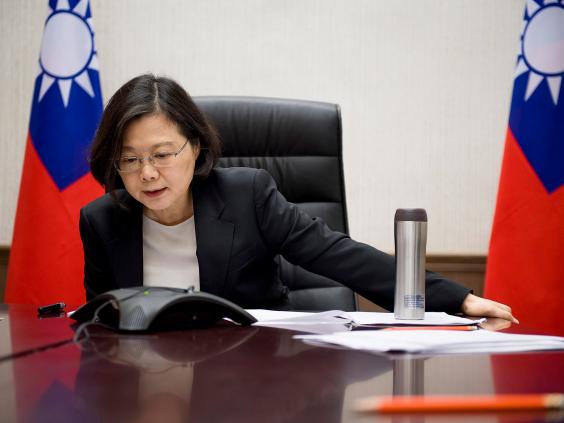
China lodged a diplomatic protest after Donald Trump spoke to President Tsai Ing-wen of Taiwan on the phone.
The move, which breaks away from four decades of US foreign policy, was the first telephone call between a US president-elect or president with Taiwan’s leadership since President Jimmy Carter switched diplomatic recognition from Taiwan to China in 1979.
China's Foreign Ministry said it had lodged "stern representations" with what it called the "relevant US side", urging the careful handling of the Taiwan issue to avoid any unnecessary disturbances in the relationship of the two superpowers.
"The one China principle is the political basis of the China-US relationship," it said.
Speaking hours after the call, China’s Foreign Minister Wang Yi apparently blamed Taiwan for the exchange.
"This is just the Taiwan side engaging in a petty action, and cannot change the 'one China' structure already formed by the international community," Mr Wang said at an academic forum in Beijing, state media reported.
"I believe that it won't change the longstanding 'one China' policy of the United States government."
The White House was adamant there was "no change" to the longstanding "one China" policy.
"We remain firmly committed to our 'one China' policy," said Ned Price, a national security spokesman for President Barack Obama. "Our fundamental interest is in peaceful and stable cross-Strait relations."
Mr Trump took to Twitter and said: "The President of Taiwan CALLED ME today to wish me congratulations on winning the Presidency. Thank you!"
Alex Huang, a spokesman for Ms Tsai, responded and said “both sides agreed ahead of time before making contact.”
Mr Trump and Ms Tsai noted that "close economic, political and security ties exist between Taiwan and the United States", the Trump transition team said in a statement.
Taiwan's presidential office said the two discussed strengthening bilateral interactions and establishing closer cooperation.
China considers Taiwan a wayward province and relations between the two sides have worsened since Ms Tsai, who heads the pro-independence Democratic Progressive Party, was elected president in January.
Agencies contributed to this report