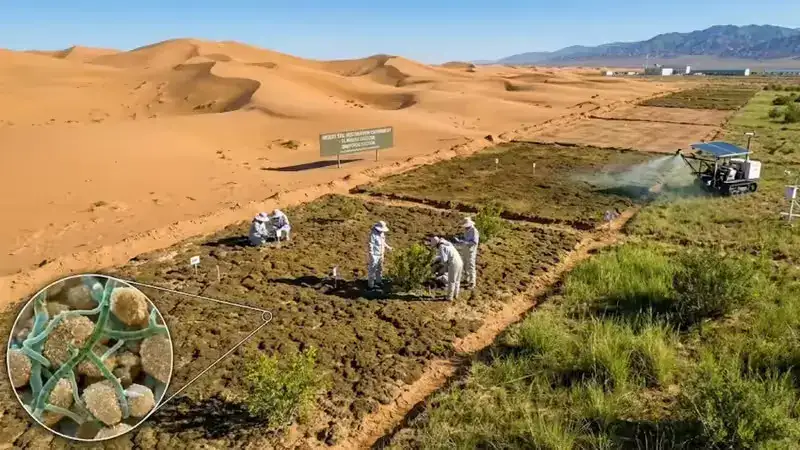
In a major breakthrough against desertification, researchers at Shapotou Desert Experimental Research Station have developed a technique that can transform barren desert sand into fertile, plant-supporting soil in just 10 months.
The method uses cyanobacteria — microscopic organisms capable of photosynthesis — to create what scientists call “biological soil crusts,” a living layer that stabilises shifting desert sand and helps vegetation grow in extreme dry conditions.
ALSO READ: Maharashtra groom gifts Rs 34.6 crore insurance cover to over 3,000 villagers
The innovation is being seen as a potentially game-changing solution for restoring degraded land, improving food security and fighting the spread of deserts globally.
How tiny microorganisms help stabilise deserts
Cyanobacteria are highly resilient microorganisms that can survive harsh desert environments with very little water. Once introduced to desert sand and exposed to moisture, they rapidly multiply and begin producing sticky sugar-based substances.
ALSO READ: Can money buy happiness?
These natural compounds act like glue, binding loose sand particles together into a stable surface. The result is a protective crust over the desert floor that prevents wind erosion, retains moisture and creates conditions necessary for plants to grow.
Scientists say this process dramatically speeds up what would otherwise take nature many years to achieve on its own.
What are biological soil crusts?
According to the journal Soil Biology and Biochemistry, Biological Soil Crusts (BSCs) are thin living layers formed when soil particles stick together through substances released by cyanobacteria and other microorganisms.
These crusts play a critical role in ecological recovery because they improve soil quality and help restore damaged ecosystems.
Researchers found that artificially applying these microbial communities can increase organic carbon accumulation by more than three times and nitrogen accumulation by nearly 15 times compared to naturally formed desert crusts.
This rapid nutrient build-up creates a more fertile foundation for shrubs, grasses, mosses and other plant life to take root.
Why the technology could change desert restoration worldwide
Traditional desert reclamation projects often rely on labour-intensive tree planting and expensive irrigation systems. Scientists say the cyanobacteria-based approach could offer a far cheaper and more sustainable alternative.
Because the microorganisms can be grown in laboratories and selected for drought resistance, the technology may be adapted for arid regions across the world — not just in China.
Research published on PubMed Central also suggests that future “synthetic microbial communities” could be engineered to make soil crust formation even faster and more efficient.
A possible breakthrough in the fight against desertification
Desertification continues to threaten agricultural land and food production in many parts of the world due to climate change, deforestation and unsustainable land use.
Scientists believe technologies like biological soil crusts could help reverse some of that damage by stabilising fragile landscapes and restoring ecosystems at a much faster pace than traditional methods.
If scaled successfully, the technique could become an important tool in global efforts to combat land degradation and support sustainable agriculture in dry regions.