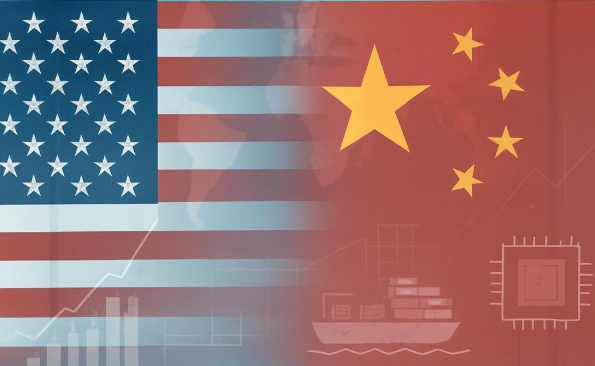
A new report suggests the global image battle between Washington and Beijing has taken a notable turn as China earns the highest global approval rating over the United States in over two decades.
In a poll conducted by Gallup across 132 countries and territories throughout 2025, China posted a median leadership approval rating of 36%, edging past the United States, which stood at 31%. Gallup said the five-point gap is the widest advantage China has held over the U.S. in nearly two decades.
The shift was driven less by a sudden wave of enthusiasm for Beijing than by a sharp deterioration in views of U.S. leadership. Gallup found U.S. approval fell from 39% in 2024 to 31% in 2025, while disapproval climbed to a record 48%. China, by contrast, saw its approval rating rise from 32% to 36%, while its disapproval rating stayed flat at 37%.
Gallup has been asking people around the world for roughly 20 years whether they approve or disapprove of the leadership of the U.S., China, Russia, and Germany. In that longer view, China has now moved ahead of the U.S. only a handful of times, including during George W. Bush's presidency and Donald Trump's first term.
Gallup says the 2025 results predate major events in early 2026, including the war with Iran, meaning the numbers do not yet capture the fallout from those developments. One of the clearest warning signs for Washington came from allied countries. Gallup found U.S. leadership approval dropped by 10 points or more in 44 countries between 2024 and 2025, while only seven recorded gains of that size.
Germany registered the steepest decline, down to 39 points, followed by Portugal. Canada, the United Kingdom, and Italy also logged substantial drops. Among NATO countries overall, Gallup said U.S. approval fell by 14 points in 2025, bringing American and Chinese standing in the alliance to near parity.
China's lead, however, is not universal. Gallup's own numbers show Beijing's median net approval, meaning approval minus disapproval, was still negative at minus-1 in 2025. The U.S. fared worse at minus-15, its lowest on record. Nearly half of all countries surveyed, 45%, gave both powers negative net ratings, meaning more respondents disapproved than approved of each. In other words, this was less a coronation for China than a broad expression of frustration with both superpowers.
Gallup also found that 54% of countries leaned more toward China than the U.S. when comparing relative net approval, while only 16% leaned toward the United States. Still, most countries were not strongly aligned with either side. Many were only weakly aligned or effectively contested.
Germany remained the most positively viewed major power in the survey at 48%, followed by China at 36%, the U.S. at 31%, and Russia at 26%. Gallup's methodology was based on nationally representative, probability-based samples of adults aged 15 and older, with roughly 1,000 respondents surveyed in each country or territory, either by phone or in person. The margin of sampling error ranged from plus or minus 1.2 to 5.6 percentage points.