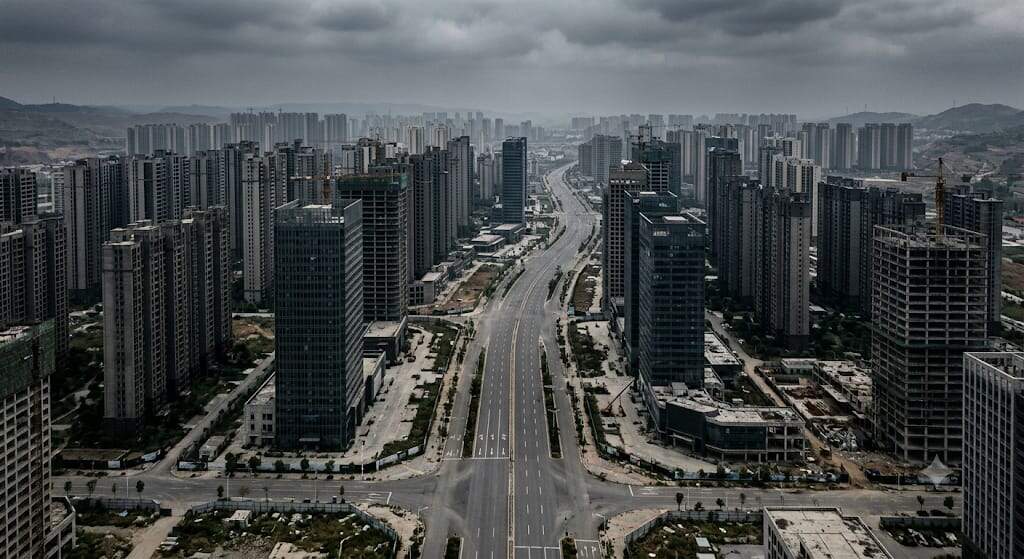
When images of empty boulevards, silent apartment blocks and vast public squares emerged from Kangbashi, a newly built district in Ordos, Inner Mongolia, the city quickly became known around the world as China's largest "ghost city". Designed to accommodate around 300,000 residents and built during the region's coal-fuelled economic boom, Kangbashi appeared to many as the ultimate example of urban overbuilding. International headlines portrayed it as a city where almost nobody lived, fuelling debates about China's property market and rapid urbanisation. Yet more than a decade later, researchers and journalists argue that Kangbashi's story is far more nuanced than the ghost-town label suggests.
Get breaking news anytime, anywhere. Download the TOI app now!
How Ordos Kangbashi became an international symbol of overbuilding
Construction of Kangbashi began in 2004, when Ordos was one of China's wealthiest regions thanks to soaring coal revenues. Rather than expanding the existing urban core, local authorities planned an entirely new administrative district featuring museums, theatres, schools, hospitals, government offices, parks and thousands of modern apartments.
The long-term vision was to relocate government institutions and gradually attract businesses and residents, creating a modern city capable of supporting future economic growth. According to urban planning researcher Christina Lee, whose research Building the New Urban Ruin: The Ghost City of Ordos Kangbashi, Inner Mongolia examines the project, Kangbashi reflected China's strategy of building infrastructure ahead of anticipated urban expansion rather than responding only to immediate demand.
Why the world thought nobody lived there
When foreign journalists visited Kangbashi in 2009, much of the city had only recently been completed. Entire neighbourhoods appeared empty because residential occupation lagged behind construction, while many apartments had been purchased as long-term investments rather than occupied immediately.
The striking photographs of deserted streets rapidly spread across international media, turning Kangbashi into the defining image of China's so-called "ghost cities". However, researchers argue that these early reports often overlooked the fact that the district was still in the middle of a development timeline expected to span nearly two decades.
Lee argues that Kangbashi became an example of what she calls a "new urban ruin," a place whose apparent emptiness reflected the tension between speculative property markets, state-led planning and the slow pace at which entirely new cities become inhabited, rather than evidence of permanent failure.
A city that was gradually coming to life
Several years after Kangbashi gained worldwide attention, journalist Wade Shepard revisited the district for Forbes and found a city that looked very different from the one portrayed in the earliest reports.
Shepard wrote that Kangbashi was no longer an empty landscape but a functioning city with government offices, schools, restaurants, shopping areas and a steadily growing population. He noted that many of the apartments had already been sold, even if some remained unoccupied because owners intended to move in later, keep them as investments or were still completing interior work, which is common in China's housing market. He also argued that many Western reports had mistaken a city still under construction for one that had failed.
According to Shepard, the district was designed on a 20-year development timeline, meaning its low occupancy during the early years was not necessarily unexpected. By the mid-2010s, government relocation, improved public services and expanding commercial activity had already begun transforming Kangbashi into a lived-in urban centre.
A lesson in how cities grow
Today, Kangbashi remains one of the world's most discussed urban planning experiments because it highlights the challenges of building cities for future populations rather than existing ones. It raises important questions about speculative real estate, infrastructure investment and whether success should be judged by a city's first few years or by decades of development.
Researchers caution against viewing Kangbashi simply as a failed "ghost city". Instead, they see it as an evolving urban landscape where infrastructure was built long before demand fully materialised. Meanwhile, reporting from Forbes suggests that much of the district has gradually filled as residents, businesses and public institutions moved in, demonstrating that the story of Kangbashi is one of delayed urbanisation rather than outright abandonment.
Rather than standing as a monument to failure, Kangbashi has become a global case study in the complexities of modern city-building. Its history shows that constructing a city can take only a few years, but building a thriving community often takes decades.