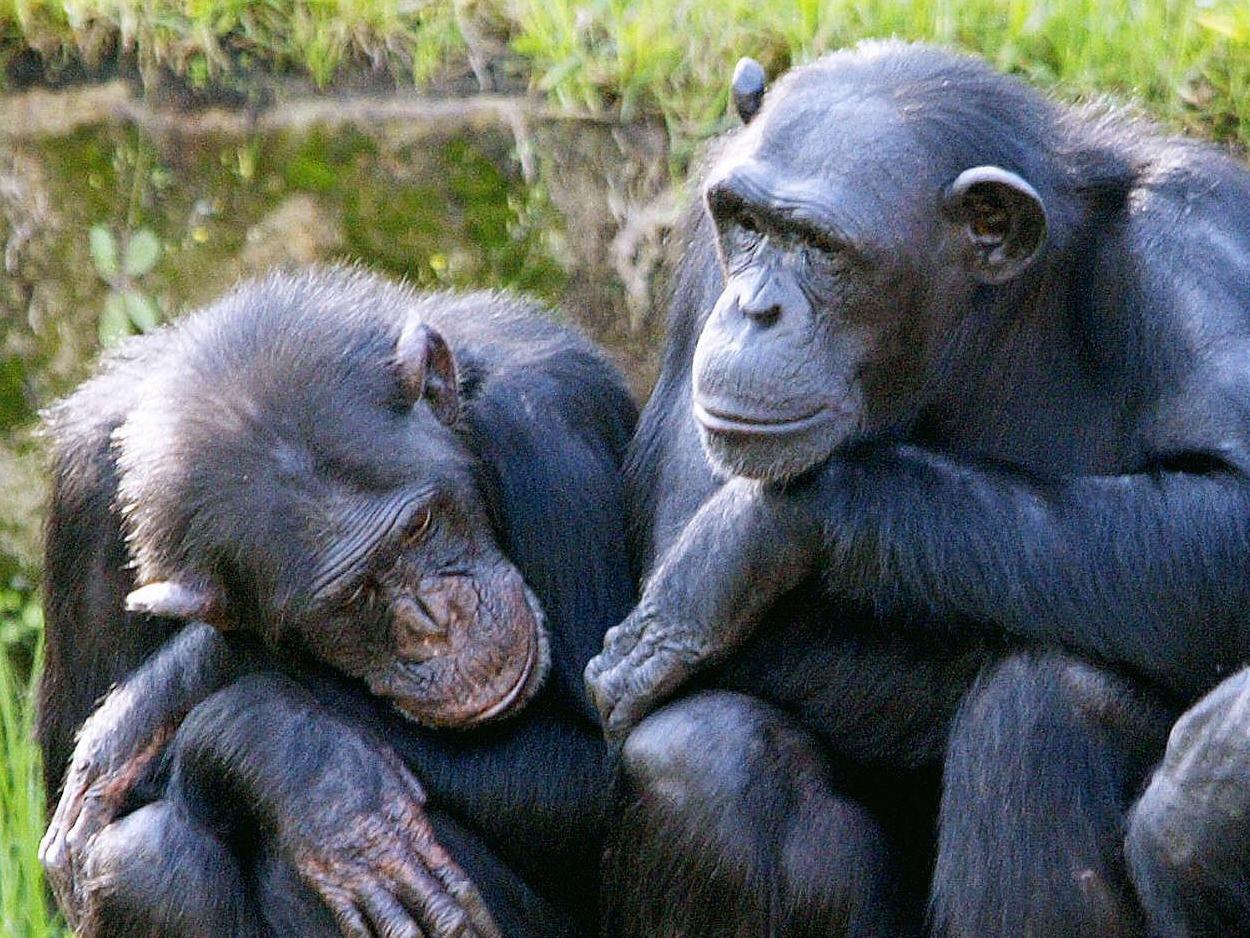
Chimpanzees who watch films together bond in a way previously thought unique to humans, research has found.
Pairs of chimps who sat together and watched the same video spent more time together and showed more signs of social bonding, such as grooming each other.
Another study found the animals also approached humans faster if they had watched the movie together.
During the two experiments, published in the journal Proceedings of the Royal Society B, eye-trackers were used to check the apes were watching the film and they were given fruit juice to encourage them to stay relatively still.
“Our results suggest that one of the most basic mechanisms of human social bonding – feeling closer to those with whom we act or attend together – is present in both humans and great apes, and thus has deeper evolutionary roots than previously suspected,” the authors said.
In the first experiment, 19 chimpanzees and seven bonobos watched a short video with a human partner who either watched with them or attended to something different.
The chimpanzees and bonobos approached the human experimenter faster if they both watched the video, which showed a group of a young chimp playing.
In the second study, 21 chimpanzees were paired with each other and the same effect was found to occur between great apes.
“As such, the current findings shed new light on great ape social cognition and social behaviour, as well as the evolutionary origin of connecting through shared experiences in humans,” the co-authors of the study, Wouter Wolf, from the department of psychology and neuroscience at Duke University in the US, and Michael Tomasello, said.
They said it was “surprising” because many researchers have argued the capacity to experience shared reality is “uniquely human”.