Ricky Hatton is getting out of boxing soon, probably with immediate effect if he loses to Manny Pacquiao in Las Vegas on 2 May, and not much longer after that even if he wins.
Which might be as well.
Indeed anyone at work in the light-welterweight division might reach for their P60 if they took a look at this.
That's a guy called Mike Alvarado doing his stuff. It is the most shocking single-punch knockout I have seen since Julian 'The Hawk' Jackson, the eye-troubled banger from the Virgin Islands, put Herol Graham to sleep in the fourth round of their fight for the vacant WBC middleweight title in Spain 19 years ago.
'Bomber' was never the same again and remains Britain's best boxer since the war never to win a world title. No argument. Jackson, like a lot of heavy hitters, had a suspect chin and ultimately was found out.
Jackson's sons, Julius and John, incidentally, boxed at the last Olympics. Julius, a light-heavyweight, went out in the first round to Ireland's Kenny Egan; John reached the second round of the competition, losing to the South Korean welterweight Kim Jung-joo. Each brother has had a pro win.
But back to the destroyers. Jackson Snr was stopped five times in his career, including a one-round nightmare against Gerald McClellan in 1994. The power of the G-Man's punching that night was something to behold. He looked invincible. Jackson went down three times before his seconds had time to rearrange his bucket and stool. It was the American's penultimate fight, a veritable stroll before the dark night he shared canvas space with Nigel Benn at the Docklands Arena in London during February 1995.
McClellan wilted in a fight almost too horrible to recall, not the victim of a single blow but several, perhaps some of them in his previous fights, or even a rumoured extra-curricular fixture in his home town of Freeport, Illinois. We will never know for sure. And no apologies here to remind readers to send Gerald what you can.
All of these fighters lived on the edge. Even Graham, although not an out-and-out kayo artist, was a high-risk, free-swinging hitter who had a decent 51% stoppage record in 54 fights, a statistic more impressive when you consider that 16 of his distance bouts came in the learning stage of his career before he won a title.
Nobody, though, bought a ticket to watch Graham "bomb" his opponents out; he was instead, said his trainer Brendan Ingle, poetry in motion. But, as the Belfast trainer and wit Eddie Shaw observed famously, "I've never seen anyone knocked out by a poem."
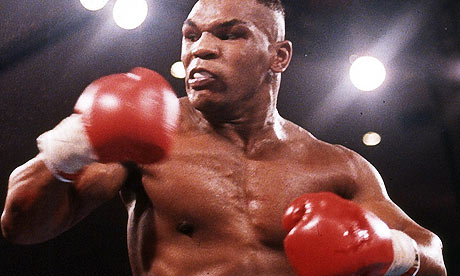
Earlier this week Mike Tyson, not for the first time, provided the argument against ring poetry. The fans, he said, come to the fights for one thing: the chance to see something that frightens them, a clean, chilling, no-questions knockout.
He certainly provided plenty of soul-shuddering finishes, none more conclusive than the night in 1988 when he took 90 seconds to ruin the career of the linear heavyweight champion Michael Spinks. Both entered the ring unbeaten. They labelled it "Once And For All". Tyson felled Spinks with a body shot – then stuck on the chin of a man plainly scared out of his wits a right hand which not only put Spinks over for a full count but sent involuntary spasms through his legs as he lay conquered.
Spinks never boxed again. Tyson? Well, he would go on, of course, terrorising here and there with his iron fists, until he too saw his frailties exposed. The reverberations, symbolic and practical, of James 'Buster' Douglas's knockout of Tyson in Tokyo only three fights (one of them a mildly rocky engagement against Frank Bruno) after Iron Mike's destruction of Spinks linger to this day. It created chaos not only in Tyson's confused mind but throughout the industry. The first rule of the fight game is: don't blink.
Sheer power does not always prevail; otherwise it would be called mugging rather than boxing. But it is difficult to deny Tyson's assertion that seeing someone knocked unconscious tugs at the animal core of most of us.
Who hit hardest? I think Tyson, because of his speed, followed so closely it hardly matters by the bigger and slower Sonny Liston, Earnie Shavers and George Foreman, among post-war heavyweights. Jack Dempsey, Joe Louis and Max Baer prevailed before that. In all weights, there have been many fearsome hitters, a lot of them in the days when gloves were little more than knuckle protectors, the skinny Welshman Jimmy Wilde the most notable from these islands. He knocked out big guys for fun.
This is one of many video collections, a selection limited by access to the film available, of course, but it might nevertheless provide abolitionists with a reminder that their campaign will always have evidence supplied by the sinners.
Some kayos have an accidental beauty, as the poor man on the end of his antagonist's perfect punch surrenders control of his brain and limbs, then floats to earth as if emigrating to a netherworld of quiet distance. When Bundini Brown said Muhammad Ali "floats like a butterfly, stings like a bee", he could hardly have known how appropriate a description that was of the image we would all be left with from Ali's eighth-round kayo of George Foreman in the Rumble in the Jungle in 1974. Ali's final hit sent George, all 220lbs of him, fluttering with such incongruous delicacy to the canvas, as if in defiance of gravity, that you had to believe in magic.
Alvarado? He fights a victim yet to be named at the MGM Grand in Las Vegas on the undercard of Hatton-Pacquiao. And you won't be watching? I don't think so.