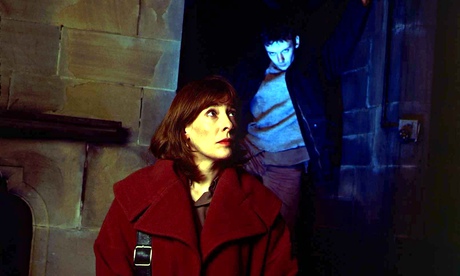
It opens explosively, with a pregnant woman suffering first a car crash and then a miscarriage. Somehow managing to put this behind her, the woman, played by Serena Gordon, moves into a new house with her husband, a youthful Martin Clunes. She then finds a mobile hanging in the nursery. Clunes is dismissive when Gordon asks how it could have got there, and when she demands to know why, while she was in her post-crash coma, he didn’t dispose of the dead foetus “properly”, with a ceremony, burial and gravestone. What he did do with it is never made clear – and that could be the problem. Gordon isn’t satisfied: without closure, she can’t mourn, and her restlessness manifests itself as a phantom pregnancy. Or could something more diabolical be going on inside her?
This is Toby, the second story in Chiller, a horror anthology from ITV that aired in 1995. At the time, the channel was competing with The X-Files, and Chiller was a sign that it wasn’t afraid to visit unspeakable horrors upon taboo places, such as antenatal clinics and school playgrounds. It also gave us more traditional scares involving disturbed misfits and a child-killer who strikes every full moon.
But it was in its second story that the series really struck gold, taking horror into the womb itself. By pushing unresolved grief to relationship-shattering extremes, Toby allows Clunes one of his more intriguing turns as an amoral character: a spouse who becomes more and more unfeeling. “Toby’s dead,” he insists to his wife, trying to keep calm as she starts ballooning and complaining of kicking despite blank ultrasounds. She thinks – she knows – she is pregnant. He and the midwives know she can’t be. As rational explanations are crossed off one by one (which brings us into contact with a hilariously stereotypical German psychiatrist), the due date of the deceased Toby looms on the kitchen calendar. Clunes decides that getting her pregnant again will stop all this nonsense. The word disturbing doesn’t begin to describe what Gordon does in turn.
Chiller is worth it for Toby alone, but the other four stories will spook you out too. Clunes is an overworked and sceptical professional; such characters recur, particularly in opener The Prophecy. We watch as death catches up with a circle of college friends, only one of whom (a young Sophie Ward) was smart enough to see that there may be trouble ahead after a ouija board delivers the verdict death/death/death.
It’s a tale that bears astonishing similarities to the Final Destination film franchise: the reluctant clairvoyant who, in slowly discovering the unstoppable hideousness she’s stirred up, begins to see predetermination everywhere. Then there are the blinkered sceptics standing firm against overwhelming evidence, and contrived deaths galore (the same workmen who hung a guillotine-sharp For Sale sign up in The Prophecy surely cut the triangular sheet metal left next to the Final Destination railroad).
Chiller is reminder of a time when networks weren’t afraid of giving horror writers free rein. It also features John Simm as a seriously ill young man, delivering the line: “If it wasn’t for the murders, and all the psychiatric problems, and me breaking into your house and bringing you here, and everything, do you think you could’ve taken to me at all?”