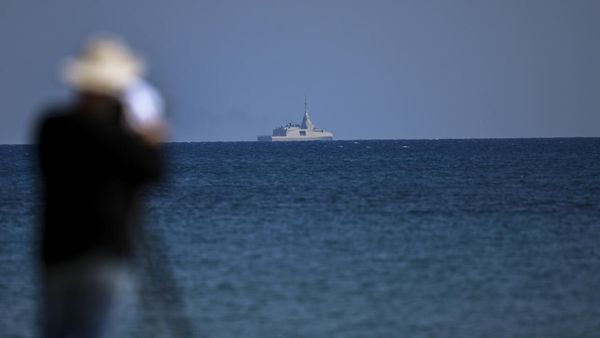
I’m closing the live blog while we await further news. You can find all the information about last night’s magnitude 8.3 earthquake in Chile, as well as any further alerts, in our main news story below.
If you’re one of the millions of people who have been affected by the earthquake, we’d still like to hear from you via Guardian Witness.
I’ll reopen this blog if there are any major developments.
Tsunami alert cancelled for all regions of Chile
Atención, se levanta alerta de tsunami en el territorio nacional.
— Carabineros de Chile (@Carabdechile) September 17, 2015
An aftershock with a magnitude of 4.7 occurred near General Santos, Mindanao, Philippines some 20 minutes ago, according to a Google public alert. There have been approximately 15 other aftershocks since the first earthquake struck Chile, the locations for which can be viewed on this map.
The US Geological Survey has further information about the Philippines quake:
Time
2015-09-17 08:34:52 (UTC)
2015-09-17 09:34:52 (GMT)
Nearby Cities
38km (24mi) SSW of Sarangani, Philippines
82km (51mi) S of Glan, Philippines
97km (60mi) S of Malapatan, Philippines
98km (61mi) SSW of Caburan, Philippines
1043km (648mi) WSW of Koror Town, Palau
Updated
Chile cancels tsunami alert for all regions except Atacama and Coquimbo
Atención: se mantiene alerta de tsunami sólo en las regiones de Atacama y Coquimbo.
— Carabineros de Chile (@Carabdechile) September 17, 2015
The Telegraph reports that operations were suspended at two major copper mines operated by Codelco and UK-listed Antofagasta after the earthquake struck Chile.
The closure of the mines, which generate an annual capacity of more than 600,000 tonnes, drove copper prices on the London Metal Exchange to two-month highs in early Asian trading as worries about supply disruptions offset lingering concerns about demand from China amid copper’s longest rout in years.
If you are based in affected areas, a new “safety check” tool on Facebook allows you to let your friends know you are safe.
Muy bueno! >> Tus amigos están a salvo tras el terremoto, Facebook lo confirma http://t.co/nixURxAGHK vía @el_pais pic.twitter.com/UXsos9ICa7
— David Alvarez (@dalvarez37) September 17, 2015
Updated
Si estas afectada de el terremoto en Chile, nos gustaría saber de usted. If you’ve been affected by the earthquake in Chile, we want to hear from you.
We’re interested in photographs and videos of evacuations, earthquake damage and flooding. We’ll include a selection of footage in our coverage on the site.
You can also download the GuardianWitness app or look for our assignments in the Guardian app and search for ‘GuardianWitness assignments’ – and if you add it to the homepage – you can keep up with all our assignments. If you’re on Instagram you can contribute using #GuardianWitness.
We have another eyewitness account from Chile, this time from Sumit Kaul, who was in Santiago when the initial earthquake struck.
Ground Shaking Experience
I was in an open area on the ground, in Santiago when the initial earthquake stuck. It was so strong that I could barely stand on the ground and saw buildings around me sway. It was very long as well, and I felt as if the ground itself would break apart. Till now, at around 5:30 AM, there have been more than 30 after shocks.
Watch another video of the moment the quake struck Chile below.
The beaches in Orange County, California will be closed as of 4am due to high waves.
#OCSDPIO: Tsunami Advisory - NO EVACUATION ORDERS. Beaches, harbors, piers & marinas CLOSED AT 4am @OrangeCountyEOC pic.twitter.com/3pEd5IcfJg
— OC Sheriff, CA (@OCSD) September 17, 2015
This map shows the areas that have been affected by the first reports of flooding.
The Associated Press has published this wrap detailing the tsunami warnings issued for Hawaii and part of California’s coast, which have been downgraded to advisory alerts.
The Pacific Tsunami Warning Center had originally issued a watch for Hawaii, saying a tsunami may have been generated by Wednesday’s earthquake. They later downgraded the alert to an advisory, saying that current data indicated there would be no major tsunami in the state, but that sea-level changes and dangerous currents could pose a threat to those in or near the water.
The center estimated that the effects from the tsunami would arrive in Hawaii about 6 a.m. (PDT) Thursday.
A similar advisory was issued for southern and central California.
That advisory affects about 300 miles of coastline stretching from the southern end of Orange County to most of San Luis Obispo County on the central coast.
The possible changes associated with the advisory are expected to hit first in the south at about 4:45 a.m. (PDT) Thursday and move north in the minutes that follow.
A watch means that a tsunami is possible, but it doesn’t mean it will happen, said Chevy Chevalier, a meteorologist with the National Weather Service in Honolulu.
“A watch is for everybody to be aware of it, that it’s a possibility,” he said. “A warning means it’s happening right now or it’s imminent.”
The powerful earthquake shook Chile’s capital, causing buildings to sway and people to take refuge in the streets. Authorities say at least five people died. Damage as reported in some coastal towns that saw flooding from small tsunami waves.
A tsunami warning was last issued for Hawaii in 2012, after a powerful earthquake off the coast of Canada. The Pacific Tsunami Warning Center lifted its tsunami advisory three hours after downgrading from a warning and less than six hours after the waves first hit the islands. The state was spared from severe surges.
The Hawaii Emergency Management Agency said state officials are standing by, awaiting updates from the warning center.
On the Big Island, officials were bracing to be the first island affected, county spokesman Ilihia Gionson said. Officials were gathered Wednesday in the county’s emergency operations center in Hilo, he said.
“It’s too early to tell,” he said. “This early it’s best to just stay informed.”
Summary
Soon I’ll be handing this blog over to London to cover the next few hours, which should include the break of morning in Chile, and with it, better conditions for authorities there to assess the damage the country has suffered.
Here is what we know so far:
- Five people have been killed after an 8.3 magnitude earthquake struck off the coast of Chile on Wednesday evening at around 7:54pm, local time. Around 20 people have been reported injured.
- One million people have been evacuated from their homes after buildings swayed and collapsed in some areas. The tremors could be felt as far as Buenos Aires, the capital of Argentina, more than 1,100km away.
- Chile is bracing for tsunamis as flooding is reported up and down the country’s coast. The hardest hit regions have been Conquimbo, where waves of up to 4.5m were recorded, and Tongoy, with waves of up to 2m. Chilean president, Michelle Bachelet said both areas had been declared catastrophe zones and troops would be sent in to deter looting.
- Tsunami warnings have been lifted for parts of the Chilean coast and some red alerts have been downgraded to yellow, suggesting the worst fears - of a tsunami such as the one that followed a 2010 earthquake, which claimed 500 lives - have not been realised.
- Peru, New Zealand, California, Hawaii and other Pacific states are also on tsunami watch.
- Dramatic images and videos have emerged of the damage caused by the earthquake, which was followed by at least 15 aftershocks.
- Read our latest wrap here.
- Contribute your own stories to Guardian Witness.
Updated
Si estas afectada de el terremoto en Chile, nos gustaría saber de usted. If you have been affected by the earthquake in Chile, we’d like to hear from you.
Here are two contributions from Guardian readers, both of who experienced the 8.3 magnitude earthquake first-hand.
Situation in Chile's capital city
in Santiago, the aftershocks are still rocking the buildings with mild force, but none of these earthquakes can be compared to the first (and main) one, that felt across all the Santiago Valley with a lot of shaking. I think that this earthquake is the strongest one since the catastrophe of February 2010. Power outages occurred in some places of Santiago, but besides that, the general situation is very calm. The transport system was not affected by the earthquakes, and buildings and houses (in general) were not damaged at all. This city did not experience any compromising situation
Earthquake in Chile
At least 19 aftershocks have occurred tonight, the last significant, at 01:10 local time (UTC-03) was 6.6" Mw. At least three deaths confirmed by the government of President Bachelet, suspended classes throughout the area center and north. medium damage to buildings, and income from the sea in Con-Con.
I was in the trade-center of my town. I saw lights falling and panicking people.
Updated
As we near the eight-hour mark since this earthquake struck, the red alert in place has been downgraded to yellow for the regions of Tarapacá, Antofagasta, Los Ríos, Los Lagos, Aysén and Magallanes.
Levanta Alerta Roja y declara Amarilla para reg. Tarap, Antof, Araucanía, Los Ríos, Los Lagos, Aysén y Magallanes http://t.co/QQNRfxgJOO
— onemichile (@onemichile) September 17, 2015
Updated
Eyewitness account: "I saw the sea start to rise"
Jocelyn Tordecilla Jorquera, 35, lives in Los Vilos, near the epicentre of the earthquake. She shared her story with my colleague Janine Israel.
The earthquake was very strong and it lasted for an unusually long time — around three minutes. It was longer than any earthquake we had felt before, including the 2010 earthquake.
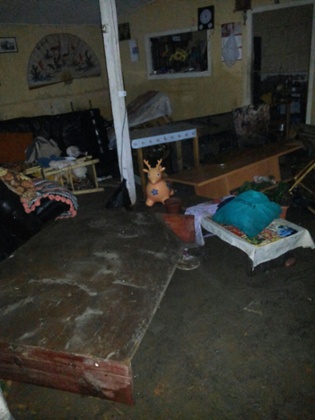
Out of my window I saw the sea start to rise extremely quickly and come crashing in about two metres into the coastline. It didn’t come in far but the force of the wave was enough to destroy the houses that are at sea level. We had always been told that tsunami waves take a number of minutes to arrive and in this case it was different — the sea rose immediately.
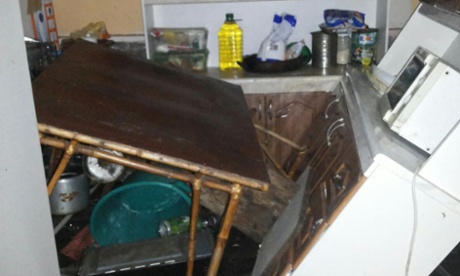
We evacuated the house on foot to the community’s designated secure zone — a hill less than a kilometre from the town with an altitude of about 20 metres above sea level. It only took us about 10 minutes to get there but there was sheer terror and anguish — people were running and no one knew what was going to happen.

Her full account will be up soon.
Updated
As it nears 3am in Chile, one million people are on the streets taking refuge from a major earthquake, which has been followed by flooding and waves of up to 4.5m.
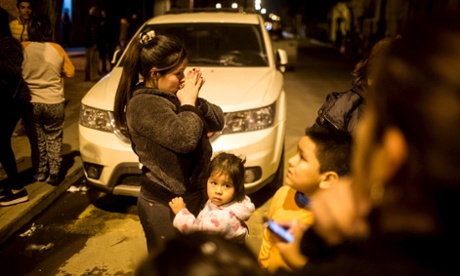
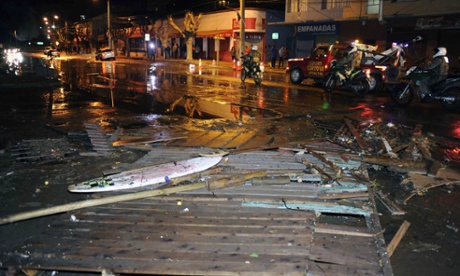
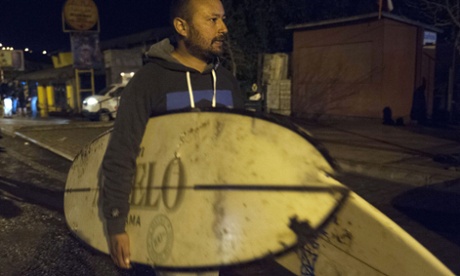
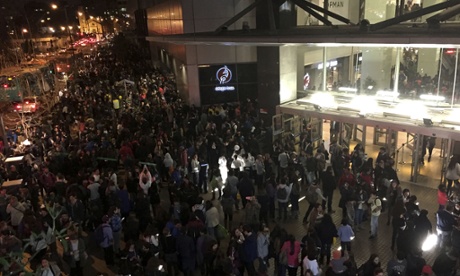
Speaking to reporters in southern California, a Caltech seismologist, Mark Simons, said those affected by the earthquake need to remain vigilant, especially if the 8.3 magnitude portends a larger seismic event. The quake, which was felt as far away as Buenos Aires in Argentina, has killed at last five people.
Updated
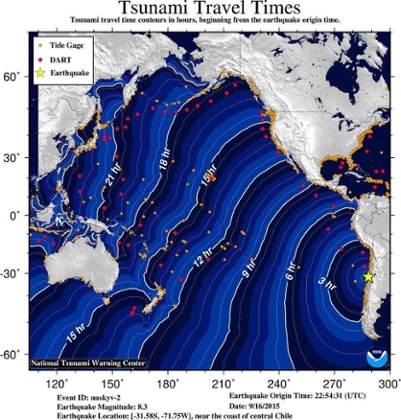
A tsunami alert remains in place across most of Chile, as well as in Hawaii, New Zealand, Peru and parts of California. This map shows how far the waves generated by the earthquake are expected to travel. It took place 7.54pm local time - just under seven hours ago.
More photographs now from Los Vilos, a town on the Chilean coast that appears to have borne the brunt of this 8.3 magnitude quake.
Nuevas fotos que me llegan de la Costanera de Los Vilos @ahoranoticiasAN @SoledadOnetto @JoseRepenning pic.twitter.com/OICAQBqtP7
— Juan Miranda (@JuanMirandaB) September 17, 2015
Chile’s emergency agency has cancelled tsunami warnings for Isla San Felix, the Juan Fernandez Archipelago and the regions of Los Rios, Los Lagos, Aysen and Magallanes. It remains active from the rest of the coast.
Se cancela alarma de tsunami en Isla San Felix, Archipiélago Juan Fernandez y la región de Los Ríos, Los Lagos, Aysén y Magallanes
— onemichile (@onemichile) September 17, 2015
Summary
If you’re just joining us, here’s the latest on the 8.3 magnitude earthquake that struck off the coast of Chile about six hours ago.
- Five people have been killed in Chile’s largest earthquake since the February 2010 quake that killed more than 500. Around 20 people have been reported injured.
- One million people have been evacuated from their homes after buildings swayed and collapsed in some areas. The tremors could be felt as far as Buenos Aires, the capital of Argentina, more than 1,100km away.
- Chile is bracing for tsunamis as flooding is reported up and down the country’s coast. The hardest hit regions have been Conquimbo, where waves of up to 4.5m were recorded, and Tongoy, with waves of up to 2m. Chilean president, Michelle Bachelet said both areas had been declared catastrophe zones and troops would be sent in to deter looting.
- Tsunami alerts have been issued for Peru, New Zealand, California, Hawaii and other Pacific states.
- Dramatic images and videos have emerged of the damage caused by the earthquake, which was followed by at least 15 aftershocks.
- Read our latest wrap here.
Updated
Associated Press has just filed this wrap, by Luis Andres Henao:
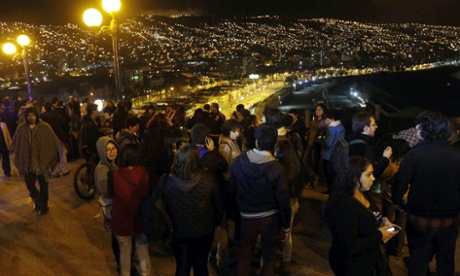
A major earthquake just offshore rattled Chileans, killing five people and shaking the Earth so strongly the tremor was felt in places across South America. Authorities worked into the early hours Thursday assessing damage in several coastal towns that saw flooding from small tsunami waves set off by the quake.
The magnitude-8.3 quake hit off northern Chile on Wednesday night, causing buildings to sway in the capital of Santiago and prompting authorities to issue a tsunami warning for the Andean nation’s entire Pacific coast. People sought safety in the streets of inland cities, while others along the shore took to their cars to get to higher ground.
“Once again we must confront a powerful blow from nature,” President Michelle Bachelet said in an address to the nation late Wednesday.
Authorities said early Thursday that five people had been killed and one person was listed as missing.
Bachelet urged people who evacuated from coastal areas to stay on high ground until authorities could fully evaluate the situation during the night. Officials said schools would be kept closed in most of the country Thursday.
Numerous aftershocks, including one at magnitude-7 and four above 6, shook the region after the initial earthquake the strongest tremor since a powerful quake and tsunami killed hundreds in 2010 and leveled part of the city of Concepcion in south-central Chile.
Although officials cautioned it was too early to know for sure, it appeared Wednesday’s quake had a much smaller impact than the 2010 tremor. If that turns out to be the case, it will be a sign that Chile’s traditionally strong risk reduction measures and emergency planning had gotten better in the last five years.
The tremor was so strong that people in Buenos Aires, Argentina, on the other side of the continent, reported feeling it. People in Peru and Brazil also reported feeling the shakes. No injuries were reported outside Chile.
Authorities said some adobe houses collapsed in the inland city of Illapel, about 175 miles (280 kilometers) north of Santiago and about 34 miles (55 kilometers) east of the quake’s epicenter.
Illapel’s mayor, Denis Cortes, told a local television station that a woman had been killed in the city but declined to give any details.
Electricity was knocked out, leaving the city in darkness. “We are very scared. Our city panicked,” Cortes said.
A magnitude-8.8 quake and ensuing tsunami in south-central Chile in 2010 killed more than 500 people, destroyed 220,000 homes, and washed away docks, riverfronts and seaside resorts. That quake released so much energy, it actually it shortened the Earth’s day by a fraction of a second by changing the planet’s rotation.
Updated
This map shows the latest tsunami threat levels in New Zealand, with waves of between 0.2m to 1m expected all the way down the east coast.
Updated #tsunami warning areas pic.twitter.com/ruzfR3NdfQ
— Kim Baker Wilson (@kimbakerwilson) September 17, 2015
Updated
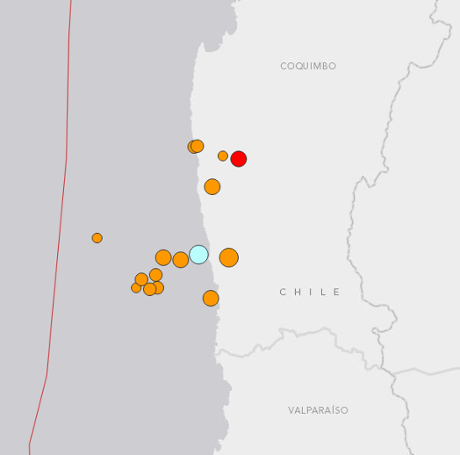
This map, from the US Geological Survey, shows the initial earthquake (in light blue) followed by 15 subsequent aftershocks. Just three were below 5 on the richter scale (and they were all 4.9).
Updated
Los Vilos is right on the Chilean coast, only a few kilometres from the epicentre of the earthquake, which we understand took place offshore. Journalist Juan Miranda has published these photographs from the town.
Algunas fotos que me llegan de Los Vilos. Del borde costero pic.twitter.com/ASEYZYrhjY
— Juan Miranda (@JuanMirandaB) September 17, 2015
Death toll climbs to five; one million evacuated
The undersecretary for the ministry of the interior and public security says five people have killed and one million people across Chile have been evacuated.
Subsecretario entrega nuevo reporte de sismo de mayor intensidad: 5 fallecidos y 1 millón de personas evacuadas pic.twitter.com/Rt2Z4wbE9F
— onemichile (@onemichile) September 17, 2015
He confirms that earlier report of a 4.5m wave hitting Conquimbo, and says waves of up to 2m have buffeted Tongoy, both towns in the region closest to the earthquake’s epicentre. The image below is from Tongoy.
#TERREMOTO, Lamentable imágen de Tongoy. destrucción a la vista. imágen @via twitter pic.twitter.com/klsSdSrNly
— Diario Elregional.cl (@Elregionalcl) September 17, 2015
Updated
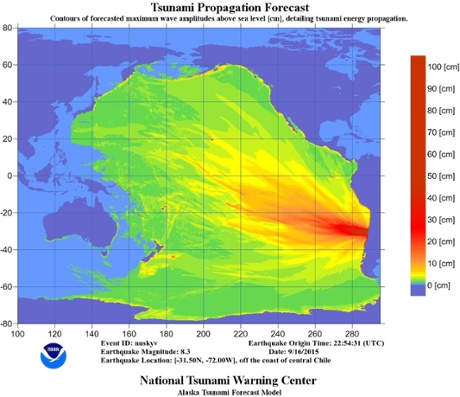
This map, from the United States National Tsunami Warning Centre, shows how the energy generated by this 8.3 magnitude quake might spread across the Pacific. The colour indicates the predicted waves above sea level in centimetres.
Updated
My colleague Jonathan Franklin has been listening the Chilean president, Michelle Bachelet, address the country.
She confirmed that three people had been killed and the towns of Coquimbo and Tongoy were heavily flooded. Both areas have been declared catastrophe zones and the army will be sent in to prevent looting. Bachelet will visit both towns tomorrow.
Franklin said that despite the earthquake striking so close to Chile’s independence day on 18 September, the casualties appear to be low, and the damage confined to walls and roofs – “and not entire towns getting flattened” as occurred in February 2010.
Chile, one of the most earthquake prone countries on Earth, has learned from past tremors: new buildings must be able to survive 9.0 magnitude earthquakes and the country has instituted a tsunami warning system, activated for the first time today.
Franklin says Bachelet’s political fortunes are intertwined with earthquakes. She was perceived to have “completely bungled” the response to the February 2010 quake, which killed 525 people. “She was slow to respond, she did not have a good tsunami warning in place,” he says.
Now, “she’s at the all-time lowest approval rating for any Chilean president, she’s at the low 20s, her credibility and leadership is being questioned heavily”, he says.
“All eyes will be on her to see if she learned the lessons from last time.”

Updated
Three dead, Chilean president says
Habla la presidente Michelle Bachelet tras el terremoto en #Chile ✏Hay 3 personas muertas ✏Suspenden las clases ✏Viajará a la cuarta región
— C5N (@C5N) September 17, 2015
Updated
In Fiji, where it’s about 2.48pm, the government has warned the first wave generated by this earthquake is expected to arrive around midnight. It advises “no immediate action”.
The Solomon Islands government is still carrying out a threat assessment, but says, “at this stage we don’t know if a tsunami has actually been generated”.
Seismic waves from Chile earthquake recorded on seismometers in schools in Australia #ChileQuake @AuScope @CitSciOZ pic.twitter.com/0h8hP0CVbJ
— Natalie Balfour (@nat_hazard) September 17, 2015
The president of Chile, Michelle Bachelet, is now on television addressing the country. We’ll have a report of her remarks shortly.
Updated
The Chilean police have confirmed that in Illapel, close to where this earthquake struck, a woman has died and seven people have been injured, three of them seriously, according to CNN Chile.
It quotes the national emergency agency saying that first tsunami hit Tongoy, just south of La Serena, around 8.20pm, triggering a nationwide red alert.
The mayor of Coquimbo, Cristian Galleguillos, told CNN Chile that the city is starting to flood and that 95% of residents have lost power. The residents were able to evacuate before the waves started to hit the coast.
Fabrizio Guzmán, communications manager for World Vision in Chile, said the quake struck during rush hour, causing congestion that left many people stranded in the streets as they tried to return home.
Updated
#LTenVivo | Así se vivió en una piscina el terremoto de la zona central de Chile pic.twitter.com/0ZS3RnbaMH http://t.co/du9d5tS3zF
— La Tercera (@latercera) September 16, 2015
More footage from central Chile, showing pool water swaying heavily. Its unclear whether this was from the initial 8.3 magnitude earthquake of the significant number of aftershocks that have followed.
Updated
Over in New Zealand, the minister for civil defence, Nikki Kaye, has issued this advice for residents in East Cape, Chatham Islands, Coromandel and Banks Peninsula.
1. Stay out of the water (sea, rivers and estuaries, including boating activities)
2. Stay off beaches and shore areas
3. Do not go sightseeing
4. Share this information with family, neighbours and friends
5. Listen to the radio and/or TV for updates
6. Follow instructions of local civil defence authorities.
The National Crisis Management Centre in Wellington has been activated to monitor this situation, and I’m receiving regular briefings.
The tsunami warning remains in place until a cancellation message is issued by MCDEM.
As reports come through of the potential impact of the earthquake in Chile, our thoughts are with everyone affected.
This comment from John Kerry’s spokesman, John Kirby.
Our thoughts are with people of #Chile tonight in the wake of powerful earthquake off northern coast. US stands ready to assist as needed.
— John Kirby (@statedeptspox) September 17, 2015
Two dead and two missing reported in Tongoy
RT @chvnoticiascl @chvnoticiascl Primer balance post terremoto ⚠: Dos fallecidos y personas desaparecidas en Tongoy ► http://t.co/lCzM96mEKj
— Chilevision (@chilevision) September 17, 2015
Tongoy is about 50km south of La Serena.
My colleague Oliver Holmes has alerted me to this tsunami watch just issued for the California coast:
*A TSUNAMI CAPABLE OF PRODUCING STRONG CURRENTS OR WAVES DANGEROUS TO PERSONS IN OR VERY NEAR THE WATER IS EXPECTED.
*CURRENTS MAY BE HAZARDOUS TO SWIMMERS... BOATS... AND COASTAL STRUCTURES AND MAY CONTINUE FOR MANY HOURS AFTER THE TSUNAMI ARRIVAL.
*THE FIRST WAVE MAY NOT BE THE LARGEST.
Waves of less than a foot (30cm) have been forecast for Newport Beach, Los Angeles Harbour, Santa Barbara and San Luis Obispo.
Updated
Chile’s national emergency office is reporting “medium” aftershocks in Coquimbo, Valparaiso and O’Higgins.
Sismo de mediana intensidad en las regiones de Coquimbo, Valparaíso y O’Higgins. Más información en http://t.co/OFmIDadvHr
— onemichile (@onemichile) September 17, 2015
Meanwhile a tsunami warning has been cancelled for the region of Magallanes, but remains in place for the rest of the coast.
Sismo de mediana intensidad en las regiones de Coquimbo, Valparaíso y O’Higgins. Más información en http://t.co/OFmIDadvHr
— onemichile (@onemichile) September 17, 2015
Updated
This scene from supermarket in La Serena, the capital of the Coquimbo region.
LaSerena, Chile... supermarket shelves rocked by earthquake pic.twitter.com/2xEx01iZSt
— JohnBelski (@JohnBelskiWLKY) September 17, 2015
An eerie scene about an hour ago in Valparaiso: tsunami warning sirens wailing across the city.
21:23 @hernancastro_ Así sonaron las alarmas en #Valparaíso @valparaiso @munivalpo pic.twitter.com/vh7lc6bBiy
— Valparaiso (@valparaiso) September 17, 2015
Here’s the scene down in the city.
Updated
Update: Hawaii under a Tsunami Advisory. No major tsunami expected for the state. However, sea level changes and strong currents may occur.
— NWSHonolulu (@NWSHonolulu) September 17, 2015
My colleague in New Zealand, Eleanor Roy, reports that that country’s Ministry of Civil Defence is “in precaution mode”, and has not yet asked the public to stay away from beaches and low-lying areas.
“At the moment any threat is a long way off and would be middle of the night stuff for New Zealand,” Shane Bayley from the Ministry of Civil Defence says.
The areas under assessment are East Cape, the Chatham Islands, Coromandel, and Banks Peninsula. “No threat confirmed for Auckland yet they are in watching mode,” Bayley says.
Here is footage of a tremor being felt in a supermarket in Valle Lo Campino, a suburb of Santiago.
Waves more than 4.5m high recorded in Coquimbo
UPDATE: 15.1 foot tsunami observed in city of Coquimbo, Chile after powerful earthquake http://t.co/3CX95pB2Ev pic.twitter.com/CXONWahOw1
— BuzzFeed Storm (@BuzzFeedStorm) September 17, 2015
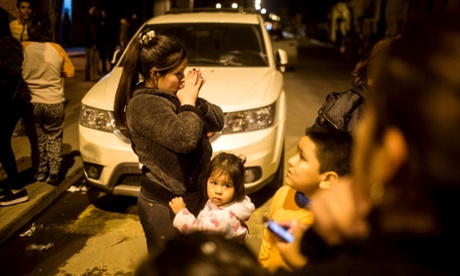
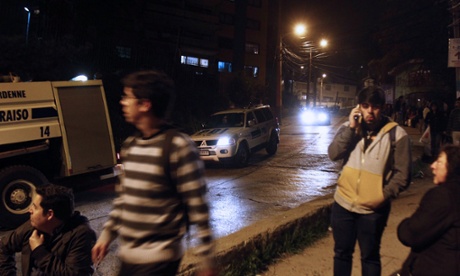
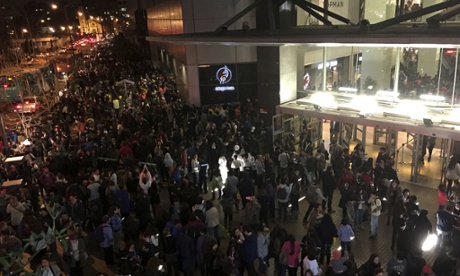
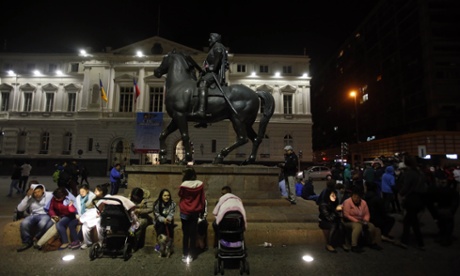
Remarkable images are coming out of Chile, as people across the country take to the streets for refuge after an 8.3 magnitude earthquake struck over two hours ago.
Updated
Chilean government reports one death
My colleague in Chile, Jonathan Franklin, says the Chilean government has reported a 25-year-old woman has died in Illapel, a town on the coast about 46km from where the earthquake hit.
She was reportedly killed by a falling wall. Another 20 have been injured.
Updated
More out of Coquimbo, where we’ve heard reports of flooding and residents are heading to higher ground.
Nadie va a dormir en Coquimbo esta noche #Chile #Terremoto pic.twitter.com/xQsVH4BaS7
— Pablo Petovel (@pablopetovel) September 17, 2015
The caption reads, “Nobody is going to sleep in Coquimbo tonight.”
Updated
More dramatic footage of flooding from Avenida Borgono in Concón, a coastal city north of Valparaiso.
Updated
Flooding seen in Coquimbo
The mayor of Coquimbo has told CNN his town, north of where the quake struck, has begun to flood.
#ANenVivo Avenida del mar en #Coquimbo pic.twitter.com/Hs4mKShnHV → http://t.co/40mNmcDm01
— Ahora Noticias (@ahoranoticiasAN) September 17, 2015
Jascha Polet, a seismologist at California Polytechnic Poloma, has produced this approximate tsunami travel map showing how far - and in how many hours - the waves produced by this earthquake could travel.
Generated this approximate tsunami travel time map (contours in hours) for Chile quake at http://t.co/mjheuzP2l7 pic.twitter.com/XntOSsNFmq
— Jascha Polet (@CPPGeophysics) September 17, 2015
Radio New Zealand reports that a tsunami warning has been issued for the country’s eastern coast.
Civil Defence issued the tsunami warning for the East Cape, Chatham Islands, Coromandel and Banks Peninsula regions a short time ago, warning residents in those areas to stay out of the water and keep away from beaches.
Civil Defence said any tsunami activity may reach the East Cape just after midnight tonight. It has warned that tsunami activity could continue for several hours and the threat should be regarded seriously until the warning was cancelled.
The Pacific Tsunami Warning Center in Hawaii said waves of up to a metre could hit New Zealand, while waves of between one and three metres could hit French Polynesia.
New Caledonia, Fiji, the Samoas, the Cook Islands, Tonga and other island nations are also being warned of 1m waves.
Smaller waves may hit Tuvalu, Papua New Guinea and Nauru.
Updated
The Chilean foreign ministry reports that the hospital and prison in Constitución, a town south of Santiago that was flattened during the last major earthquake in 2010, have been evacuated.
Updated
Buildings swayed, evacuated in Buenos Aires
My colleague Uki Goni reports that tremors were felt as far as the Argentinian capital, Buenos Aires.
He writes:
The Chilean earthquake set off car alarms in Buenos Aires 690 miles (1,110km) away on the Atlantic side of the South American continent.
Public buildings, such as the buildings of the University of Buenos Aires, were evacuated. Tall buildings in the upscale neighbourhoods of Belgrano and Palermo swayed so much that their dwellers ran out into the streets.
Reports from other Argentine cities, such as Rosario and Mendoza, also reported swaying buildings and evacuated buildings. No casualties have been reported.
Updated
A tide gauge at Coquimbo, north of where the earthquake struck, shows that two hours after the tremor large waves – up to 4m high – are continuing to hit the shore.
Coquimbo tide gage shows that significant tsunami waves still (hour+ later) arriving at coast after Mw8.3 earthquake pic.twitter.com/qz7QT1AZt5
— Jascha Polet (@CPPGeophysics) September 17, 2015
Updated
No reports yet of any casualties from this earthquake, which struck about two hours ago, but already photographs of the damage are coming through.
Imagen del patio de comidas del mall de La Serena. @christianpino @tvn_gonzalo pic.twitter.com/dzvHtgCFws
— Rodrigo Vilches M. (@RodrigoVilchesM) September 17, 2015
La Serena is in the Coquimbo region, the closest administrative zone to the epicentre of the earthquake.
Así quedó el patio de comidas del mall de La Serena. #terremoto pic.twitter.com/EABMyH4SFw
— Rodrigo Vilches M. (@RodrigoVilchesM) September 17, 2015
Imágenes de un supermercado cerca de La Recova en #LaSerena pic.twitter.com/fgrNiz1abb #Chile
— Diego (85 días) (@Diego_Pelayo) September 17, 2015
Updated
Here is video from Valparaiso, a large town close to where this earthquake struck, off the central Chilean coast.
A mass evacuation is underway in the town in anticipation of a possible tsunami.
FOTO: Evacuación preventiva en #Valparaíso tras fuerte sismo. pic.twitter.com/TQljouawDo
— huelladigital.cl (@huella_digital) September 16, 2015
Updated
"People are terrified"
I’ve just spoken with Jonathan Franklin, the Guardian’s correspondent in Chile, who said he was in the surfing town of Pichilemu south of Santiago “right at sea level when this all happened, so we basically headed to the hills”.
“I was right at one of the biggest surf breaks in Chile, a national holiday is in two days, the entire country is on vacation starting today, so beaches are packed,” he said.
“The wine glasses started to shake and the kids started to scream, it was a very long quake, it must have been about two minutes long.”
A cell phone warning system was put in place after an earthquake and tsunami in 2010 killed 525 people. Franklin said it sounded for the first time on Wednesday evening. “All of a sudden, every single cell phone started to send off like an air raid alarm,” he said.
“If you’re in the tsunami alert zone your cell would have started going crazy, it was an indication that you had to get about 30 or 40m above sea level,” he said.
People on the coast were being given exact times for when waves were expected to hit. “For every part of the coast they give you the exact moment, so here, supposedly in five minutes the wave is going to hit,” he said.
“People are terrified ... Already we’re hearing reports of buildings collapsing, and also of rock slides, there’s a lot of really arid, mountainous zones here, and electricity out.”
#LTenVivo | Fotos de las evacuaciones preventivas que se registran en la V Región http://t.co/oOSw4zxQ0s pic.twitter.com/K4WJhrHilW
— La Tercera (@latercera) September 16, 2015
Updated
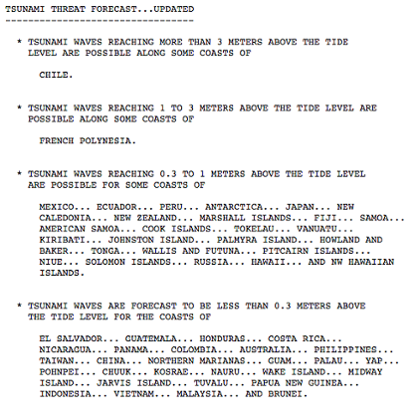
Here is the latest tsunami warning from the US Geological Survey.
My colleague Nick Evershed has produced this map showing the epicentre of this 8.3 magnitude earthquake, which struck Chile just over an hour ago.
"Widespread hazardous tsunami waves possible"
An 8.3 magnitude earthquake has struck Chile, causing buildings in the capital Santiago, to sway, and residents to take refuge in the streets.
The US Geological Survey said the quake’s epicentre was about 46km west of Illapel, a town about three hours’ drive north of the Chilean capital.
It occurred around 7.54pm, local time, and had a depth of 10km.
The Pacific Tsunami Warming Centre says “widespread hazardous tsunami waves” are possible along the coasts of Chile, Peru and Hawaii.
CNN has gathered footage purporting to show when the earthquake struck.
#BREAKING: New video shows powerful 8.3-magnitude earthquake in Chile - http://t.co/RFjwjwUiLp (Video: CNN Chile) pic.twitter.com/TloV8vzpxx
— Grasswire (@grasswire) September 16, 2015
Stay with us for all the latest developments.
Updated