To help children who are unable to attend Tokyo Olympic and Paralympic events due to illness or disability, efforts are under way to enable them to physically experience the fervor of the competition through the use of advanced technology, including robotics and virtual reality devices.
These efforts are being made through a joint project in which Tokyo schools for students with special needs and a hospital will work with the Tokyo Organizing Committee of the Olympic and Paralympic Games, the Tokyo metropolitan government and Japanese companies such as Panasonic Corp.
More than 1,000 children are expected to take part in the project.
According to an official related to the Tokyo Games, the project is scheduled to be implemented at five schools that cater to students with special needs and one hospital. Two types of robots -- modeled after 2020 Olympic mascot Miraitowa and 2020 Paralympic mascot Someity -- equipped with microphones and video cameras will be placed at a sports arena as "avatar robots."
People at the schools and the hospital will see video images from the viewpoint of the robots, while students with disabilities and children at the hospital will use a remote-control device enabling them -- through the robots -- to high-five or shake hands with athletes at the arena.
Omnidirectional footage that has been taken at the venues will be shown at a specialized dome-shaped theater.
This kind of system allows children to have experiences that simulate actually attending the events, thanks to footage captured through the use of virtual reality technology.
The opening ceremony and some of the athletic competitions at the Games are on the list of events to be "viewed at the virtual reality arena."
Eyeing utilization of these technological advances as a 2020 Games legacy, the Tokyo metropolitan government intends to move ahead in setting up a 5G next-generation mobile communications system that can send massive amounts of data instantly.
"We hope future star athletes will emerge from among these children, who will experience the Games through this effort," an official related to the Tokyo Games said.
Active roles for avatars
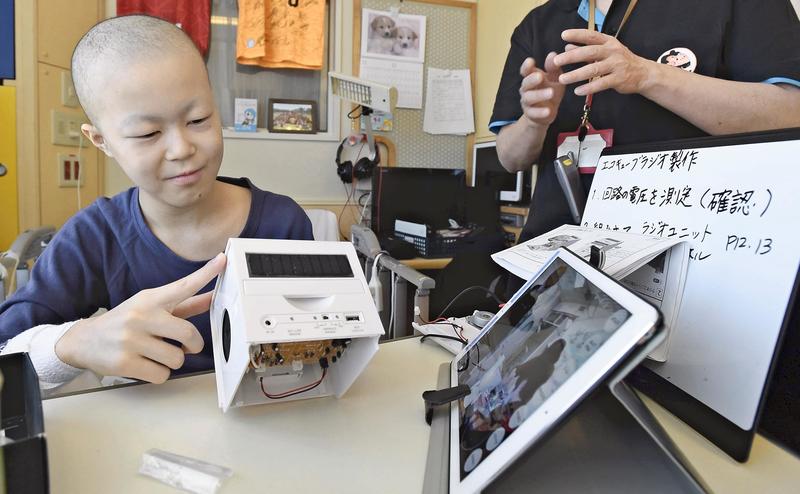
"Avatar robots" equipped with video cameras, microphones and speakers have come to play more active roles at schools and elsewhere, helping those struggling with illness or disability to participate in society.
"Eiki raised his hand!" Sixth-grade students at Yokohama city-run Kogaya Elementary School cheered when they saw the gesture by a 20-centimeter-tall robot standing on a desk in their classroom. Remotely operating the robot was their classmate Eiki Kaneko, 12, a hospital patient in Tokyo.
In their social studies class on the day, the students discussed the achievements of Ii Naosuke, a high-ranking official of the shogunate in the waning years of the Edo period.
As Eiki said the words, "I can go along with him," in reference to the thinking of Ii, who signed the Japan-U.S. Amity and Commerce Treaty, the class broke into applause.
"Because I gained a real sense of the joy of spending time with my friends, it has made me think about pushing through the difficulty of my treatment," a cheerful Eiki said.
"It's been fun to talk with kids in the same grade and has been a refreshing change," said a smiling Shunnosuke Sakamoto, 14, a second-year student at a junior high school who in December "attended" a lesson via robot while hospitalized at the Kanagawa Children's Medical Center in Yokohama.
"They can see what it's like in the class and how their friends are doing, so the children become positive and gain that 'I want to go back to school soon' feeling," said Tomoko Kubota, an instructor at the metropolitan government-run Bokuto School for Special Needs, where a robot takes part in extracurricular activities as an avatar for hospitalized children.
Read more from The Japan News at https://japannews.yomiuri.co.jp/