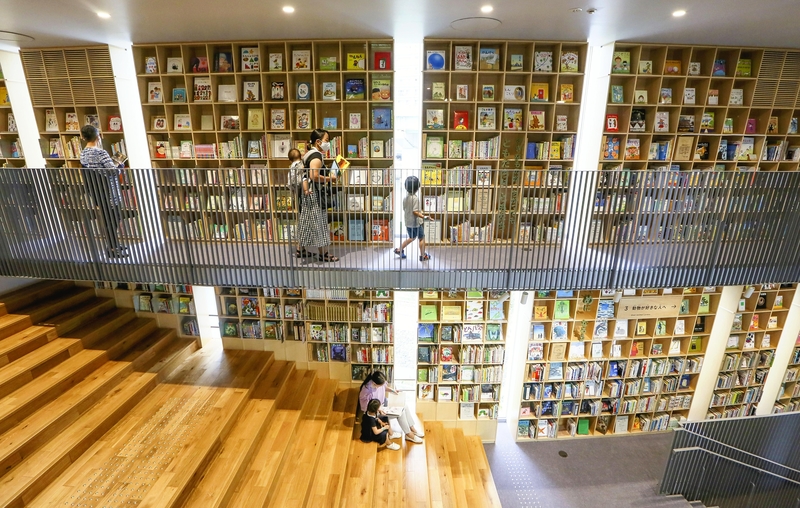
OSAKA -- Opened in July, the Nakanoshima Children's Book Forest is a library facility in Kita Ward, Osaka, that was designed, built and donated to the city by renowned architect Tadao Ando.
As with similar projects currently under way near areas severely affected by the Great Hanshin Earthquake in 1995 and the Great East Japan Earthquake in 2011, this library is meant to embody the wish of Ando, 79, to nurture the imagination and courage of children, who will lead the world's future, through reading.
The new library in Osaka has about 18,000 books, including picture books and children's books for youngsters from infants to junior high school students. For Ando, who has been based in Osaka for more than half a century, this is a way of giving back to local society.
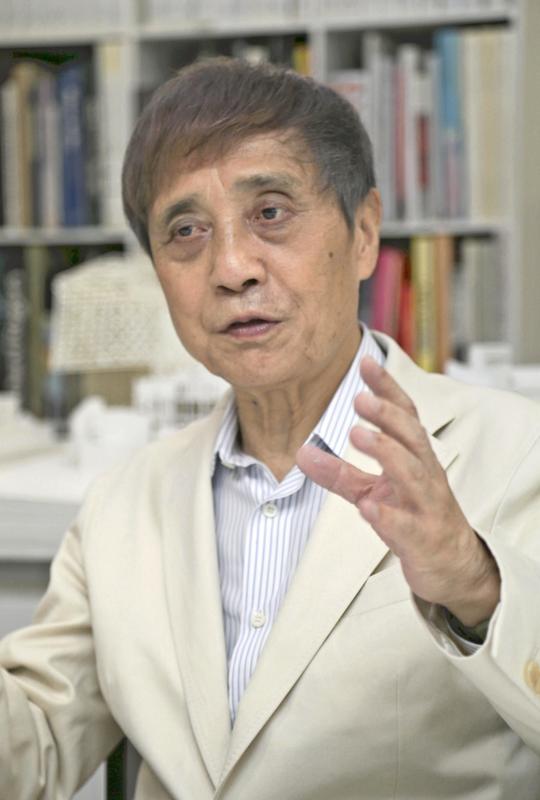
Ando designed the Osaka building with an emphasis on opening children's minds. Visitors are allowed to read books not only indoors, but also on the library's terrace, in the park outside the building, and in other comfortable spaces, reflecting Ando's idea that children today "need a place where they can read and think freely as they don't have much free time."
Ando believes that people can feel emotion by reading books in their hands and appreciate expressions in these books resonating in their minds. He is concerned about the current general tendency of people reading less printed matter. He has said that he himself grew up in an environment where there were not many books, but he was greatly excited by a future city depicted in "Tetsuwan Atom" (Astro Boy) by Osamu Tezuka, and this experience may have motivated him to become an architect.
Similar children's library projects are under way in Kobe East Park, where there is a "monument of the memory and reconstruction" to remember the Great Hanshin Earthquake, and in Tono, Iwate Prefecture, where volunteer activities were based after the Great East Japan Earthquake. The openings of these buildings are scheduled in around the spring of 2022 and in July 2021, respectively.
The facility in Kobe will be a new two-story reinforced concrete building. In Tono, an old-fashioned two-story wooden house in the city center will be renovated to house a library. Both facilities will be donated to the cities.
After each of the two earthquakes, Ando established the Momo-Kaki Orphans Fund, a scholarship to support children who lost their parents in the quakes and distribute donations from across Japan to bereaved children and orphans.
"Post-disaster recovery starts with developing human resources. I want to be helpful for children in the disaster-hit areas to be able to study on their own and live positively by looking to the future" -- this belief and wish of Ando have become the foundation of the library projects in the two cities. He has said he also hopes that the two facilities will serve as "a place to pass on the memory of the disaster to the future."
Ando has said he realized once again that "the world is one" after the outbreak of the novel coronavirus. In addition to overcoming the pandemic, there are a large number of global issues for humans to address, including climate change and population problems.
"People today need to have the power of thinking about matters from a wide perspective and free from the norms and taking action by having courage," Ando said. "I think reading books can develop such power, particularly in children. I hope children having rich sensibilities nurtured through reading will venture out into the world."
--Images on atrium wall
Nakanoshima Children's Book Forest is located along the Dojima River running through the center of Osaka. The three-story reinforced concrete building has a distinctive curved exterior. On entering the building, I was impressed with the soft light shining into the spacious interior.
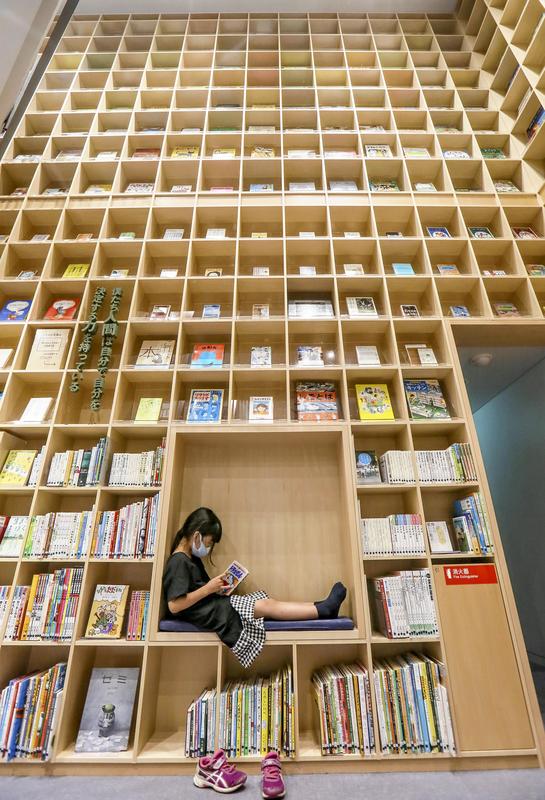
"There are many animal books." "I want to read this." I heard children innocently speak in amazement in front of the bookshelves filling the walls. To help prevent infections with the novel coronavirus, only those who had made a reservation were allowed to enter the facility, up to 50 persons for a 90-minute stay.
When I was at the facility, children with their parents sat wherever they wanted and had opened books in front of them.
The books are arranged according to 12 themes, including "Let's Play with Nature" and "Beautiful Things." There is also a section with books that famous people had loved to read as children. When I visited, there was a German science fiction series that had been a great favorite of Kyoto University Prof. Shinya Yamanaka, who is the facility's honorary curator.
In the dimly lit, cylindrical atrium, a video was projected onto the walls to invite children to the world of its story.
When the image of a girl on a broomstick and her dialogue appeared on the walls, the children were so enchanted that they did not speak a word.
The facility has a lot of unique mechanisms and playful elements to guide children to an imaginary "forest" beyond the books. It is certain that each children will be able to encounter an important book for themselves at this facility.
Read more from The Japan News at https://japannews.yomiuri.co.jp/