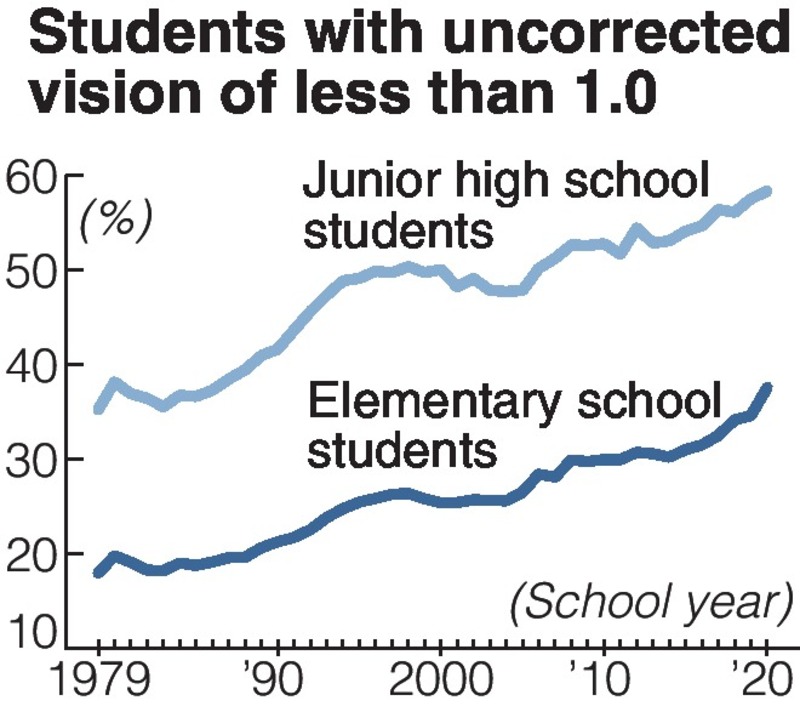
The eyesight of elementary and junior high school students declined to a record low in the 2020 school year, according to the results of an education ministry study announced Wednesday.
The percentage of elementary school students with uncorrected eyesight less than 1.0 -- equivalent to 20/20 vision on the Japanese acuity scale -- increased by 2.95 percentage points from the previous year to 37.52%, while the percentage of junior high school students scoring below the benchmark increased by 0.82 points to 58.29%.
The figure for high school students stood at 63.17%, a 4.47 percentage point rebound from the 2019 school year, which was the worst showing on record for the cohort.
The share of kindergarteners with less than 1.0 acuity increased by 1.84 points to 27.90%.
Eyesight tended to grow worse with age: 24.22% of first graders, 49.47% of sixth graders and 60.61% of junior high school third-years were found to have less than 1.0 acuity.
Increased screen time spent on smartphones and other digital devices has been speculated to be one factor taking a toll on young eyes.
Elementary and junior high school students are expected to spend even more time using electronic devices for classes and other activities under the ministry's GIGA School Program. Launched this spring, the program allots one e-learning device to each student.
In order to gauge the impact of the new program, the Education, Culture, Sports, Science and Technology Ministry began collecting data on myopia this school year, studying approximately 9,000 elementary and junior high school students nationwide, as part of its annual health survey.
Obesity, defined as being 20% heavier than standard weight, was also found to have increased across most age groups from the previous year's survey. The percentage of students 20% lighter than standard also increased.
"This trend may have been affected by changes in lifestyle, such as the lack of physical activity during school closures," said a ministry official.
Although school health surveys are usually conducted from April to June, the 2020 survey was extended to cover April 2020 to March 2021, in light of school closures amid the novel coronavirus pandemic. This year's survey contained data on 3.34 million students aged 5-17 -- or 25% of all the nation's students from kindergarten to high school.
"Since the timing of the survey is different from previous years, it is not possible to make simple comparisons with past figures," the official said.
Read more from The Japan News at https://japannews.yomiuri.co.jp/