Many of today’s children face a challenging future. The world’s population could reach almost 10 billion by the middle of the century, the effects of climate change are increasingly being felt, and the gap between the richest and poorest in society has become a gulf. But presenting young people with doom and gloom scenarios is only likely to frighten them. It might even make them despondent, and therefore less likely to engage with sustainability teaching; the people who have the biggest stake in the future, on whose shoulders the burden of change will weigh most heavily, could be ‘switched off’ from learning the skills they’ll need to survive and thrive.
“How we ensure that future generations have access to an appropriate and fair amount of resources – that is a deeply fundamental question,” says Professor James Longhurst, assistant vice chancellor, environment and sustainability, at the University of the West of England. “Young people need to be prepared for the sorts of challenges that they will face in their lifetime, consider their own responses to those challenges, and more importantly, think through what their contribution to the solution will be.”
That’s the foundation of Education for Sustainable Development (ESD). It isn’t about spelling out worst-case scenarios; it’s about giving students the knowledge, values and social critical thinking abilities they need to live happy, healthy sustainable lives. The core teaching concepts are based around empowering and motivating learners to examine their own behaviour and that of others, and take action that will improve their well-being as well as that of the planet.
Children are then encouraged to think about how we could get from probable to preferable scenarios, and what steps are needed to get there. When this is coupled with ‘action learning’ – involving children in choosing a project or issue they would like to address, then helping them see it through to completion, assessing what they’ve learnt and how to apply this knowledge – it can really “change self-esteem and your sense of agency for making a difference,” says Ann Finlayson, chief executive of SEEd, which aims to support and encourage educators to help young people live a more sustainable life.
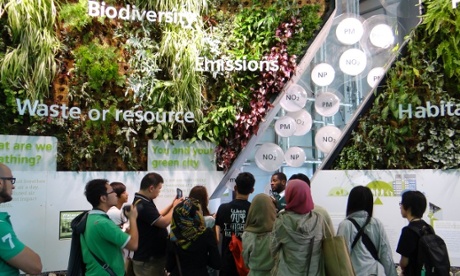
The Crystal, a strikingly futuristic building on the Royal Docks, East London, is designed to help students of all ages envisage what a sustainable future might look like, particularly in a technological and urban context. Aside from being one of the world’s greenest buildings, it’s home to a large, permanent exhibition centred around fourteen zones that showcase global sustainability trends, challenges and futures, including urban planning, energy, water, healthy lifestyles and the environment.
Engaging visuals and real-life examples that children can apply to their own lives are at the heart of the exhibition. “It’s about possible solutions, and solutions that are already in place today,” says Rachel McVeagh, education facilitator for The Crystal. One of the exhibits tasks children with running a city for 40 years. “They look at power, water and finance and then they try and make the right decisions to build a sustainable city,” she says. “It shows them the challenges involved in balancing a sustainable life with quality of life.”
Chris Dillon, event and safety manager at The Crystal, says that “everyone from grandparents down to toddlers” has visited the building since it opened in 2012. Visits are often tailored to suit each group’s particular interests, and teaching resources are available through The Crystal’s website. The Crystal also aims to motivate students to study sustainable engineering. “The University of East London recently brought in their third year engineering students,” Chris says, “and they were able to speak to our technology manager about a career in engineering.”
Oasis Academy Silvertown is walking distance from The Crystal. School principal Charles Claxton says it has become a source of inspiration for both teachers and pupils alike. “It’s so much more relevant than just saying ‘well, remember to switch the lights off, children’. It brings it [sustainability] to life.”
When the school visited recently, pupils were able to use it as a resource for a piece of creative writing about utopias and dystopias. “We were talking about utopian visions of what a city might look like, and also contrasting that with a dystopian vision... All of the displays on energy conservation, good transport infrastructure and so on – they were able to build that information into their utopian vision.”
Professor Longhurst says that “whether you’re in primary school or in higher education – anywhere on that spectrum – the opportunity to visit a place, to be inspired by the alternative futures that are presented in The Crystal, for example, those are incredibly important parts of an educational experience.”
At present sustainable development doesn’t feature in the national curriculum for schools in England, and climate change is only taught to GSCE students. SEEd believes this needs to change – not least because Education for Sustainable Development can help students develop the skills they need to critically assess the masses of information they’re now constantly bombarded with, figure out their impact on the world, and ultimately lead more fulfilling and sustainable lives.
Copy on this page is controlled by The Crystal, sponsors of the Guardian Sustainable Business Awards and the business futures hub.