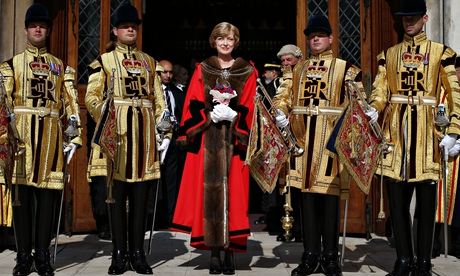
From the moment of her choosing as chair of the independent panel inquiry into child sexual abuse, Fiona Woolf’s departure (Report, 1 November) was as foreseeable as her dinner party links with Leon Brittan (Head of abuse inquiry’s letter rewritten to mask Brittan links, 31 October). The next chair will depart in similar ignominy if Mrs May and the victim groups don’t use their imagination when choosing for this inquiry into our capital city’s dirtiest secrets.
This is about a place where former/current politicians, bankers and civil servants share boardrooms; politicians and tabloid editors share horses; and tabloid editors share drinks with senior policemen and senior criminals. From the start of their training, London’s lawyers eat dinners wherein they learn to aspire to enter the same set of relationships, and while I truly admire many, there is no detergent made that could wash those plates clean, in these circumstances.
I suggest Mrs May look to the many supremely clever lawyers whose only aspirations are to pay the mortgage while teaching the next generation of lawyers to seek justice, and whose only sin was to occasionally inhale when at uni. In the more than 90 law schools in the country, there is a collection of caring, true, and honest women and men who know more law than most, and know far better than most how to investigate what is going on.
Professor Stephen Whittle
School of Law, Manchester Metropolitan University
• Fiona Woolf suggested that the only person not connected with the establishment would be a hermit, which came across as facile and thoughtless. Presumably, the government is looking for a figure with the appropriate intellectual and personal abilities to command the respect of the victims, and who will be able to pursue the inquiry without fear or favour. We have a great university tradition of liberal and radical thinking in this country: why not appoint a senior academic? Alternatively, what about an international human rights lawyer from Europe or the US?
Crispin Read Wilson
Swanage, Dorset
• Fiona Woolf says she’s not a member of the establishment. If the mayor of the City of London, a former president of the Law Society and a CBE can’t join the establishment, what chance the rest of us?
Bob Hughes
Willoughby, Warwickshire
• The failure to appoint a chair to the independent panel inquiry is indeed “a shambles” (Editorial, 1 November). The delay is highly insensitive to those who have already suffered greatly – and another example of the insularity and arrogance of the London-centric Westminster establishment – no consultation with the victims considered necessary. It is a culture that has extended to MPs fiddling their expenses, the dilatory response to the flooding in the south-west of the country, the unfair distribution of infrastructure funding to the regions, and the failure of Cameron, Clegg and Miliband to understand and respond to Scotland’s post-devolution narrative. All of which contributes to disillusionment with the established political parties. It may be, as your leader column suggests, that an independent inquiry with a sharper focus will serve the victims of historical abuse better – although only if it had statutory clout. But addressing the wider agenda of enhancing local democracy and funding beyond Westminster, including the extension of user involvement in the governance of services and institutions that have so badly failed those they were meant to care for, has the potential to prevent the need for future inquiries.
Emeritus Professor Mike Stein
University of York
• One of the most depressing aspects of the whole saga is the view now being promoted that anyone suitably qualified for the role will, of necessity, be a member of the establishment. That very mindset that only the inner elite could carry out the role is part of the problem.There are many individuals outside the charmed circle capable of chairing the inquiry. My initial suggestion would have been the solicitor Gareth Peirce. Her representation of the Guildford Four and the Birmingham Six stands as proof of her resolute integrity. She shuns the media limelight and does not appear to frequent the glitzy dinner party circuit. She spurned attempts to award her the CBE. I have no idea if Ms Peirce would be interested in the role but did Theresa May even consider asking her? If not, is it because Ms Peirce is firmly not of the establishment?
Dr Chris Morris
Kidderminster, Worcestershire
• Theresa May is allegedly finding it hard to locate someone who is not of the establishment to chair her inquiry. Can I suggest she look north of the border? Scotland is still part of the UK, and an eminent Scottish lawyer has recently relocated to England. To someone like Elish Angiolini – former solicitor general of Scotland, now principal of St Hugh’s College Oxford, and currently scrutinising the Met’s handling of rape allegations (Report, 10 June)?
Margaret Squires
St Andrews
• Alison Millar (the lawyer representing some of the child abuse victims) says that the head of inquiry must be a high court judge, so as to be able to punish those who are in contempt when giving evidence to the inquiry. Is it not possible for Mike Mansfield (or another intellectually able lawyer who is not part of the establishment) to be made a high court judge for the purpose?
John Gorringe
London