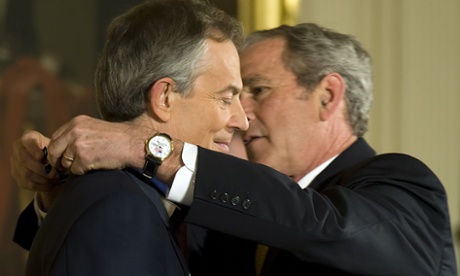
First, there were the heated disputes between Sir John Chilcot and successive cabinet secretaries about what records of conversations between Tony Blair and George Bush, and other documents, could be revealed.
It was not until these disputes were settled last summer that Chilcot drafted the passages containing criticism of prominent figures who gave evidence to the inquiry. They include Blair; Jack Straw, foreign secretary at the time of the invasion of Iraq; Sir Richard Dearlove, then head of MI6; Lord Goldsmith, the attorney general; and Geoff Hoon, the defence secretary.
Chilcot argued that he had to wait for a deal on the Blair-Bush records, and on other sensitive cabinet papers, before he sent out the draft passages to those he intended to criticise, as part of the Maxwellisation process. He had to wait, Chilcot argued, because he first needed to know what the final report would be able to reveal in public, before sending out the draft passages containing criticism of individuals.
Thus Blair has been able to argue that he cannot be blamed for the delays. The initial cause of the delay was Chilcot’s determination, strongly supported by another inquiry panel member, Sir Roderic Lyne, to publish much more of the contents of classified documents – including 130 records of conversations between Blair and Bush – than the government machine wanted.
Officials in the Cabinet Office, who saw their task as guarding hallowed British traditions of secrecy, were horrified when they first heard of Chilcot’s intentions. Chilcot made clear that in his view the notes went to the heart of the inquiry – how Blair led Britain to join the invasion of Iraq.
The notes, “illuminate prime minister Blair’s positions at critical points”, he said. “The question when and how the prime minister made commitments to the US about the UK’s involvement in military action in Iraq, and subsequent decisions on the UK’s continuing involvement, is central to its considerations”, Chilcot stressed.
He made the point that it was a bit rich for cabinet secretaries to stop the release of the documents given that Blair and his closest advisers, including Jonathan Powell and Alastair Campbell, had been allowed to publish freely on the same events and on the same private conversations.
Some Whitehall officials blame Washington for refusing permission to reveal the content of the Bush-Blair notes. The truth is the dispute over disclosure was mainly the result of obstruction in Whitehall in discussions with successive cabinet secretaries, Sir Gus (now Lord) O’Donnell, and Sir Jeremy Heywood.
Aware that the crediblity of the inquiry was at stake, Chilcot faced an uphill task. How far he got is not clear from his letter to David Cameron, published on Wednesday. He told the prime minister that agreement had been reached with Whitehall on what material would be published “in relation to records of conversations” between Blair and Bush.
Philippe Sands QC, international law professor at University College London, who has followed the inquiry closely, said it now appeared that among the records which will not be published is a minute of a meeting between Blair and Bush at the White House on 31 January 2003, six weeks before the invasion. According to well-placed sources, Blair then told Bush he “would support the use of force without a second UN security council resolution”.
The long delay initially caused by his disputes with Whitehall has led Chilcot’s critics to question his entire handling of the inquiry. Yet Chilcot could have published interim findings on some of the discrete issues involved, some critics say.
One of these is the evidence the inquiry has gathered in a separate exercise, about the legality of the invasion. Sands said it was widely known that most of the submissions the inquiry heard on this concluded that the invasion was unlawful. The inquiry could also have published an interim report on lessons to be learned from the invasion, lessons which are now widely known.
Despite Cameron’s insistence, in his letter to Chilcot, that he would have wanted to see the report finished “well before the forthcoming election”, its delay could suit the leadership of the Labour and Conservative parties – both of which supported the invasion.