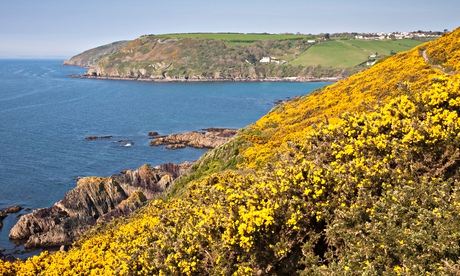
Off Hannafore, Looe island is silhouetted against a sparkling sea and surrounded by rocks as the tide recedes. Sunlight filters through trees on the island’s landward side. The summit was the site of a medieval chapel, and here, on the mainland, a hillside of dazzling gorse overlooks the coastal route where people saunter across turf starred with celandines, dandelions, violets and stitchworts.
Blackthorn foams with blossom, the willows bear fluffy catkins, and wrens and chiffchaffs sound from thickets of honeysuckle and bramble. Ahead, the cliffs of Hendersick rise above shadowy gullies, ribs of wave-eroded slate, and the turquoise water that slurps into sandy inlets. Bladder campion quivers in draughts of warm air and swaths of primroses thrive along the most sheltered parts of path.
From above the Hore stone, within earshot of oystercatchers below and skylarks inland, a vista of blue sea extends from Rame head in the east to Dodman point in the west. At Talland the church tower peeps above cliff-top fields. More visible from out at sea are the landmarks marking the western end of a measured nautical mile along this stretch of coast.
Past the graveyard, sunken lanes edged with ramsons and alexanders lead downhill towards Stinker cove and Rotterdam beach where pack ponies used to drag away seaweed and sand for fertiliser. The osier beds, nearby, were also valued – for their stems, which were woven into panniers and lobster pots.
Today, cars are parked in every available space, the two cafes are busy and the stony beach is thronged with visitors. The path to Polperro has been diverted around landslides up a steep hill between the onion-scent of three-cornered leeks and a field of sheep and lambs resting in the afternoon sun.
The last stretch is through south-facing cliff land where tiny plots or quillets were cultivated with early potatoes and vegetables. Now untended, the gateways, access steps and outgrown shelter hedges of privet and griselinia, are the only reminders of this former human endeavour.
Twitter: @GdnCountryDiary