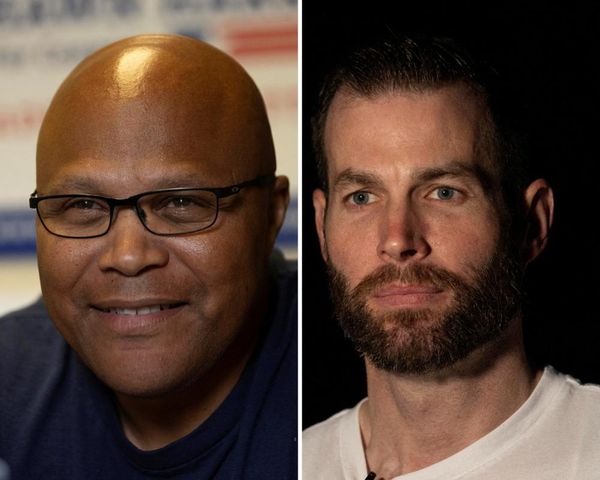
Oct. 27--One singer recently turned 89. The other 42.
One has commanded an international audience for well over half a century. The other made waves in Chicago a couple of years ago and has been generating national attention ever since.
But both vocalists -- New Yorker Tony Bennett and Chicagoan Paul Marinaro -- each in his own way proves that the art of male jazz singing still flourishes and deepens, albeit in the work of a select number of artists. Unconcerned with musical fashion and unwilling to compromise artistic standards, Bennett and Marinaro continue to champion classic American songwriting, each through an exceptional new recording.
Bennett last defied conventional wisdom on what sells records via "Cheek to Cheek," his duets album with Lady Gaga, which last year debuted at No. 1 on the Billboard 200 chart, sold 131,000 copies in its first week and made Bennett the oldest living artist to achieve a No. 1 record (he was a mere 88 when "Cheek to Cheek" came out). The album quickly went gold (500,000 units sold) and continues to sell. More important, though, Gaga met Bennett on his musical turf, the two singing from the Bennett songbook in a jazz-band setting.
In concert over the summer at the Ravinia Festival in Highland Park, Bennett and Gaga showed that their chemistry was not the work of studio engineers cleverly manipulating knobs and dials. Gaga sang quite well and treated Bennett as the master/teacher he is, and Bennett responded with some of his sharpest and most exuberant stage work of recent vintage. The elder singer did most of the heavy lifting in an intermissionless concert that featured more than 30 tunes, Bennett duetting nimbly with Gaga but also often singing alone, as she headed backstage to change costumes (often).
Bennett is back with "The Silver Lining: The Songs of Jerome Kern," a more introspective album than "Cheek to Cheek" and one that places a brighter spotlight on the nature of his instrument and his interpretations. Backed only by Bill Charlap's jazz trio on some tracks, by solo or duo piano on others, Bennett doesn't benefit from the energy and array of instrumental color that the "Cheek to Cheek" big band provided.
Instead, he's quite exposed, his vocal lines prominent in the foreground, the jazz accompaniment hovering in the distant background.
Yet this spare, lean musical context makes Bennett sound all the more impressive, if only because the majesty of his vocals and the ingenuity of his readings render everything else secondary. When the band plays an interlude, we wait impatiently for him to return to the fore. When the instrumentalists accompany him, we focus above all on the idiosyncrasies of his turns of phrase and the subtleties of his vocal inflections.
There's a yearning, longing quality to so much of Kern's songwriting, which plays handsomely to Bennett's strengths as a performer of ballads. Few male singers past or present dare to unfurl a melodic line as slowly or deliberately as Bennett, and fewer still can sustain interest at such unhurried tempos.
Even for those who have been listening to Bennett for decades, however, the tenderness and vulnerability he expresses on "The Way You Look Tonight," for instance, can catch you off guard. When he whispers a phrase or elides two lines or lingers on a particularly telling word, he's illuminating the subtext of Dorothy Fields' brilliant lyric. Even Bennett's pauses and silences tell us a great deal about what the song's protagonist is feeling.
Yet the octogenarian who sounds so worldly wise in "The Way You Look Tonight" somehow conveys a sense of innocence and wonder in "They Didn't Believe Me." The simplicity of his delivery befits the message of the song, in which the central character can hardly believe a particular someone has returned his affections and longs to shout it from the mountaintops. Remarkably, though, Bennett delivers most of this at quite a hush.
Even if Bennett weren't performing at such an exalted age, "The Silver Lining" would represent a profound vision of Kern's oeuvre. That Bennett can apply a lifetime of experience to this material, all the while showing a high degree of vocal control, makes this recording one for the ages.
Singer Marinaro, of course, represents the other end of the chronological spectrum, though he has been around long enough to know his way around the repertoire that Bennett, Frank Sinatra, Johnny Hartman, Billy Eckstine and other visionaries immortalized.
But Marinaro's approach in "One Night in Chicago" takes a very different tack than Bennett's release, the younger singer producing just the kind of energy and fire you would expect in a live album from a rising artist. If Bennett's "Silver Lining" casts the venerable vocalist in a pristine, tautly controlled studio environment, Marinaro's recording takes listeners into the freewheeling, rambunctious ambience of a late-night Chicago jazz club, complete with audience buzz, glasses clinking and the heady, anything-goes spirit of gritty jazz improvisation.
The choice is a clever one for Marinaro, whose exquisite debut recording of two years ago, "Without a Song," was a carefully engineered affair that on some tracks intertwined the sound of his voice with that of his father from historic acetate recordings. This time around, Marinaro breaks free of studio and editing constraints, cutting loose in up-tempo swing pieces such as "I'm Just a Lucky So and So" and "Devil May Care," Marinaro's luxuriant baritone big and brawny in climactic passages.
Yet Marinaro also clearly has learned a great deal about ballad singing from Bennett, Sinatra and others whose traditions he builds upon. His insinuating tone and skill at turning a pitch ever-so-slightly sharp at key moments in "The Moon Was Yellow" says a great deal about the caliber of his craft. If he's treading on Sinatra's territory in "I've Got the World on a String," his relaxed swing tempo and slowly gathering momentum affirms that he's very much his own man. Through it all, Marinaro's voice remains an uncommonly supple and compelling instrument.
If anyone wonders whether Bennett's legacy will live on, it's obvious that it already does, in every track of Marinaro's "One Night in Chicago."
Sinatra tribute
What's shaping up as the city's biggest celebration of this year's Frank Sinatra centennial will feature Paul Marinaro, Johnny Rodgers, Joan Curto, Beckie Menzie, Tom Michael and Shelley MacArthur -- with Rich Daniels leading the City Lights Orchestra -- for a dinner, concert and dance starting at 6 p.m. Nov. 28 at the Palmer House Hilton, 17 E. Monroe St.; $125-$150; for tickets, visit www.celebrating100yearsofsinatra.brownpapertickets.com.
"Portraits in Jazz": Howard Reich's e-book collects his exclusive interviews with Frank Sinatra, Tony Bennett, Lena Horne, Ella Fitzgerald and others, as well as profiles of early masters such as Louis Armstrong, Duke Ellington and Billie Holiday. Get "Portraits in Jazz" at chicagotribune.com/ebooks.
hreich@tribpub.com