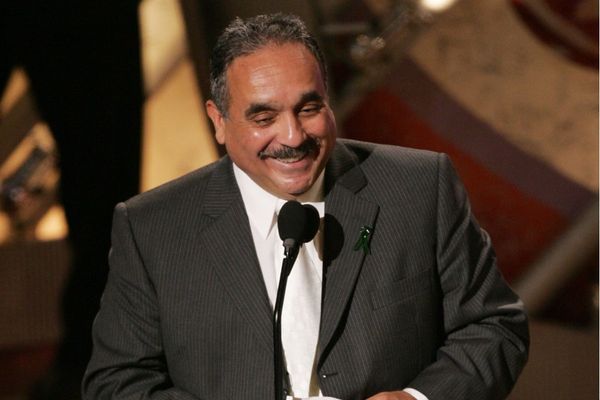
April 02--"I am not trying to write weird, prickly little plays and I am not trying to write boffo box office," the playwright Will Eno observed over lunch recently, "but if you keep it lean then there is room for people to fill in things."
Eno has been accused of many things by his bemused detractors -- it's probably fair to call him a writer who divides folks -- but leaving extraneous dramaturgical fat is not one of them. After I'd filed my review of Eno's play "Title and Deed" the other day, a smart editor requested more information to help readers. I'd said that the play, now at the Lookingglass Theatre and starring Michael Patrick Thornton, was composed of a single monologue by an unknown person, seemingly not from earth. The editor asked for the reason for the monologue -- you know, the usual whos, whats, whens and whys. Good questions, I acknowledged. Alas, the play does not say.
By not saying, of course, "Title and Deed" says so much about life and death, not unlike Eno's other plays, such as "Middletown" (seen at the Steppenwolf Theatre), "The Realistic Joneses" on Broadway and "Thom Pain (based on nothing)," which was the play, another rambling, existentially oriented monologue that first propelled Eno to what passes for fame for a New York playwright, around a decade ago, when Eno was about 40 years old.
As we chatted about the different reactions people have to his work (some argue he writes about nothing, in circles), Eno said that he'd been trolling one of those amateur-review websites and found that people tended to give his work either five stars or one. "I was talking to Tracy Letts about this," he said. (Eno and Letts became friends after Letts appeared alongside Michael C. Hall in "Realistic Joneses"). "I said I'd love to write a play that got 21/2 stars instead of all those ones and fives."
"'No you wouldn't,' Tracy said. And he was right."
So what exactly was he writing about in "Title and Deed"? "I truly never try to write a crazy thing that no one can understand," Eno said, smiling sweetly. "I just had this crazy idea that we all walk around like mortality is our big secret."
Think about that and you see his point. Eno is full of such observations -- at one point, apropos of marriage and other long-term relationships, he observed: "We start dealing with less and less of each other." At another moment, over a sandwich, he said: "The feeling of being a person is always the feeling of being your person."
He does seem wildly interested in his own career development and certainly not in writing to anyone's order. "I am blessed," he said, "to be just a little bit out of it." But if you've interviewed a lot of playwrights, most of whom say they write with no one particular in mind, you can't help but be struck by Eno's constant reference to what he wants for his audiences. "In my heart of hearts," he said at one point, "I'm hoping everyone can find things of real usable feeling."
I suggested to Eno, who grew up in Massachusetts, that Chicago was, when it came to his work, most of which has premiered on the East Coast, a bit late to the party. "Well," he said, "I am flattered to think there is a party to which someone could be late."
In August, Eno lost his father and watched the birth of his first child, a daughter, in a period of less than 24 hours. "They were just doing what they were doing," he said of the timing, chatting about these profound comings and goings, common to us all. I wondered what he thought after the tedious comparisons people -- including me -- keep making between his work and that of Samuel Beckett. "I embrace the Beckettian," he said, grinning.
But in many ways, Eno is closer to Anton Chekhov than the absurdists. Fundamentally, his plays are about endurance. If you head out to "Title and Deed," and you should, then you'll intuit that you don't need a whole lot of information to recognize someone, someone not unlike yourself, dealing with stuff, and then carrying on.
cjones5@tribpub.com