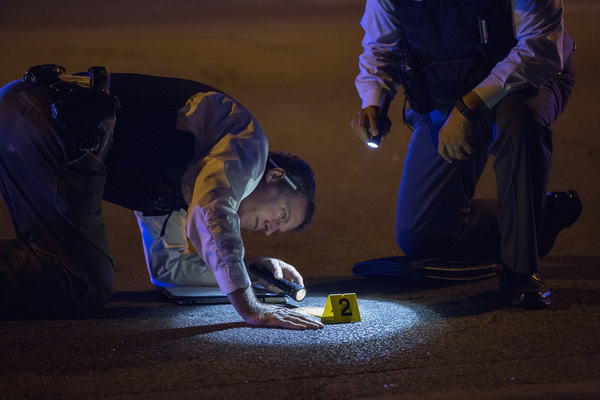
CHICAGO _ After the deadliest year in two decades, the first half of 2017 seemed just as grim in Chicago as homicides remained devastatingly high, raising fears that the "spike" in violence had become a new normal for the city.
Then in the second half of the year, homicides plummeted, particularly in two of the city's most violence-plagued neighborhoods, contributing to about a 15 percent overall drop in killings over last year.
That decrease has raised new hopes that Chicago could make progress in shedding its national reputation for gun violence, an image fueled by both President Donald Trump's frequent mentions and by the distressing loss on Chicago's streets.
Why the second-half decrease?
In an interview with the Chicago Tribune, police Superintendent Eddie Johnson cited new technology and tactics in those crime-plagued neighborhoods, and suggested that police relations with the community were improving. Anti-police sentiments were inflamed in 2016 after the release of a video showing a white police officer fatally shoot black teenager Laquan McDonald, and some accused police of going "fetal."
Johnson, however, has said he believed the video and its publicity emboldened criminals to break the law, a brazenness he now believes may have waned.
"I think that they used that to their advantage because if you think they don't pay attention to that type of thing, you're fooling yourself because they do," he said. "I think the boldness of them is starting to tick down a bit, but it's still there."
If officers were truly going "fetal" in 2016, there's no statistical indication that the police pullback has changed this year. Two key measures of police aggressiveness _ arrests and street stops _ are around the same level this year as last, and yet homicides dropped. The Police Department notes, however, that while overall arrests are flat, arrests for gun crimes have increased 28 percent.
Experts and some neighborhood activists warn, however, that tallies in 2017 aren't reason to cheer just yet. Though violence has dropped in recent months, Chicago will still end 2017 with historically high totals. Indeed, if last year was excluded, this year's homicide toll would be the highest in Chicago since 2002.
In 2016, Chicago logged more than 700 homicides and over 4,000 shooting victims. This year's totals will be below both of those tallies. Through Tuesday, 644 people were slain in Chicago, compared with 754 during the same period last year, a drop of about 15 percent, according to Chicago police statistics. That represents the largest single-year drop in homicides since 2004.
The Police Department statistics do not include about 20 slayings on area expressways, police-involved shootings or other homicides in which a person was killed in self-defense or their deaths were still being investigated.
The number of people wounded and killed by gunfire dropped by about 18 percent to 3,543 from 4,327, according to the Chicago Tribune's statistics through Wednesday. That's still a rate of about 10 shootings a day.
Johnson said he's looking at the decrease as one small step toward a safer city.
"The way violence goes ... the reductions have to be incremental," Johnson said. "But the fact that we've got it over 100 (homicides) in terms of reduction is really room for encouragement and positive thinking going into 2018."
Crime experts were not surprised by the drop in violence this year, saying 2016 may have been an anomaly.
"It's good news," said Richard Rosenfeld, a criminology professor at the University of Missouri at St. Louis. "Although the numbers still remain, I would say, intolerably high."
Others are even less enthusiastic about the drop. The Rev. Ira Acree, a West Side pastor, pointed to a decline in the city's African-American population, including the Austin community where his church is located, as a sign of how many people are fed up with the city's violence. He pointed to losses in some South and West Side neighborhoods, where crime is still rampant, job opportunities are scarce and schools have closed.
Public safety issues and economic desperation are two of the main reasons African-Americans have moved out of communities like Austin and, in some cases, Chicago altogether, he said.
"The bottom line is if you can manage to dodge bullets, you've still got to eat, you've still got to have a way to feed your family and put a roof over your head," said Acree, pastor of the Greater St. John Bible Church. "Not only can the parents not eat properly or sustain themselves in a decent manner, but the future for the children is so bleak and dark because whenever you close schools, you're obliterating the potential and the future of a generation."
Acree also said that despite the reduction in homicides, the sheer number of people killed in Chicago in 2017 "is still a travesty."
"People are running out of the city like wildfire, and we're celebrating that we don't have 700 people who got killed, we've got 600," he said. "Give me a break."