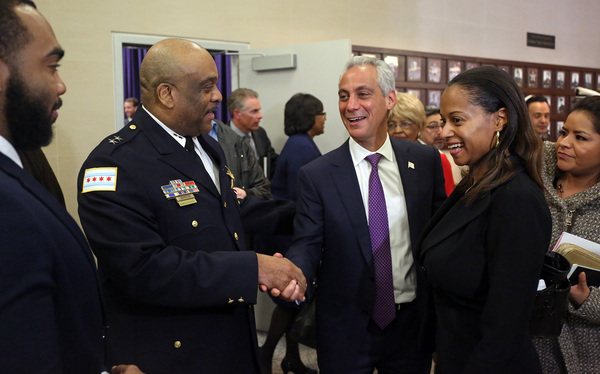
CHICAGO _ Chicago Mayor Rahm Emanuel won approval Wednesday of the first piece of his plan to revamp the city's system of investigating police abuse complaints, but not before protesters sent a message that the issue is far from over.
A couple dozen protesters rose and shouted "hold the vote" to signify their call for more community input into the final plan. Police led them from City Council chambers as Emanuel pounded the gavel and Public Safety Committee Chairman Ald. Ariel Reboyras, 30th, tried to yell his opening statements on the ordinance to be heard over the fracas.
After the delay, aldermen talked about the pros and cons of Emanuel's ordinance before approving the plan 39-8. The City Council handed the mayor a major victory as he tries to restore trust in the Police Department amid a sharp rise this year in shootings and murders.
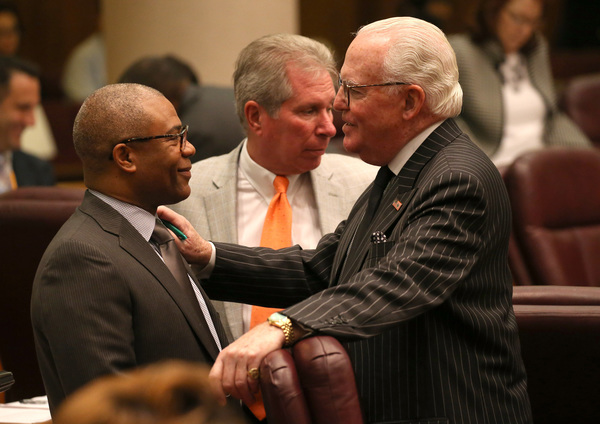
Ald. Walter Burnett Jr., 27th, backed Emanuel's plan, saying "we are getting things done here," before stressing the need to address the problem.
"We live with these things in a whole bunch of different ways in our community," said Burnett, whose ward includes a swath of the West Side. "We live with it every day. Our whole family has been brutalized by police officers and put in jail unjustly ... We've been through this stuff. We live with it."
Voting "no" were Aldermen Leslie Hairston, 5th; Marty Quinn, 13th; Matt O'Shea, 19th; Mike Zalewski, 23rd; Roberto Maldonado, 26th; Chris Taliaferro, 29th; Nicholas Sposato, 38th; Anthony Napolitano, 41st. Several of the aldermen voting against the police accountability plan have numerous cops living in their wards. The police union has spoken out against Emanuel's plan.
Under the plan, the much-maligned Independent Police Review Authority will be replaced by the Civilian Office of Police Accountability, or COPA. City Hall also will create a new post of deputy inspector general to monitor both the Police Department and new oversight agency.
But a new Community Safety Oversight Board won't come until sometime next year. The panel will play a key role in picking the new police oversight agency's chief and determine just how independent the new system will be from the mayor's office.
"This is not the end, this is not a victory," said Ald. John Arena, 45th. "This is only a first step to try to correct for sins of the past and make sure those sins are not repeated in the future."
Emanuel said he's delaying creation of the oversight board at the request of community groups that want more input on how that board is structured. The mayor repeatedly has said he needs to move forward with the rest of the plan because the staff of the current police review authority is dwindling with workers know the agency is being disbanded, and that makes it tough to keep up with the caseload.
The new agency will have greater power to investigate alleged police abuse and the use of deadly force. It also will be able to recommend changes to police policy and procedure. The new watchdog would audit the new police accountability system and identify patterns and practices that violate constitutional rights.
Emanuel initially planned to introduce the plan in June, but the effort was delayed several times as community groups demanded more input. Several more hearings were held, and Emanuel agreed to a series of changes.
Key among those changes was giving the new police investigations agency and the new watchdog a guaranteed minimum funding level so the mayor or council cannot gut its power by reducing its budget.
Emanuel also agreed to allow the new COPA chief to hire from a pool of pre-selected legal firms to enforce subpoenas. Critics said leaving that sole authority to the Law Department would create a conflict of interest because the Law Department also represents cops sued in cases that COPA would be investigating.
The police investigations agency's expanded powers include the authority to look into allegations of illegal search and seizure and denying suspects access to an attorney _ duties now handled by internal affairs at the Police Department. The ordinance also places restrictions on a mediation process that a Chicago Tribune investigation determined has often resulted in light punishment for officers.
At least for now, however, significant power over the new system will remain in the mayor's hands. The first chief will be Sharon Fairley, who the mayor appointed as chief of the current oversight agency. And the new police watchdog will be chosen by the city inspector general, who is appointed by the mayor.
The attempt to revamp the system comes as the U.S. Department of Justice conducts a civil rights probe into the Police Department. The DOJ may demand further changes to the accountability system.
"This was our chance to get it right the first time, Chicago, before the U.S. Department of Justice tells us to start over again," said Ald. Leslie Hairston, 5th, who voted against the plan. "Sadly, Chicago ain't ready for reform. We prove it over and over again."
The DOJ probe came after the court-ordered release last November of a police dash-cam video showing the fatal shooting by a police officer of teen Laquan McDonald. The video resulted in protests and calls for the mayor's resignation. That led to sagging community confidence in police. This year, shootings and murders have risen to levels not seen in 20 years.
Even with Wednesday's strong win in the City Council, Emanuel will likely find himself immediately challenged by critics on the deficiencies of his plan.
Before a council joint committee took a preliminary vote on the package Tuesday, some African-American leaders already were blasting it as insufficient and calling on the mayor to consider proposals that give power to an elected civilian police oversight board.
Brenda Sheriff, vice president of the Southside branch of the NAACP, questioned Emanuel's sincerity.
"No matter how many tears Mayor Rahm Emanuel sheds at press conferences, if he is unwilling to promote these substantive changes we demand, the world will know that he is only feigning compassion for communities of color that continue to be victimized by those sworn to serve and protect them," Sheriff said.
Hours into Tuesday's lengthy committee meeting on the mayor's plan, Lamon Reccord, a young African-American activist who has gained prominence during anti-police protests in the months since the McDonald video was released, rose to his feet in council chambers. Reccord shouted his displeasure with what he described as a too-familiar process to address a deep-seated problem.
"You've been saying the same s_ for years, while we're getting killed," Reccord yelled repeatedly at aldermen and Emanuel administration officials as police led him from the meeting.