In April 1986, an explosion at the Chernobyl nuclear power plant in the former Soviet Union, now Ukraine, caused a terrible tragedy. The accident generated widespread concern in Japan during that year's Golden Week holiday period.
Toichi Sakata, who was in charge of nuclear energy policy at the Science and Technology Agency (now the Education, Culture, Sports, Science and Technology Ministry), was in the United States at the time, where he scrambled to collect information on the Chernobyl accident.
Twenty-five years later, Japan suffered its own nuclear disaster, when an accident occurred at the Fukushima No. 1 nuclear power plant. Soon after, Sakata was appointed ambassador to Ukraine, where he promoted cooperation to help clear up the accident.
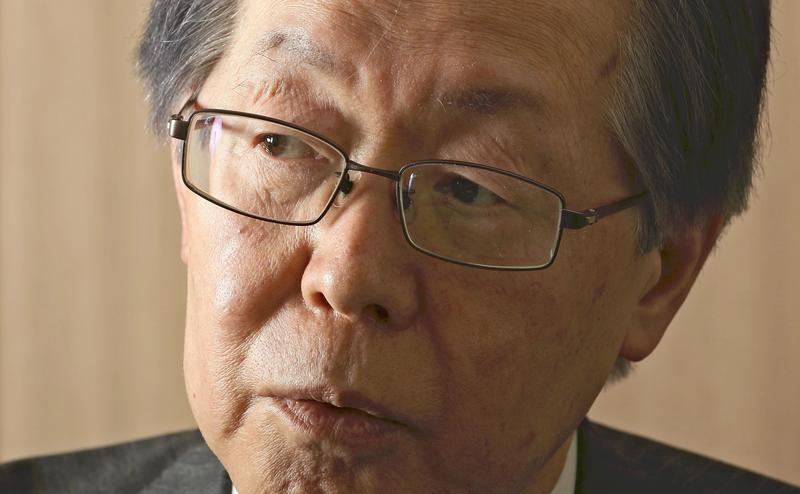
In this article, Sakata offered his thoughts and insights on the two disasters and nuclear energy.
The age of the Iron Curtain
The first report came from Sweden. It had detected radiation drifting from the east and wondered if something -- perhaps a nuclear accident -- had happened in the Soviet Union. Bewilderment prevailed around the world.
At the time, I was first secretary at the Japanese Embassy in Washington and in charge of nuclear energy matters.
[On April 26, 1986, problems in operating a reactor at the Chernobyl nuclear power plant in the Soviet Union led to an explosion and a fire. Massive amounts of radioactive material were dispersed around the world, and even reached Japan.]
Mikhail Gorbachev was the Soviet leader. Although Gorbachev had been pushing his glasnost policy of openness, this was still the time of the Iron Curtain. Hardly any information about the accident was coming from the Soviet Union.
Japan and Western nations had no recourse but to rely on the United States for information. On April 28, I contacted the U.S. Nuclear Regulatory Commission. However, the NRC still did not know the details of what had happened. I sent a diplomatic cable explaining the situation.
April 29 was Emperor Showa's birthday, so a party was held at the Japanese ambassador's official residence. Soon after the party started, a senior official from the embassy approached me and said, "The Tokyo summit meeting will be held soon. Prime Minister [Yasuhiro] Nakasone is extremely concerned about this nuclear accident. We need you to collect as much information as you can about it."
I spent the next week or so, until the summit meeting started on May 4, doing nothing but gathering information about the Chernobyl accident.
U.S. government bodies involved in nuclear energy matters include the NRC, the State Department, the Energy Department, the Environmental Protection Agency and the Arms Control and Disarmament Agency. I contacted them daily to collect information.
On around May 1, the State Department told me it would hold an explanatory briefing for Western diplomats. I went to the department and was guided to an underground operations center. This place leaps into action when a crisis occurs. I realized this was an extraordinary situation.
Seven Americans explained in turn what had happened. I was surprised that the first three speakers were all from the U.S. Central Intelligence Agency. The first described the conditions at the accident site, the second detailed the accident's impact on the Soviet Union's energy supply, and the third explained the impact on Soviet agricultural production. They had prepared all this in less than one week after the accident. It was an impressive display of the United States' ability to quickly collect and analyze information.
I returned to the embassy and began writing a diplomatic cable. These messages include the name, title and organization of an information source.
The CIA representatives provided their names but not their titles. When I telephoned the CIA to ask for these details, I was told that the agency could not answer my questions.
So, I thought these details might be listed in the directory of U.S. government officials. The bulky directory contained the names of officials serving as section chief and similar-level positions or higher. However, the CIA section lists only about the top 10 officials, such as the director. This brought home the fact that the agency is a special organization.
At the Tokyo summit meeting, Japan proposed that information should be promptly provided and assistance extended if a nuclear accident occurs. These proposals were announced in a statement at the meeting, and would later morph into the Convention on Assistance in the Case of a Nuclear Accident or Radiological Emergency and the Convention on Early Notification of a Nuclear Accident.
Dispatched to Ukraine
When I first heard about the nuclear accident, I wondered why such a thing could have happened. Every nation using nuclear power conducts screenings, carefully manages the equipment and checks the facilities. The common view among people involved in the nuclear energy industry was that an accident could not happen. I also believed such a major accident would never occur in Japan.
However, in March 2011 -- 25 years after the Chernobyl disaster -- an accident occurred at the Fukushima No. 1 nuclear power plant. Both Chernobyl and Fukushima were both rated Level 7 major accidents -- the highest on the international scale for nuclear events. The accident stunned me.
In September 2011, about six months after the Fukushima nuclear accident, I was installed as Japan's ambassador to Ukraine. At first, I was a little hesitant. However, many tasks needed to be thoroughly completed in Fukushima, including decontamination work, decommissioning the reactors and enabling residents to return to their homes. I thought the experience of the Ukrainian government in its ongoing handling of Chernobyl issues could be helpful for Japan's efforts to deal with the Fukushima accident.
I also had a responsibility, as someone who had advocated the nation's nuclear energy policy. I felt I must do whatever I could.
I went to Chernobyl soon after taking up my post in Ukraine. From an observation room about 300 meters away, I saw reactor No. 4, which had caused the accident. It was encased by a concrete sarcophagus to prevent more radiation from leaking out.
The radiation level measured at the observation room was 70 times higher than that recorded at the Japanese ambassador's official residence in the capital, Kiev. Even after 25 years, the figure remained this high. I was astounded. The sarcophagus also is deteriorating and has been covered by a large steel shelter.
I realized that cleaning up such an accident is a battle that will take a mind-boggling number of years. Can mankind and society coexist and live together with nuclear power? I had to ask myself this question.
Japan and Ukraine have both experienced terrible nuclear accidents. What path should they take in the years ahead? I thought deeply about this.
A dream technology
When I finished graduate school in the early 1970s, nuclear energy was on the rise. After going through the oil shock, Japan was developing nuclear power to try to bring stability to the economy and society.
Achieving this involved a long to-do list, including the development of a new type of nuclear reactor. A particularly important project was perfecting a nuclear fuel cycle that would reuse plutonium created through the burning of uranium. This would be an efficient use of resources. The government and industry circles tackled this job with gusto.
[The government encouragd the development of facilities, including the Monju fast-breeder reactor and the Mutsu nuclear power ship. Plutonium used for the nuclear fuel cycle could also become a material used in nuclear weapons. The United States allowed Japan's peaceful use of plutonium, and in 1988 the Japan-U.S. nuclear cooperation agreement came into effect. However, none of these technological developments proceeded smoothly.]
For various reasons, the initial objectives could not be achieved. I think there was a degree of justification and logic behind policy formation on each occasion. But there were gaps between the policies and what could be done on the ground. The actual facilities did not proceed as the policies envisioned. It could be said that the policymakers did not properly look at these sites, or give enough consideration to them.
This is especially so when discussing plutonium.
Because the nuclear project has not progressed as planned, Japan's stockpile of plutonium continues to grow. That such a situation could happen was never even considered.
During my time at the Japanese Embassy in the United States, I was involved in negotiations for the Japan-U.S. nuclear cooperation pact. We managed to overcome strident opposition in the U.S. Congress and ink a deal valid for 30 years. This term will expire on July 16. Although the agreement will be renewed automatically, Japan has a responsibility to properly fulfill its practical operations and ensure they fit the spirit of the agreement.
Some nations have criticized Japan over its nuclear program and suggest the nation is trying to acquire nuclear weapons. The government should confidently say that will never happen. This is because Japan undergoes inspections by international organizations and stays transparent about how much plutonium it keeps.
Nuclear power is an energy created by technology.
The hurdles to getting people's support for nuclear power have been raised significantly due to the Chernobyl and Fukushima accidents. I think the government must accept that strong public sentiment exists, and very carefully make efforts to safely proceed with the nuclear energy policy.
(From The Yomiuri Shimbun, May 4, 2018)
Toichi Sakata
Sakata is president of the Japan Space Forum, a general incorporated foundation. After completing his master's degree at the University of Tokyo's School of Engineering, he joined the Science and Technology Agency (now the Education, Culture, Sports, Science and Technology Ministry) in 1974. Sakata has headed sections involved with nuclear fuel, nuclear policy and research and development. He has been in his current post since 2015. He is 69.
Read more from The Japan News at https://japannews.yomiuri.co.jp/