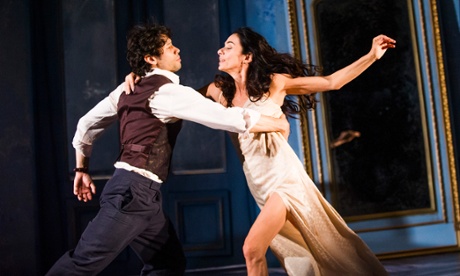
Alessandra Ferri was 52 when she returned to the ballet stage last season, as the luminous, eloquent star of Wayne McGregor’s Woolf Works. However the production that had initially lured the former ballerina out of retirement was Chéri, a dance-theatre work by Martha Clarke, based on the two linked novellas by Colette – Chéri (1920) and La Fin de Chéri (1926). In this London revival, Ferri proves herself a perfect match for Léa, Colette’s beautiful but ageing heroine, in love with a much younger man.
Ferri’s dance technique is preternaturally youthful still, but she can morph from skittish ardour to haggard-looking defeat in a convincing second. She’s also superbly partnered by Herman Cornejo as a narcissistic, passionate and treacherous Chéri: a pretty boy who by the end of the work has become a shell-shocked ghost, traumatised by his experience in the great war.
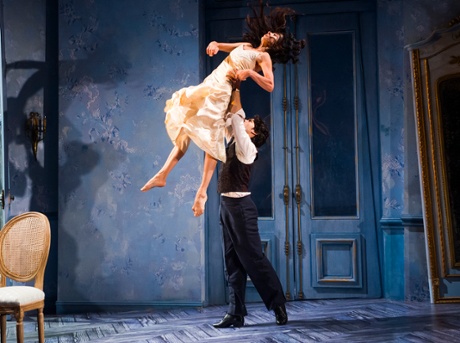
Clarke’s production is rich and redolent of period atmosphere. The Linbury stage becomes a Parisian apartment, its walls decorated with mirrors into which the lovers frequently gaze, Chéri with adoring self-love, Léa with apprehension. In one corner, pianist Sarah Rothenberg plays music by Ravel, Debussy and others – a sound score of shimmering sensuality and dark emotion that deftly accompanies the dance and text with which the story is told.
Narrating the work is Francesca Annis, who plays Charlotte – Léa’s “best” friend and Chéri’s mother. Aside from an overly whimsical French accent, Annis is a splendidly arch and bitchy commentator, her pragmatism a brutal complement to the lovers’ heady affair and its inexorable destruction. Clarke herself finds vivid choreographic detail with which to portray that destruction, a trance of slow, giddy revolving lifts that moves into a harsher, angstier vocabulary as Léa resigns herself to the fact that Chéri must marry a suitable bride. One image, in which she’s hoisted high against the bedroom wall, resonates with a harrowing vulnerability and need.
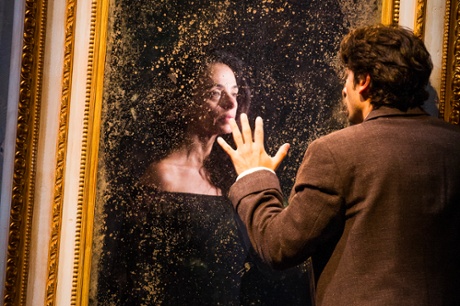
Yet however fine the detail and committed the performers, Clarke’s choreographic range is fundamentally limited, and the work’s creeping sense of repetition is underlined by the weakness of its final scene. Not only does Clarke fail to give Cornejo a convincingly traumatised vocabulary here, she misses a trick in having him re-encounter the much older Léa as a reflection in the mirror rather than face to face. What could have been the evening’s most highly charged moment unravels, instead, into unsatisfying ambiguity.
- At the Linbury Studio, London, until 4 October. Box office: 020-7304 4000.