CHENNAI: More than 76% of travellers in metro stations always wear masks and up to 88% of them maintain social distance against less than 5% of people in regular railway stations, market places or places of worship following such behaviour, a cross-section city survey done by the Government Omandurar Medical College and Hospital has showed.
But what has shocked public health officials is that despite elaborate standard operating procedures released before the restrictions were relaxed, frequently touched surfaces in more than 70% of public places are not disinfected, nearly half of them do not have facilities of hand wash/sanitization and about 98% do not have a place to safely dispose used masks and other such biomedical waste. “The survey gives us a glimpse of how people behave in different places and where there are slips,” said Omandurar Medical College and Hospital dean Dr R Jayanthi. “It tells how much more should be done to stop new outbreaks.”
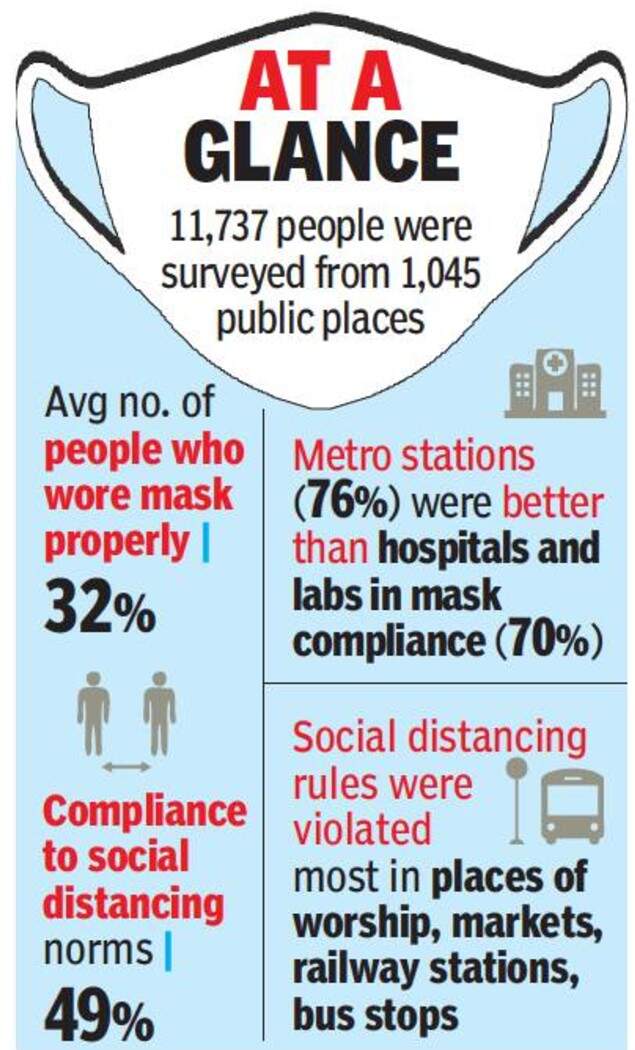
The yet-to-be published survey was conducted between July 23 and 31 among 11,737 people in 1,045 public places including malls, hotels, markets, places of worship, bus stops and railway stations. Preliminary analysis showed that an average of 38% of people wear masks and social distancing norms are followed in less than 50% of public places. “There are huge differences in people’s behaviour at different places,” she said.
Adherence to masks in metro rail stations was better than at hospitals and diagnostic labs where it was 68%-70%. While social distancing rules hovered between 67% and 88% in shopping malls, star hotels and metro stations, in places of worship and marketplaces and railway stations it was 5% to 23%. The college asked a 22-member team including medical interns and data entry operators led by Dr Arun Murugan, head of department of community medicine, to carry out a survey so it can be used as evidence for better health policies.
Organisations including WHO, CDC and ICMR have repeatedly said that masks and social distancing should be used as active prevention measures along with vaccinations. “Even people who have taken two doses of the vaccine must wear masks to prevent infection. The vaccine may stop them from getting hospitalised, but they can still get infected and transmit the infection,” said health secretary J Radhakrishnan. “One of the most recent pieces of evidence is what we saw in Kilpauk where 23 people were infected after a religious festival,” he said.