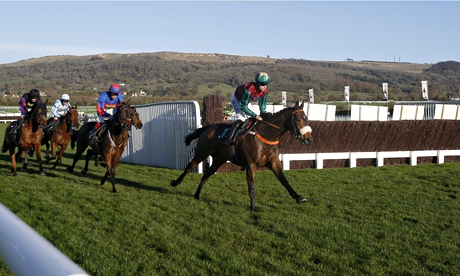
The £160,000 Paddy Power Gold Cup at Cheltenham on Saturday afternoon could be run with six of the 16 fences omitted, including all four of the jumps in the home straight, for safety reasons due to low sun obscuring the view of both horses and jockeys. The course will also consider running cards with only two steeplechases between November and January after one of the main events at the track on Fridaywas also affected by low sun, despite being deliberately scheduled with the aim of avoiding the problem.
Simon Claisse, Cheltenham’s director of racing, said on Friday evening that he had “explored the options” for moving Saturday’s big race with the British Horseracing Authority but had been told it was impossible to run a race before the published start time. As a result punters and racegoers will not be sure how many fences will be jumped in the Paddy Power, one of the most competitive and eagerly awaited handicap chases of the season, until shortly before the off.
The omission of a number of obstacles would have a significant impact on the feature event and both Cheltenham and the BHA will hope they are not forced to deal with adverse publicity surrounding the big jumps race of the weekend following on from Wetherby’s Charlie Hall being run over the wrong distance a fortnight ago and then Wincanton’s Badger Ales Trophy being won by a horse that was not qualified to run.
“Having looked at the rules, they [the BHA] said that a race cannot be run before its advertised time,” Claisse said. “Normally when these things occur we are looking to run races later than their advertised times but running it later is not going to help.
“The forecast is for a mixture of sunshine and cloud but I’ve been talking to the jockeys tonight and their view is that, for whatever reason, even at 1.50 this afternoon the sun was very bright. I’m sure most people have experienced it when driving down the road in winter sun that sometimes it seems brighter than on other occasions. Atmospheric conditions can have a bearing.
“Safety has to be our number one priority. We must do what’s right on the day for the safety of the participants. Keeping our fingers crossed is not the way that we want to run our business but until we can establish some new parameters for when we run our races, that’s all we can do.”
The three chases on Friday’s card were deliberately timed to be run as the first three races of the day at 1.15, 1.50 and 2.25 to avoid the issue of low sun obscuring the view of both jockeys and horses as they approached fences in the home straight. However, several riders expressed concern about bright sunshine shortly before the start of the novice chase at 2.25, giving the course no option but to omit six jumps including both fences in the home straight. After a run-in of about half a mile from the last jump, the race was won by Philip Hobbs’s Champagne West from his stablemate Colour Squadron, the 7-4 favourite.
“It is entirely the jockeys’ call,” Claisse said. “The starter comes through to the stipendiary steward and says that the jockeys aren’t happy, and then the stipe asks me to take the obstacles out. That’s it, there’s no deliberation.
“We’ve not experienced a sun issue at 2.25 on a November Open meeting before, so it looks as if we may need to revise the period of time when we can’t run chases after the clocks have gone back. At the moment it is from 2.40 through to 4.00, which is why on a card like today’s we had three chases straight up. We’ve done that for years now to try to avoid this problem.”
Even the threat of sudden bright sunshine during Saturday’s race could be enough to lead to fences which might be affected being taken out of the contest. Buywise, a horse with obvious talent but a tendency towards jumping errors in the latter stages of a race, is one contender whose chance might improve if some fences are omitted.
“The Paddy Power is due off at 2.30 and, if we do what the jockeys requested today, it’s six jumps and four fences [which will be omitted] out of the 16,” Claisse said. “Maybe [in future] it will be only two chases a day from November through to the end of January, that’s the only way of making sure this is not going to happen when there are no clouds. To some extent we’re determined by Channel 4’s airtime in terms of getting four [races] away on television. Sponsors support prize money and a lot of things have to be taken into consideration.”
Hobbs suggested after Friday’s novice chase that Colour Squadron might have been disadvantaged by the omission of six fences while also pointing out that safety considerations meant there was no alternative on the day.
“If they’d had more fences it would have helped,” Hobbs said, “but it was a very long run-in, which was probably against him, and he’s gone left a bit on the run-in as well. In this day and age health and safety comes first. If the jockeys say they can’t see, that’s what has to be done. At one stage [in the past], of course, they wouldn’t have been taken out at all but we’re in a different era now.
“We still get a race with a result. You could argue the result might change if the fences were there, but I don’t think it’s a big deal. It’s just unfortunate circumstances.”
Richard Johnson, Champagne West’s rider, said that the decision to omit fences had been an easy one to take. “When we turned in, I couldn’t see much at all,” Johnson said, “and at the end of the day, safety is important as well.
“It’s just not worth the risk. It’s easy when you are in the stands thinking it doesn’t look bad, but you literally can’t really see the orange boards [on the fences] or anything, because there is a massive shadow on them.”
Colour Squadron remains one of the highest-rated maiden chasers in Britain after his latest defeat, but Hobbs also has a horse with a big future in Champagne West, who is now expected to step up to three miles and is top-priced at 20-1 for the RSA Chase at the Festival in March.
“It was a promising performance at two-and-a-half miles, but it bodes even better for three miles, which is where I think his future lies,” Hobbs said. “He’s beginning to grow up and relax more and I think he’ll be a good horse in time. We didn’t learn too much about his jumping because the fences were taken out, but he jumps well enough.”
Parlour Games, who is by Monsun out of the Group One and Classic-winning mare Petrushka, showed an impressive turn of foot on rain-softened ground to win the Grade Two Neptune Investment Management Novice Hurdle, while Hobbs completed a 105-1 treble on the day when Balthazar King took the Glenfarclas Cross-Country Chase for the second year running at odds of 4-7.
“He must be the best-bred horse I’ve ever ridden,” Barry Geraghty, who rode Parlour Games for trainer John Ferguson, said. “Us porky lads don’t get those opportunities. You could say that it was a bit of a sprint, but he did it really well.”
Balthazar King would be an obvious favourite for to record a third successive victory in the Festival’s race over the same obstacles next spring, but the 10-year-old is likely to miss the big meeting in March to run instead in the Grand National, in which he finished runner-up last season.
“He is phenomenal, to keep going for so long and so well,” Hobbs said. “He’s now won eight races here and I have just been told that he is one off the record for the number of races won at Cheltenham.
“I think going straight to the National is the plan for two reasons. Although he is very genuine, he is definitely better fresh, and secondly, he doesn’t want soft ground. The two things together mean it is better to wait.”