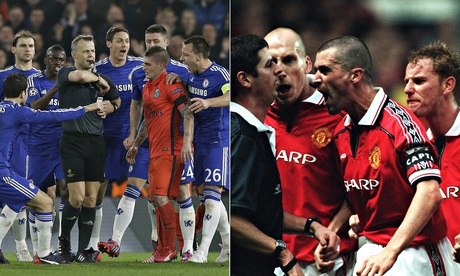
If Chelsea players had converged on their opponents as quickly as they converged on the referee on Wednesday evening, then they might not have been outplayed so convincingly by Paris Saint-Germain. It was one of the defining images of Chelsea’s defeat, a show of force that was also in some ways an admission of impotence: their entire team, except Thibaut Courtois, surrounding Bjorn Kuipers and seemingly trying to convince the official to send off Zlatan Ibrahimovic for maiming Oscar so badly that the Brazilian was back skittering ineffectively around the pitch within seconds. Chelsea’s ploy seemed to work on that occasion but in general their approach did neither them nor the sport any favours.
Of course, lobbying referees to apply or overturn decisions is nothing new and Chelsea are far from the only culprits – PSG were no angels either on Wednesday night, and just two days previously Manchester United’s Ángel Di María was sent off for tugging the shirt of the referee Michael Oliver as he protested against being booked. The image of Roy Keane’s vein threatening to explode out of his temples as he and his Manchester United team-mates rained abuse down on Andy D’Urso hangs high in football’s Hall of Infamy, alongside Argentina taking turns to bump and shove the referee Edgardo Codesal in the 1990 World Cup final. The list goes on, and there will be regular new additions until the game’s governors do something about it.
There are two things the authorities could do. The first would be to actively encourage referees to emulate Oliver and flash yellow and red cards for dissent. They could take this further by giving referees the power to move free-kicks forward 10 yards if players do not accept their rulings – that scheme seemed set to be introduced in 2005 after a successful trial on these shores, but Fifa ultimately decided against it on the grounds that, it said, the concept was alien to non-rugby-playing countries so could not be enforced.
The introduction of such measures would, however, be mere tinkering: the most important and effective way of defusing decisions would be to demonstrate that all reasonable steps are being taken to ensure that those decisions are correct. Which brings us back, as ever, to the suspicious dereliction of duty that is the continued refusal to use video replays. It is almost as if the powers that be do not mind allowing such scope for human error, such murkiness around match-altering verdicts. That cannot be healthy. And, indeed, it has the opposite effect to the one supposedly sought, as it undermines match officials. Referees themselves tacitly acknowledge this by being so reluctant to punish dissent, knowing that the protesters may very well be right.
For now, as football carries on regardless, it makes sense for managers and players to try to influence referees – to a degree. It often works. And if the other team are doing it, chances are your team need to put forward their case too. But a team can overdo it, not just in terms of the image of the sport, which, as John Terry has had the honesty to admit, is not foremost in players’ minds when they are competing for glory, but also in terms of their self-interest. At times this season Chelsea have looked as if their minds are so cluttered with conspiracy theories and scams that they have failed to channel their more important creativity and energy (in tactical terms, José Mourinho’s persistent negativity adds to the confusion).
Whether it is Branislav Ivanovic trying to grab the red card out of the referee’s hand before Nemanja Matic was sent off against Burnley, or all of Wednesday night’s rumbles and tumbles, it has seemed that Mourinho’s side are sometimes fuelled by a rage that blurs their focus and drains them. PSG were not found wanting for aggression or conniving but they also kept enough clarity of mind to assert their technique and imagination.