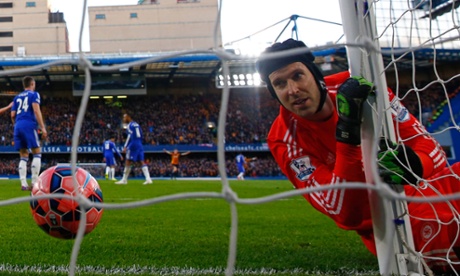
In between the millions spent at Chelsea and Real Madrid, José Mourinho has on his CV an alternative history of making talented but unlikely attacking players look like world beaters. His Porto side won a Champions League with Dmitri Alenichev and Carlos Alberto as their cutting edge. At Internazionale one of his proudest achievements was helping the 30‑year‑old – but still prolific – Diego Milito become the attacking spearhead for Europe’s champion club team.
Alarmingly for Mourinho, this process appears to have been resurrected in reverse in recent weeks as Chelsea develop an unwanted habit of making opposition strikers look unexpectedly unplayable.
On New Year’s Day Harry Kane produced what will hopefully be a moment of decisive career-ignition in the 5‑3 thrashing of the league leaders at White Hart Lane. And on Saturday it was the turn of Jon Stead to outfox and out-muscle Chelsea’s defence, a late career high for a centre-forward who a decade ago set up the winning goal for England Under-21s in a match where his opposite numbers were Robin van Persie and Klaas-Jan Huntelaar but who has had 10 teams in 10 years since and is on loan at Bradford City from Huddersfield Town. Chelsea: making tyros and journeymen look great since the turn of the year. Rickie Lambert, who is due at the Bridge on Tuesday, will no doubt be looking on with interest.
Before kick-off on Saturday Mourinho could be seen briefly larking around with Branislav Ivanovic, straightening the pockets on his rested right-back’s slightly spiffy purple jacket. Did he feel a moment’s misgiving there? Ivanovic’s high-pressure physicality was missing in a Chelsea defence made up of Kurt Zouma, Gary Cahill, César Azpilicueta and the Danish teenager Andreas Christensen. The real issue was not the defensive personnel, however. It was the space in front of the defence, that first line of ballast without which even the best centre-halves are vulnerable to attackers running from deep, or with time to drop off, hold the ball and turn, as Stead did so well.
Bradford’s first goal, thumped in brilliantly by Stead, was given a nudge along by Ramires’s weak attempts to close down on the edge of his area. Later, as Bradford scored from a shoddily defended long throw and then from two supremely well-executed surges through the centre of Chelsea’s defensive block, there was the rare spectacle of a table-topping defensive core in disarray, as they have been twice before this season.
First at Newcastle, where four Chelsea players could be seen haring back towards their own goalkeeper for both of Papiss Cissé’s goals. And then at Tottenham, when Cahill was made to scamper about like a startled cat in the face of Kane’s unshielded aggression Even the very best teams lose now and then. Usually, though, this is down to small details – set pieces, individual mistakes – rather than the ability, even while playing like champions elsewhere, to suddenly go to pieces at the back.
And while it would be easiest to blame this on individuals having a wobble, the problem is surely one of balance, not to mention further confirmation of the complex nature of team building where even a set of players as classy as Chelsea’s first XI can experience some minor engineering hiccups.
It may sound perverse given that Nemanja Matic would surely be in a team of the season to date but his excellence as a holding midfielder has at times camouflaged a potential weakness in the defensive spine of the team. In particular, if Matic’s midfield partner is Cesc Fàbregas, who likes to get ahead of the play, the Serb can be left swivelling around trying to cover too large a space against opponents ready to break.
It is tribute to Chelsea’s excellence in all other areas that this weak spot has only occasionally been gouged out, but it is still there. Even Schalke, thrashed comprehensively in Germany in November, managed to overrun Chelsea’s midfield at times at Stamford Bridge in September, Julian Draxler effectively reverse-man-marking Matic in the second half while others swarmed into the gaps around him.
Against Tottenham, with Kane and Christian Eriksen ferreting about between the lines, Mourinho reinforced that space by bringing on Ramires for Oscar. The problem here is simply that neither the Brazilian nor John Obi Mikel is an adequate first-cum-second-choice central midfielder for a team with such high-grade talent elsewhere. Or indeed for a team who put such an accent on the position, which is a genuinely vital part of a system where the attacking players often stream forward together.
Mikel has been a useful cog in many fine performances. He is, though, essentially a willing block of gristle in that role, a neat, sideways passer and a player with enough intelligence to function there without ever looking a dominant presence.
If it seems harsh to pick away at the only discordant note in a season of exhilarating success to date, then Chelsea’s fans can be certain that Mourinho, who knows his team’s qualities better than anyone, will be doing exactly this before the visit of Liverpool in the second leg of their Capital One Cup semi-final.
It is already an area Chelsea’s manager has worked away at continually over the season. For all the wider sense of Matic and Fàbregas as a settled central pivot, Chelsea have in fact played the same midfield pair in successive matches only once since mid‑December, with Matic-Mikel a common choice, followed closely by Matic-Ramires and Mikel-Ramires.
It is surely here that Mourinho’s attention will be focused ready for a three-week spell in which they play Liverpool, Manchester City, Aston Villa, Everton and Paris Saint-Germain, all of whom have attackers well capable of picking away at the wounds opened by Kane and Stead. It is a mark of the talent within the league leaders that it is just as easy to see Chelsea winning all five matches and surging on towards the season’s end game.
What does seem certain is their ultimate successes will be bound up in Mourinho’s attempts to find balance in the one occasional note of uncertainty in his still-evolving Chelsea 2.0.