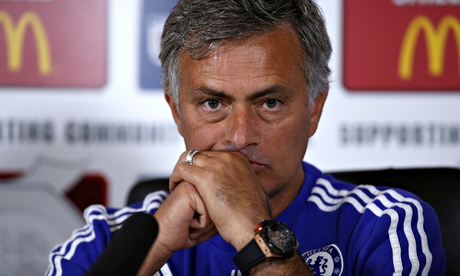
You can generally tell when José Mourinho feels a little antsy about life in general. As a basic rule any time you actually notice him – talking, gesturing, spreading his own special Mourinho voodoo – then something is probably up. And Mourinho has been talking this week before the Community Shield match against Arsenal at Wembley. Just when you thought he’d gone quiet. A creak of the coffin lid. José’s back. And he’s going on about stuff.
In among the pot shots and wisecracks, Chelsea’s manager has had two main areas of interest in the last week of pre-season. First the overly lavish spending of others, a mischievous line of argument given Mourinho’s own status as the highest-spending manager in world football over the last decade. And beyond that the strength of Chelsea’s own playing core, most notably Eden Hazard’s claim on having had a more successful season than Cristiano Ronaldo which, for all the slight sense of double take, is based on an unarguably decisive contribution by Hazard to Chelsea’s title win.
It is not hard to find the real sore point here. Winning back-to-back English league titles is a huge challenge even at the best of times, a feat only two managers – Sir Alex Ferguson and Mourinho himself 10 years ago – have achieved since Bob Paisley in 1983. Going further back, only Herbert Chapman – who gets a medal despite dying of the grippe halfway through Arsenal’s 1933-34 title season – has ever won back-to-back titles in two separate managerial spells (and in Chapman’s case at two clubs, Huddersfield the first).
This is a task Mourinho must undertake having so far fallen into what is a recurrent failing among recent English champions. When it comes to recruitment, Chelsea have not had a productive summer. This may or may not matter – analysing the likely worth of millions spent is one of the more brain-manglingly pointless summer activities – but Mourinho has been fairly open about the need to add to his squad.
And yet entering the final month of the window Chelsea are £10m or so in the black having lost Petr Cech, Filipe Luís and Gaël Kakuta, with the only arrivals being Nathan, who has four years on loan in Belgium written all over him, Asmir Begovic and the silhouette of the footballer who used to be Radamel Falcao.
This is not for the want of false trails and dead ends. Antoine Griezmann, Alexandre Lacazette, Raphaël Varane, Pedro, Axel Witsel and Gareth Bale are just some of the alluringly talented footballers yet to find themselves grinning for the cameras and adding not just quality but numbers to a squad growing a little thin at the edges, with only 18 senior outfield players listed.
Not that we should be surprised by this. The last Premier League champions to retain the title were Manchester United in 2009, tribute both to the relative competitiveness of that stodgy oligopoly at the top, but also to the recent habit of spending badly in the immediate aftermath of triumph.
Last summer Manchester City reinforced their champion status by signing Eliaquim Mangala and Fernando, which as celebrations go, is a bit like winning the first three stages of the Tour de France and celebrating by letting all the air out of your own tyres and taking up the unicycle. The year before, Manchester United lost Ferguson, Ryan Giggs and, ultimately, Nemanja Vidic, and added David Moyes and a panic-bought Marouane Fellaini. In 2012 City spent £67m on Fernandinho, Jack Rodwell, Scott Sinclair, Maicon and Javi García, which is certainly a very expensive way of signing Fernandinho.
The last really major star-name champion spend came in 2010, when Chelsea burped up £92m on Ramires, David Luiz and Fernando Torres (all of whom, lest we forget, now have a Champions League winner’s medal). Beyond that, a refusal to splurge on established stars has been the trend.
This is partly down to financial fair play and partly perhaps to the more orderly, plc-shaped dilution of managerial influence. A title-winning manager will always want to spend money, just as Ferguson and Bill Shankly talked about building from strength, mending the roof while the sun shines and so on.
A well-run accounts department, on the other hand, will want to sweat a successful team. In a sense this is a consequence of a sport governed entirely by finance bumping up against the economics of what we might call Wenger’s Law of Real Returns. Manchester City might well have finished above Chelsea last season had they spent, say, £25m on a top-class central midfielder. Their only concrete reward would have been an extra £500,000 in prize money.
Being in contention, existing profitably within the Champions League set is the real prize from a financial perspective. Hence perhaps another reason English clubs have failed to challenge the very best in the Champions League recently. Spend to get there, to win a league title. But what’s the margin on winning it again?
Plus in Chelsea’s case, the ship is pretty tightly run these days. They do a lot of business – eight players from the last time they played the Community Shield in 2012 have moved on – but it is generally pretty good business. If Mourinho bought the title last year he bought it for loose change. With players coming in and out, Diego Costa and Cesc Fàbregas arrived for a combined total summer spend of £5m, the most demonstrably successful month of pre-season business in Premier League history.
And yet fast-forward a year and it was perhaps a one-season fix. The Costa-Fàbregas axis may have been the defining note in Chelsea’s early kick away from the pack but the title season split neatly in two: the giddy times up to Boxing Day that brought 21 wins in 27 matches; and the sticky patch after it when Chelsea won seven out of 17, manned the defence and became a team driven by their hind quarters in the second half of the season.
Costa, hamstrings twanging, scored 13 goals before Boxing Day and seven after it. Fàbregas contributed 18 assist up to New Years Day and just four in the next five months, a familiar late-season deceleration, but also a function of opponents cramping his influence, having twigged that this is a star midfielder of such restricted mobility his only real option when pressurised is to shuttle the ball on.
This week Fabregas said the only way to improve on last season is to win the Champions League. This would certainly require reinforcement in his own position, with memories fresh of how Chelsea’s midfield was overpowered by Paris Saint-Germain, Fàbregas himself resembling a man trying to run the wrong way up an escalator in his pursuit of Blaise Matuidi and Thiago Motta.
Chelsea’s starting team against Arsenal on Sunday will probably be as close as possible to the first-choice team from last season. And yet, for all his snippiness, Mourinho’s knows his players. A more optimistic view says Costa will be fit after a non-tournament summer. Falcao needs to only score more than four goals in the Premier League to offer an upgrade on Didier Drogba. A new left-back will surely arrive – possibly Baba Rahman of Augsburg – while José Callejón and John Stones would be excellent additions.
Beyond this something surely has to give with the Loftus-Cheek Pack, that crop of young talents Chelsea’s hierarchy are so keen to establish as first-team players. At the very least the prospect of watching Mourinho manage, shuffle his pack, and wring the most from a fine, if rather slight squad promises a fascinating start to the season.