During the World Cup in Brazil last summer there was a billboard campaign for a domestic airline featuring a beaming David Luiz dressed up in full pilot’s uniform. Wearing that familiarly endearing facial expression, the look of a man who’s just been hit on the head by a rock and thinks it’s the greatest thing that’s ever happened to him, David Luiz was shown ushering prospective passengers towards a jumbo jet he was, so the suggestion seemed to be, about to leap aboard and start flying around the place.
It must be said for those with a fear of air travel this wasn’t the most comforting image in the departure lounge. Please, David Luiz. Oh dear. No more loop the loops. No more rolls. No more warp-speed … David Luiz?… Er. Has anyone seen David Luiz?
Oh, how we like to laugh at the world’s most expensive defender, at least in England. The way he romps along with the ball like a thoroughbred pantomime horse, the way his many fine moments are scattered about so carelessly, and best of all the way he occasionally produces not just a mistake, but a mega-mistake, a brain freeze, a calamity of defence.
This is the same meandering presence Gary Neville described as “a PlayStation player being controlled by a kid in the crowd”. Neville was making a specific point on a specific game but the label stuck. Only last month it was reported that Arsène Wenger had been “reassuring” Arsenal fans that his new signing, the relatively callow Brazilian defender Gabriel Paulista, was “not like David Luiz”.
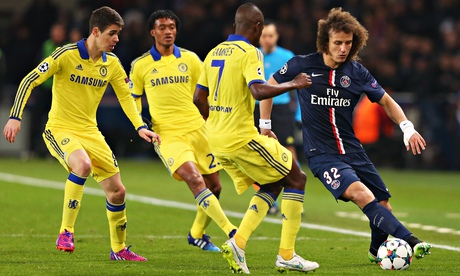
And yet this week in Paris this same David Luiz produced a performance of assurance and tactical discipline against Chelsea. First as an arm-flapping midfield enforcer, shutting down Diego Costa’s favourite inside-left channel and hustling Cesc Fàbregas into anonymity. And by the end, despite often being portrayed as a high-grade blunderbuss with the ball at his feet, completing more passes than any other player on the pitch.
What a joy it is to watch him when he’s playing with this kind of verve, not just those snorting, galloping runs, the theatrical range of passing, but the sense of a player with a Technicolor vision of the game around him, not so much a picture in his head as a perfectly crafted stick-man cartoon with speech bubbles and doodles and jokes in the margin.
Best of all David Luiz wasn’t just good in Paris, he was good in an interesting way, not least for an excellent Chelsea team who can still at times appear oddly passive. The natural assumption in England is that at Chelsea the things José Mourinho is very good at – organisation, discipline – were always likely to flag up rather painfully the things David Luiz is bad at. But perhaps the opposite is also true and the things David Luiz is good at can highlight some weaknesses in Mourinho’s set-up.
This is in part a question of boldness and attitude. Chelsea will be deserving champions of England but if they do have a weakness so far it is perhaps they are a little shy of their abilities against the better teams, too ready to hold in the clinches and hope to counterpunch. The fact is Chelsea have yet to beat really top-quality opponents this season, drawing 1-1 against Manchester United, Manchester City (twice) and now PSG, each time after taking the lead only to stall while in the ascendancy.
This is perhaps what a David Luiz-style player (or equivalent) might have added this season. Here is a man who always plays like a prince, a footballer who – win, lose or collapse completely – appears convinced at all times he’s not just the best player on the pitch but a candidate for the title of greatest athlete in human history.
This high-class but still evolving Chelsea could probably do with a dusting of this now and then, the kind of infectious, slightly loopy champion spirit that means while David Luiz might lose his way at the odd set piece, or fail to man-mark as he arguably did for Chelsea’s goal on Tuesday, he is still capable of striding around on one leg for 120 minutes in a Champions League final with the air of man who never at any stage believes he’s going to lose.
There is more to this than style. For all his flaws David Luiz is above all a modern kind of defensive player, a centre-back or deep midfielder whose expertise is on the front foot, concerned as much with managing the transition from defence to attack, the ability to anticipate and intercept, performing not as a lump of obstructive gristle but as just another high-class footballer, part of an ambitious attacking whole.
This is what the rest of the world thinks being a centre-half is now. There are quite possibly plenty of people in other countries who roll their eyes and chuckle at our own English Premier League defenders. Who look at, say, Chris Smalling, and say, yes, he has a sense of well-intentioned positional doggedness but give him the ball at his feet and he plays like a PlayStation footballer controlled by a kid in the crowd who’s not actually very good at controlling a PlayStation footballer. These English! Hilarious!
Certainly Chelsea’s present duo can look like a case of two “flat” defenders in tandem, perhaps even a symptom in miniature of that tendency to hold what they have when they could step out, be more progressive, trust their front players more in big games. Meanwhile David Luiz, the wonky captain, looks a fine fit at a club who seem enlivened by his basic energy, not to mention a player who, for all his flaws, has a whiff of something this Chelsea might just need to take the step up from an excellent team to a really memorable one.