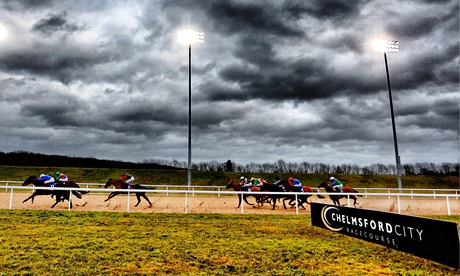
It was not necessary to look very far at Chelmsford City in Essex on Sunday to find reminders of its brief, troubled existence as Great Leighs, which became the first new racecourse in Britain for 81 years when it opened in May 2008.
The two-tier marquee which once passed for the grandstand at Great Leighs has been replaced by a smart new £6m facility for its second coming as Chelmsford City, which launched in front of an invited audience of around 800, but it is still on the inside of the track, which forces racegoers to watch most of the action on a big screen. The signs at more remote parts of the course have also emerged from mothballs still proclaiming it as Great Leighs, which staged its final card in January 2009. And it is, and always will be, a great deal closer to Great Leighs than it is to Chelmsford, nearly 10 miles away.
John Holmes, the local entrepreneur who built the track in the first place, is still there too.
Nearly seven years ago, on a muddy, miserable opening day when it quickly became clear that Great Leighs was a half-finished calamity waiting to happen, Holmes buzzed around all afternoon, predicting the brightest of futures for a track that was in administration eight months later. Holmes himself was later forced into bankruptcy with debts of nearly £25m.
This time Holmes was a little more low key, leaving most of the talking to Phil Siers and Joe Scanlon, the course’s managing director and chairman, respectively, and both employees of BetFred bookmakers, the track’s new majority owner. Standing in the winner’s enclosure after the featured Betsi Golden Mile Stakes, however, which was sponsored by a firm for which Holmes acts as a consultant, he was able to look both forward and back.
“The vision basically hasn’t changed,” he said. “It’s just that someone else has now picked up the reins to go forward with what Great Leighs was about. It’s about a track in a terrific position which ticks all the boxes. It has the support of trainers and owners and the public.
“The difference between this time and last time is that we don’t have a banking culture facing meltdown, that looked at valuable assets and thought, do we want to support them or sell them? The track has what it always needed now, which is the right level of support and a passionate investor like Fred [Done, BetFred’s chairman]. It can only grow and grow on to bigger and better things.”
Wholly inadequate though the facilities were for racegoers, there was never anything wrong with the track itself at Great Leighs. It is a one-mile, US-style oval with sweeping turns and an hour or less from Newmarket by horsebox with no need to risk the M25. John Gosden and Charlie Appleby, two of the leading names at Flat racing’s HQ, both recorded doubles on Sunday’s card.
Gosden’s Tempus Temporis, which was his first winner for the Godolphin operation in the feature race, cost $300,000 as a yearling and is the sort of high-class animal that Chelmsford City hopes to attract in numbers. There will be middle- to low-grade events, too, of course, but more exalted ambitions include a race-earning elevation to Pattern status and a revival of the “Breeders’ Cup trial” card, which had a solitary outing in September 2008.
As was the case the first time, jockeys were delighted by the track and conditions, though there was more kickback than most had expected. Nicky Mackay’s comment after winning the second race on Zamoura was typical. “The track’s lovely, really nice to ride,” Mackay said. “Once it gets a bit of wear, it will be really good.”
But will the grand ambitions prove to be any more realistic for Chelmsford City than they were for Great Leighs?
“The people who ran it before built a great running surface,” said Scanlon, a betting industry veteran. “The reasons it failed last time were financial. Through BetFred I’d like to think we don’t have those issues. We’ve got plans for a grass track and outline planning permission for another grandstand [on the outside of the track].”
The British Horseracing Authority shared in the embarrassment when Great Leighs folded in 2009, having allowed the track to open when the public areas were little more than a building site. Any direct involvement by Holmes in Chelmsford City could be seen as an issue by the authority, which has the power, in theory at least, to remove the track’s licence to operate.
Scanlon, though, insists Holmes is now a relatively peripheral figure. “John Holmes cannot be, and isn’t, a director of the company and can’t have any involvement in the day-to-day running of the business,” he said.
“I’m not here to defend him but I would say he’s not been warned off, he’s allowed on racecourses, he’s not shot or killed anyone as far as I know. We were quite happy and he was happy to agree to those terms.”
The first meeting at Chelmsford City open to all is scheduled for 1 February. A course with a troubled history is apparently back on track but there is still enough of the old mixed in with the new to make one wonder if its story may not have a few more twists and turns to come.