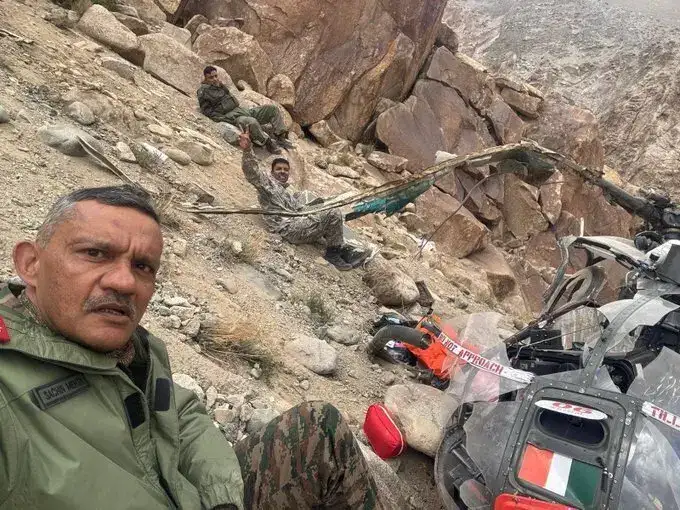
A senior Indian Army commander and two pilots survived injuries after a Cheetah light helicopter crashed in the high-altitude Ladakh sector on May 20, prompting the Army to order a formal investigation into the incident.
The aircraft was on a routine flight in the strategically sensitive region when it met with an accident. It was carrying three personnel, including Division Commander Major General Sachin Mehta and two pilots, all of whom sustained injuries after the helicopter went down.
Court of Inquiry ordered into crash
The Indian Army has instituted a Court of Inquiry to examine technical, mechanical and environmental factors that may have led to the crash. Officials said a detailed probe has been initiated to determine the exact cause of the incident.
The Army also rejected a video circulating on social media and in the media space, calling it “fake and misleading” and alleging that it was part of a malicious campaign intended to tarnish the force’s image and spread fabricated narratives.
Cheetah helicopter: Ageing fleet under scrutiny
The crashed aircraft was an Indian Army Cheetah light helicopter, widely used for high-altitude reconnaissance, logistics and casualty evacuation in remote forward areas.
The platform, introduced in India through a license agreement signed by Hindustan Aeronautics Limited (HAL) in 1970, has been in service for decades. The first Cheetah built from raw materials was delivered in 1976–77.
The helicopter is based on the Eurocopter LAMA SA 315B design and is powered by an Artouste III B turboshaft engine. It is designed for operations across a wide range of weight, altitude and centre of gravity conditions and is used for surveillance, rescue, troop movement and logistics support.
The five-seater aircraft has a length of 12.91 metres, width of 2.38 metres, height of 3.09 metres, maximum take-off weight of 1,950 kg, cruise speed of 192 km/h, range of 560 km and endurance of 3.10 hours. It can carry three passengers along with two crew members and has held a record in high-altitude flying among helicopter categories.
HAL has produced more than 275 units of the Cheetah series, which remain in service in India and abroad, including export orders such as those from Namibia.
Safety record and past concerns over ageing fleet
The Cheetah and Chetak helicopter fleet has faced long-standing safety concerns due to its ageing airframes and maintenance challenges. In 2015, the Army Wives Agitation Group (AWAG) claimed that 191 Cheetah and Chetak helicopters had crashed over three decades, resulting in 294 pilot fatalities, and had urged the then Defence Minister to replace the fleet.
The issue resurfaced again in 2022 after a fatal Cheetah crash in Arunachal Pradesh. AWAG later wrote to Prime Minister Narendra Modi, claiming that 31 military pilots had died in accidents involving these helicopters since 2017 and pressing for faster replacement.
Despite these concerns, the helicopters continue to be deployed for reconnaissance, casualty evacuation, logistics and troop movement in high-altitude regions where operational alternatives are limited.
Replacement programme and LUH induction
HAL’s Light Utility Helicopter (LUH) has been selected as the replacement for the ageing Cheetah-Chetak fleet. The LUH is an indigenous 3-ton class, single-engine rotorcraft designed for high-altitude operations in Himalayan conditions.
It features a glass cockpit, supports a payload of 400 to 500 kg, and can carry up to eight personnel including two crew members and six troops. It has a maximum take-off weight of 3,150 kg, maximum speed of 235 km/h, operational range of up to 350 km, extendable to 500 km with internal fuel, and a service ceiling of 6,500 metres.
The Defence Acquisition Council approved procurement of 12 Limited Series Production LUH units in 2021, but the transition has been slower than expected, extending the operational life of the existing fleet.
Earlier attempts to induct Russian Ka-226T helicopters also did not materialise after the proposed joint programme stalled over cost, localisation and commercial issues.
The continued reliance on the Cheetah fleet has therefore remained central to high-altitude operations despite ongoing concerns over ageing platforms and delayed replacement timelines.