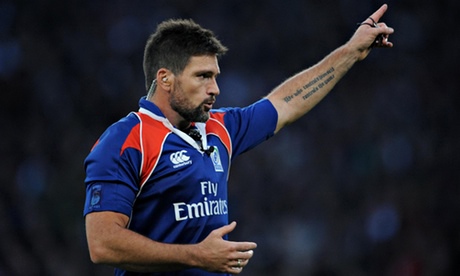
All rugby union referees will have smiled wryly at the letter published in the sports pages of the Sunday Times at the weekend. “Along with 80,000 other spectators at Twickenham I saw Nigel Owens have a shocker of a game last Saturday,” wrote Mr Michael Parker. “Catching up on Sunday in front of the television I saw him give a faultless refereeing performance. Odd game, rugby.”
What a well-observed summation of what everybody secretly knows: that refereeing is a nigh-impossible job. The best you can hope for is to please some of the people some of the time. The former All Black captain Sean Fitzpatrick was asked this week why so few international players decide to become referees when they retire. “I spent 12 years trying to referee games,” quipped Fitzpatrick, neatly summing up the growing on-field pressures faced by the whistling profession.
The homophobic abuse directed at Owens during the New Zealand game would certainly be enough to make anyone think twice about officiating at elite level. Just occasionally, though, leading referees do themselves no favours. After Willie le Roux had put Cobus Reinach over for South Africa’s second try at Twickenham on Saturday, Steve Walsh could be heard via the RefLink microphone congratulating Le Roux on his sweet offload. “Lovely pass, mate, lovely,” cooed Walsh, prompting sick bags to be passed the length and breadth of the East Stand.
Imagine the chair umpire at the All England Club saying something similar to Roger Federer in a Wimbledon final against Andy Murray? Or a Premier League referee congratulating a Manchester United player for setting up a goal at Liverpool? It was indeed a lovely pass but that is not the point. Referees are not there to be the players’ mates, not on the field at any rate. They are there to be fair, neutral arbiters, showing neither fear nor favour. Nobody wants fans with whistles.
It was also remarkable how much Walsh had to say during the game. Giving his audience a running commentary might seem helpful to some but he had more matey chats with the Springbok captain Jean de Villiers in 80 minutes than some married couples have in a fortnight. He spoke a lot to Chris Robshaw, too, to the point where you began to wonder what happened to the quaint notion of referees actually refereeing what they see, rather than reacting to what they hear. Walsh received as many unsolicited tips from each side about perceived skulduggery as a sergeant manning the front desk at a busy metropolitan police station.
There is absolutely no suggestion that Walsh does not know the law book backwards. His detractors suspect he is seldom displeased by what he sees in the bathroom mirror each morning but, ultimately, that is his own business. No, the issue here is clarity and authority, particularly in the era of big screen replays and with a World Cup of tiny margins looming next year.
Much has been said and written about television match official decisions, less so about their potentially emasculating effect on elite refs. The number of calls now being openly questioned on the field is unquestionably far higher than it was a decade ago. Who is actually calling the shots? The referee, his assistants, the captains, the coaches, the TMOs, the assessors or the referee managers?
There seem to be more opinions floating around than ever. Against New Zealand, for example, even Owens and his TMO ended up having a polite disagreement about the rights and wrongs of Dane Coles’s sin-binning, among the reasons why the International Rugby Board is offering host unions the option of such discussions being conducted in private in future.
Interestingly, cricket is going the other way. Only this week the first ‘live’ umpire/third umpire conversation about a dismissal was broadcast on television, resulting in a raised finger being shown to Australia’s Matthew Wade in a game versus South Africa.
Cricket-style referrals are also set to be trialled in southern hemisphere rugby from 2016, for better or worse. There is already scant evidence to suggest the majority of referees are adopting the more decisive approach proposed by England’s Wayne Barnes at the start of this season. He suggested referees should rely on their instincts more often to avoid excessive stoppages to the game. It is proving easier said than done.
In the end, however, no one benefits from endless querying of decisions. Referees risk being undermined, making their job harder still and consistency even more elusive. One or two England players privately felt Walsh did them few weekend favours, failing to stick to his promise to deal with Springbok tacklers who clung on to opponents on the floor and permitting too wide a gap at lineouts, which left players unable to contest opposition throws without illegally diving across. They probably had a point but imagine if England had the power to challenge those kinds of calls in mid-game? Matches would last all night.
Better, surely, to encourage refs to retake the initiative. March sides back 10 metres if they repeatedly try and influence decisions by accusing the other team of cheating. Stop trying to be everyone’s best friend. Explain precisely what the boundaries are and then encourage the game to flow as much as possible, rather than endlessly debating who did what to whom 15 phases back. A little less conversation and a little more action would benefit everyone.
LESS IS MORE
As the November internationals thunder on, the more you wonder what state everyone will be in by next year’s World Cup. Some significant rugby names believe it is no longer enough for everyone simply to cross their fingers and hope for the best. “At the moment we are killing the players,” said the former Argentina captain Gus Pichot, speaking at this week’s World Rugby conference and exhibition in London. “We need to get the global schedule right and then worry about finances.” His stark warning needs heeding.
WORTH WATCHING THIS WEEK
Wales v New Zealand. Along with England, Wales have yet to set the autumn alight. They will throw everything at the All Blacks, as always, but something remarkable will be required if Warren Gatland’s side are to gain a precious victory against southern hemisphere opposition. Crack the Kiwi code, however, and a whole new dimension will be added to England’s visit to the Millennium Stadium at the start of next year’s Six Nations.