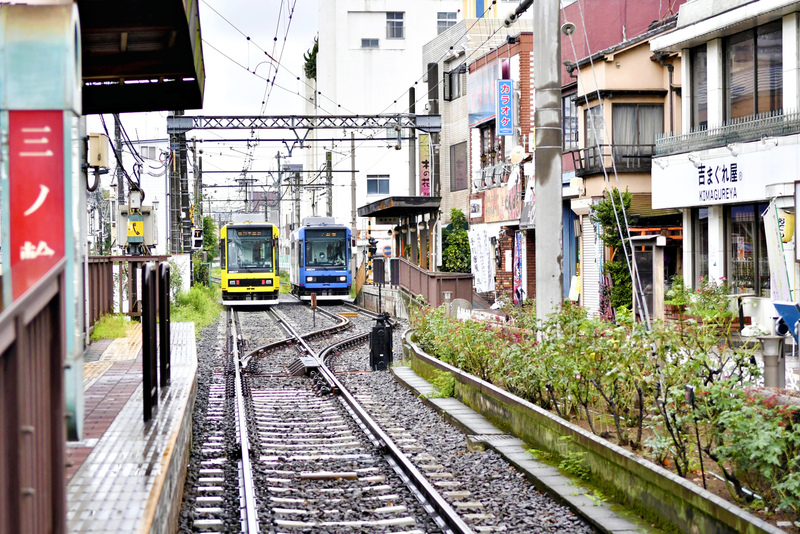
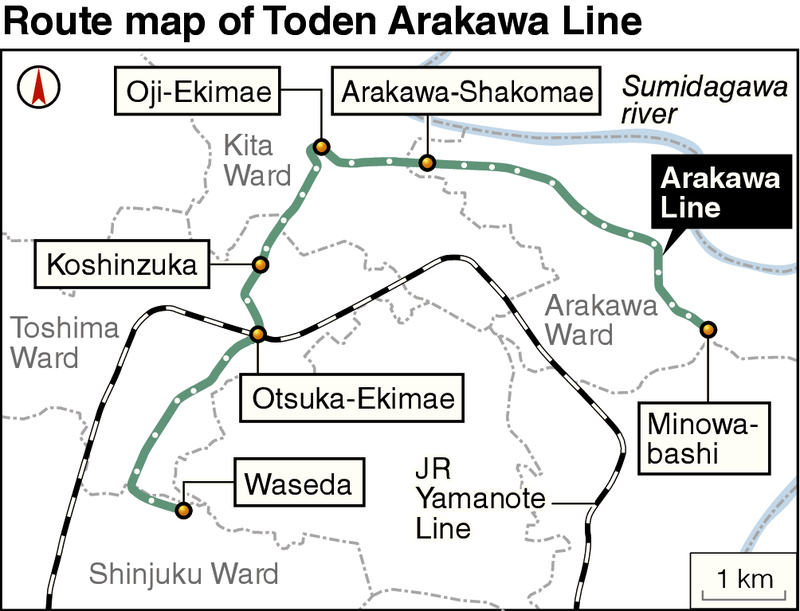
The Toden Arakawa Line travels about 12 kilometers in Tokyo between Minowabashi Station in Arakawa Ward and Waseda Station in Shinjuku Ward. The line is the only active remnant of what was once an extensive streetcar network in Tokyo.
Why did that line alone survive?
Seeking an answer, I recently caught a single-car train at Minowabashi Station.
Once I was aboard, the doors were closed with the ring of a bell and the train started moving. It slowly traveled along the rails, but arrived at the next stop quite soon. The line has 30 stops, spaced an average of only about 420 meters apart.
My train traveled on its exclusive track through a residential area and went past Arakawa-Shakomae Station, where I saw a rail yard with many other trains standing by.
When approaching Oji-Ekimae Station, my train followed its track right into the road, mingling with passenger cars and buses. Near Otsuka-Ekimae Station, the train track passed under the JR Yamanote Line.
The train occasionally stopped at red traffic lights just as ordinary vehicles do. After stopping and starting repeatedly, it arrived at the terminal, Waseda Station, an hour after my journey had begun.
The line has carried 45,000 to 52,000 passengers a day for the past decade. There were only two years when it was in the black, but it serves as an important means of transportation for locals.
According to the Tokyo metropolitan government's transportation bureau, the Toden network had 40 routes at its peak. In fiscal 1960, an average of 1.64 million people a day used the service.
The route map as of 1962 shows there were stops near such tourist spots as the Kaminarimon gate and Tokyo Tower, as well as the Otemachi and Kasumigaseki office areas.
Amid an increase in the number of privately owned cars, however, Toden trains started being caught in traffic congestion while traveling on tracks on the road. It made the service more and more difficult to keep on schedule, leading to a gradual decrease of passengers.
The metropolitan government, which was pouring a large amount of money into the development of subway lines, decided to abolish all Toden routes in stages from 1967. "Routes totaling as long as 181 kilometers were abolished over a period of five years," an official at the transportation bureau said.
The Toden Arakawa Line too was supposed to be abolished, but in the end it was spared. The reason is explained in a book describing 100 years of Tokyo metropolitan governmental transportation systems.
First, the route was mostly on tracks that did not run in the street, which helped to ensure on-time service by greatly minimizing the effects of traffic jams.
In fact, on the current Arakawa Line, only 14 percent, or about 1.7 kilometers, of its entire route runs on tracks built on roads where vehicles also travel.
In addition, there were no major streets where the bus could operate as a replacement for the train.
Also, backed by strong requests from local residents, the metropolitan government decided in 1974 to retain the service. In October that year, the government merged two routes -- between Minowabashi and Oji-Ekimae and between Arakawa-Shakomae and Waseda -- and renamed it the Arakawa Line.
"I'm so happy the Arakawa Line survived," said Masahiro Asaga, 71, chairman of the Koshinzuka Shoeikai, a shopping association in the district near Koshinzuka Station in Toshima Ward. As the district is a bit far from major train or subway stations, such as Sugamo and Nishi-Sugamo, "our shopping district could have been deserted without the Arakawa Line."
The association and two other similar organizations near Waseda Station made up a plan to present a 20-minute rakugo comic storytelling event on a fully reserved carriage of the Arakawa Line traveling between Waseda and Koshinzuka stations in September, November and December.
"I want more people to visit our shopping districts, where time-tested shops still remain, by taking the Arakawa Line," Asaga said.
The Arakawa Ward government planted rose trees along about four kilometers of the line. About 90 members of the volunteer organization Arakawa Bara no Kai look after the trees. Some of the flowers will be at their best in mid-October. "I hope visitors will enjoy the flowers and the scent of roses. We did a lot of manual work to look after the trees during the hot summer," said Yuri Kishi, 47, representative of the group.
The Arakawa Line alone survived and still sustains the local community. Hop aboard to take a break from your busy life, enjoy traditional scenery and meet friendly people along the way.
Read more from The Japan News at https://japannews.yomiuri.co.jp/