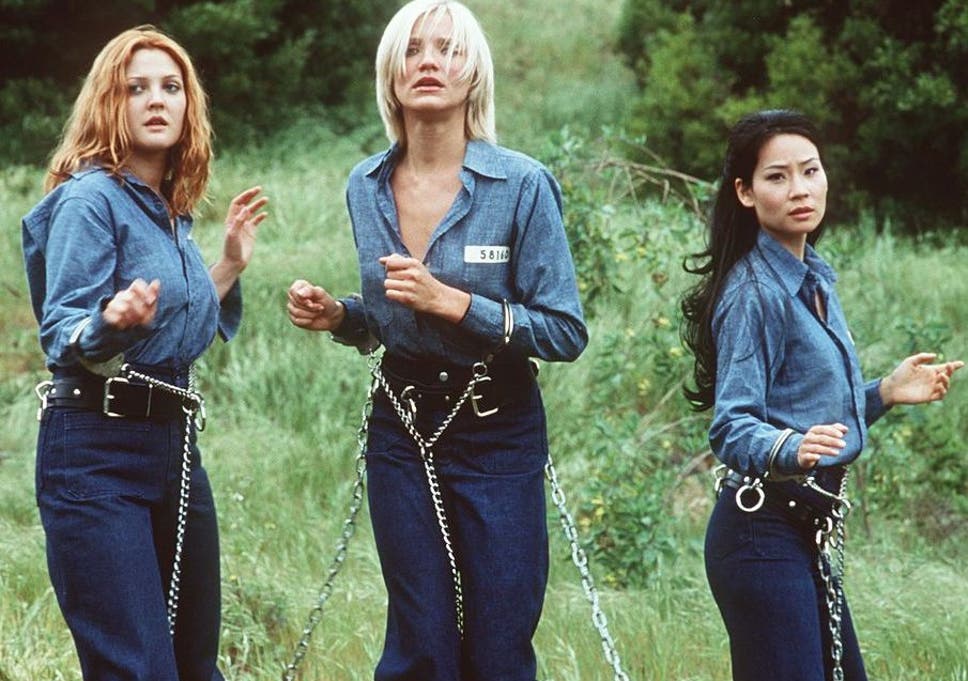
In the first 10 minutes of 2000’s Charlie’s Angels, Cameron Diaz, Drew Barrymore and Lucy Liu change into 28 different costumes. There are wigs, bikinis, astronaut suits and a Mission: Impossible-style latex mask that briefly transforms Barrymore into LL Cool J. Released almost 20 years ago, Charlie’s Angels is a film of flare and excess, in which everything is in service of outlandish set pieces and ogling Diaz’s rear end. As a franchise reboot opens to dismal box office and middling reviews, it is time to acknowledge that its predecessor is something of a masterpiece.
Perhaps not deliberately so. Charlie’s Angels entered production in 1999 without a script (“It’s not the most introspective film in town,” director McG told Entertainment Weekly), and at least two cast members who hated each other. “I get why you’re here, and you’ve got talent,” Bill Murrayreportedly said of Barrymore and Diaz on set, before turning to Liu: “But what in the hell are you doing here? You can’t act!” Liu allegedly began throwing punches, and Murray didn’t come back for the 2003 sequel.
But it’s in the film’s improvised, “let’s just do whatever” ethos that Charlie’s Angels becomes fascinating. It’s also there in its relentless butt shots; its fixation on shiny teeth and hair being shaken loose in the wind, and the absolute absence of narrative, character and music that isn’t ripped from a Sounds of the 80s CD. In truth, Charlie’s Angels is an unintentional art film, such a maximalist and ambiguously knowing piece of eye candy that it becomes almost Warholian.
Elizabeth Banks’s new revival, led by the lower star-wattage trio of Naomi Scott, Ella Balinska and Kristen Stewart, has been criticised for its “T-shirt feminism” and endless repetition of the importance of girl-power. While she apparently handled such messaging poorly, Banks also had little choice but to address the sleazy elephant in the room.
Charlie’s Angels, from its earliest inception as an Aaron Spelling-produced series and proud representative of what was known as “Jiggle TV”, was exclusively about beautiful women in tight clothes solving crimes. Instead of its plots or storylines, Farrah Fawcett’s feathered hairdo remains its sole cultural imprint. The 2000 film version is equally prehistoric in its aesthetic choices – the camera fixates on curves, bums and legs, Barrymore at one point licking a steering wheel, and Diaz unzipping her swimsuit in slow-motion.
It is, however, progressive in other ways. A rare high-budget action film entirely anchored by women, Charlie’s Angels also represents an early victory for female producers – Drew Barrymore, alongside production partner Nancy Juvonen, brought the project to fruition after years of it being stuck in development hell, and her fingerprints are all over the final product. Like Barrymore’s public persona, it is relentlessly positive in an upbeat, politically neutral and sickly-sweet sort of way, free of judgements and awash in Spice Girls-era feminism that could fit nicely onto a bumper sticker.
The Angels, Natalie (Diaz), Dylan (Barrymore) and Alex (Liu) are best friends, devoid of rivalry or competition, with their friendship taking emotional precedence over the men in their lives... which is nice. Even if, ultimately, the film’s political statements begin and end with the somewhat basic idea that women can enjoy shoes, makeup, sex and silliness while still being smart, too.
But the film also seems aware of its paper-thin feminism. Charlie’s Angels, as summed up in a fairly withering review by the late critic Roger Ebert, is “like the trailer for a video game movie”. It is a deliberately mindless celebration of glamour and nonsense, which maybe shouldn’t be celebrated, but can be appreciated all the same.
Existing like a breath-mint accompanying your restaurant bill, the alleged plot is nice but inessential. It involves a software genius played by Sam Rockwell, whose invention has fallen into nefarious hands. Kelly Lynch, as Rockwell’s business partner, is also secretly villainous – we know this, because she’s wearing an enormous brown wig. It’s a hairdo that makes her look like Chrissie Hynde’s evil twin.
“Of course!” Natalie wails at one point. “All Red Star satellites have global positioning systems. Combine that with voice identification and any cell phone could be a homing device!” Such expository scenes are played almost on fast-forward, the Angels finishing one another’s sentences and coming to similar investigative conclusions. And then it’s onto the next sexy set piece, which usually involves some sort of skin-tight outfit, light belly-dancing, or a lovely, not-at-all-inappropriate bit of brown-face.
Its fascinating mindlessness is best reflected, and most victorious, in how it distils movie stardom into an easily digestible bite. Natalie, Dylan and Alex aren’t so much characters as avatars for fame, beauty and aesthetic allure; a three-headed symbol for why we are so spellbound by really, really good-looking people. If stardom is an indefinable “X-factor” that can only be recognised by instinctively knowing when it’s in front of you, then Charlie’s Angels is its natural endpoint – final confirmation that as long as we are dazzled by the beauty and colour on screen, everything else is incidental.
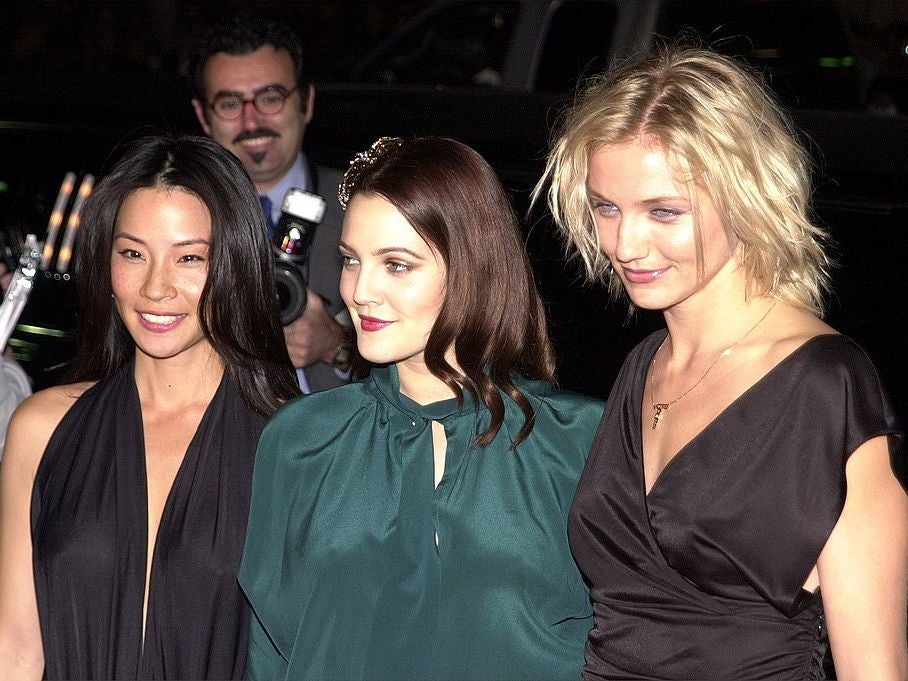
Diaz is so camera-ready and sun-kissed here that she is practically glowing. McG devotes three entirely pointless sequences solely to her physical elasticity, as she dances in her underwear, dreams of performing disco moves alongside an ensemble of male dancers, and embarrasses herself on the US television show Soul Train. She is all teeth and limbs and shiny enthusiasm, and such a radiating force of A-list light that you only notice on second or third viewing that we know absolutely nothing about Natalie as a person.
Barrymore, her red hair cut into a shaggy mop, looks and sounds like a rock star. She swaggers into her white Chevrolet after dumping her boyfriend, and moon-walks out of a prison cell after dispatching three goons, all with her hands tied behind her back. Liu, meanwhile, is breathtaking, full of bouncy strength and easy glam. Given that she was a bona fide movie-star-in-training, who shot the film at the same time as she was shooting Ally McBeal, Liu’s lack of a single post-Charlie’s Angels star vehicle is proof that the Hollywood of 2000 had (or has) no idea what to do with actors of colour.
Charlie’s Angels just about manages to get by because of its sheer star power, enhanced by an incredible theme song, “Independent Women Part 1” by Destiny’s Child, that is equally as cool and brilliant and weightless in its empowerment. That additional concoction, of beautiful movie stars, bright Americana, and shots of Diaz punching people to the sounds of The Prodigy’s “Smack My Bitch Up”, transforms Charlie’s Angels from abject trash into an almost post-cinema masterpiece.
Perhaps it’s why the new Charlie’s Angels hasn’t worked as well. Remove the mindlessness, introduce an air of self-importance and strand poor Kristen Stewart (reportedly the best thing in it) alongside two young actors nobody knows, and you’re left with not very much at all.
”People may still think it’s crap,” Barrymore said of Charlie’s Angels in 2000. “But the important thing is we gave the audience something they can enjoy.” For better or for worse, the film is exactly what Barrymore hoped it would be.