
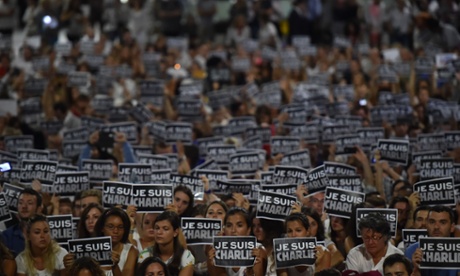
People across France queued at dawn on Wednesday for a copy of the first Charlie Hebdo magazine to be published since last week’s terrorist attack on its offices. Its print run had been raised to 5m copies, as French citizens continue to make an emphatic statement about their support for free speech in general and solidarity with Charlie Hebdo in particular.
Presumably, then, many millions have now read the “survival issue” of the magazine - many more than a typical Charlie Hebdo publication, which had a circulation of 60,000 before the attacks.
The front cover by the surviving cartoonist Luz, portrays the prophet Muhammad, and not for the first time.
But nobody is sacred. Charlie Hebdo has frequently satirised religious figures including cartoons of the pope holding a condom above his head, and a rabbi with a goofy grin making reference to the holocaust.
Free speech advocates urged media organisations to republish Charlie Hebdo’s cartoon covers as a gesture of solidarity after the attacks.
“The ability to express ourselves freely is fundamental to a free society,” said Jodie Ginsberg, chief executive officer of Index on Censorship. “This includes the freedom to publish, to satirise, to joke, to criticise, even when that might cause offence to others.”
And newspapers around the world did. In Europe, Libération, Le Monde and Frankfurter Allgemeine used the image of the front cover online. And the Guardian ran the cover online as a small inline image.
In the US, the Washington Post, USA Today, LA Times, Wall Street Journal, The Daily Beast and CBS News ran the cover but the New York Times did not. In Australia, the ABC showed the image of the cartoon on its 24-hour rolling news programme with a warning to viewers.
The Qur’an does not explicitly forbid images of Muhammad, but several hadith – sayings and actions attributed to the prophet – prohibit Muslims from creating visual depictions of human figures. This forms the basis of arguments against Charlie Hebdo’s cartoons that images of the prophet Muhammad should never be allowed on the grounds that we shouldn’t knowingly offend.
Are you one of Charlie Hebdo’s new readers, or are you a long time fan? What do you make of its satirising of religion? And should the satirising of all religions be allowed in the name of free speech? Share your thoughts in the form below












