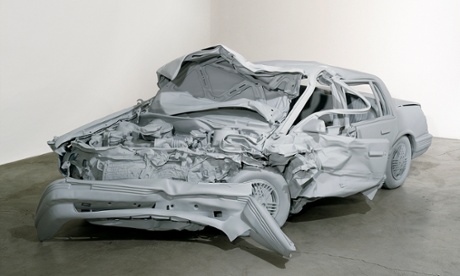
The car’s a wreck – the left door has crumpled, the bumper’s on the floor, and the bonnet has roared up and smashed the windscreen. But it doesn’t feel like a wreck when you circumambulate it, gazing at every little crinkle on its shattered surface. It feels, instead, as if the car were born wrecked. It feels flawless, unnervingly flawless.
Charles Ray’s Unpainted Sculpture, from 1997, takes the form of a destroyed Pontiac Grand Am whose body, upholstery, chassis and tires are all made of fiberglass covered in a low-gloss grey finish. It sits silently in a giant gallery, each of its damaged parts joined into an impassive whole. The downbeat, colorless surface, and the single material used to imitate metal, rubber and fabric, render the car staggeringly mute. It weighs a ton but looks weightless. The accidental form of the ruined car has become a seamless, unspoiled sculpture: a ghost of itself, but an apotheosis too.
Faster, slipperier, more responsive and selfie-friendly: these are too often the parameters we assign to contemporary art. Not Charles Ray, whose art is the subject of a stern but ravishing retrospective now on view at the Art Institute of Chicago – his first major show since 1998 (he works slowly, very slowly), and essential for anyone who cares about the state of sculpture today. His art is subversive, anxious, and painstaking to the point of neurosis.
This show, as a consequence, includes only 19 works, about one for each year of the show’s timeline. They’re spread across nine airy galleries, in an indulgently uncluttered display. And they confirm Ray’s status as our leading exponent of figurative sculpture after the death of the figurative tradition. (An earlier version of this show took place at the Kunstmuseum Basel in Switzerland, though several excellent new sculptures are shown here for the first time. The Swiss and American shows share a catalogue, and though images can’t capture the uncanny essence of Ray’s sculptures, a superb essay on his career by the art historian Anne Wagner makes it worth a read.)
Ray was born here in Chicago, in 1953, though he now lives in Los Angeles, where he has taught more than three decades’ worth of students at UCLA’s sculpture program. His early art embraced abstraction, chance and performative actions – in one well-known photographic work from 1973, Ray impaled himself on a plank of wood, his arms and legs dangling above the floor. Yet in the past 20 years, and especially since the early 2000s, Ray has turned to figurative approaches explicitly indebted to Greek and Roman sculpture. One literal invocation of that classical debt appears in School Play, which depicts a Roman-style boy wearing a bedsheet toga, a made-in-China plastic sword and bath sandals. Other figures, made of stainless steel and almost always nude, have the monochrome appeal of Attic statuary, though their love handles and bald spots put them at some distance from the Greek ideal.
His classicism, however, is not at all nostalgic or revanchist. On the contrary, though Ray’s art is traditional in its formal strategies, it is radically innovative in both its spirit and its technological commitment. (He shares that disparity with another American sculptor, Jeff Koons – though Ray’s Hellenistic figures make much stronger demands on viewers than Koons’s impassive balloon dogs and Incredible Hulks.) As this show proves, over the past decade he has unironically embraced millennia-established formats for sculptural objects: upright nudes, reclining figures, even a stainless steel equestrian statue, weighing 10 tons and standing in the Art Institute’s garden. His classical ambitions, however, go hand-in-hand with much more contemporary iconography and strategies of fabrication.
For Unpainted Sculpture, Ray’s car wreck, the artist and his team had to disassemble a real smashed automobile, then take a 3D scan of each part. They produced fiberglass duplicates of the crumpled door, the warped fender, the bucket seats, and all the rest. (And then painted them gray: the title is really weird.) But since fiberglass turns out to be rather thicker than steel and sheet metal, the car couldn’t simply be reassembled. It was up to Ray to rethink the work’s part-to-part relations, to decide what mattered and what should be scrapped. It wasn’t enough to reproduce the car; Ray had to sculpt it.
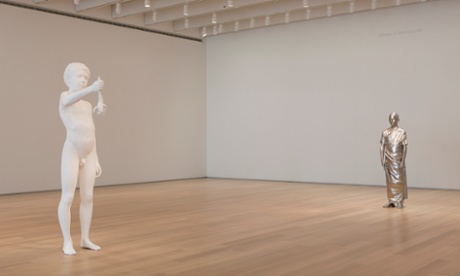
For Ray, scrupulous reproduction – indeed, fanatical reproduction – is not a goal in itself. It’s a means to insist on the relevance and the potential for his chosen medium, at a moment when room-filling installations have more pull than discrete sculptures. Another strategy: scaling up his figures to, say, 150% of life size. The absolutely extraordinary Boy With Frog, from 2009, stands 8ft tall, and the discrepancy between his height and his youth takes on creepy, unforgettable power. The figure’s body is not Greco-virile, but soft and puerile. The buttocks are small, the thighs unmuscled. He has no nipples. The poor frog, with his left leg flopping down, is covered in warts, but both the smooth child and the scurfy amphibian are made of the same stainless steel, painted the same undifferentiated white, unified into a scary and haunting whole.
The last time I’d seen Boy With Frog was in Venice, where it stood outside the Punta della Dogana: a pristine, mock-heroic sculpture jutting into the Grand Canal. The sculpture elicited a fevered backlash, though, and two years ago Venetian officials ordered it removed, replacing it with a kitschy lamppost perfect for tourist smooches. (The Art Institute, more out of necessity than squeamishness, has prefaced this show with a warning: Some works in this exhibition may not be suitable for younger viewers.) Ray has taken a considered risk by employing perilous subject matter in his recent art, most obviously nude children and adolescents. The risk is worth it. For while his innovations in matter and space would be achievement enough on their own, it’s ultimately the psychological profundity of his vulnerable boys and ruined cars that most endures in the memory.
The newest work in this unmissable show, Huck and Jim, depicts the heroes of Mark Twain’s novels at 50% more than life size. Jim, standing proud at 9ft tall, has his hand hovering over the back of Huck, who’s bent at the waist. Their nudity classicizes these Americans, though it stems directly from Twain’s novel (“We was always naked, day and night,” Huck says, “and besides I didn’t go much on clothes, nohow”), and the lack of clothes, far from being prurient, beautifully unites the escaped slave and the white outsider – who are here the same color, light gray.
Huck and Jim was initially conceived for the plaza outside the recently opened new home of the Whitney Museum in New York, where it should have greeted the thousands and thousands of visitors streaming down the High Line into that new building. As Calvin Tomkins of the New Yorker recently reported, though, the Whitney backed down – fearful that “this particular image of a naked African-American man and a naked white teenager in close proximity ... might offend non-museum-going visitors.” It is New York’s loss.
Charles Ray: Sculpture, 1997–2014 is at the Art Institute of Chicago to 4 October