Just a day after the sudden death of his father, 10-year-old Donald Kennedy found himself sitting in the House of Commons gallery, flanked on one side by his mother, Charles Kennedy’s ex-wife Sarah Gurling, and on the other by Gurling’s brother, James, to hear tributes to his father. It was an experience he will come to value rather more when he’s older than he must have done on the day: he seemed both there and not there, bewildered and lost.
Donald also looked uncannily like a much younger version of his father, and it was hard not to imagine Charles sitting alongside his family. What he would have made of it all is anyone’s guess. Laugh or cry? Both, probably. These occasions are strange affairs – momentary truces in the parliamentary calendar in which the finest of words are often spoken from all sides of the house, revealing every bit as much about the living as the departed. The very qualities Charles was most frequently remembered for – his humour, loyalty, sense of principle and generosity – were all too often ones the speakers seldom revealed themselves. Death plays these tricks.
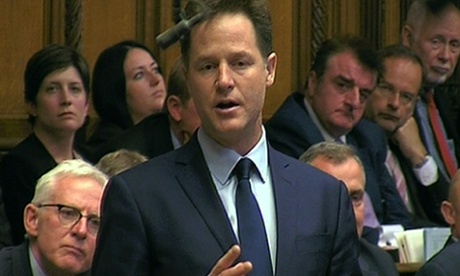
David Cameron played it fairly straight, admitting his main point of contact with Kennedy had been to share the odd fag behind the Commons’ bike shed when he was a newcomer to parliament in 2003, and the first genuine sign of emotion came when Nick Clegg rose to give his eulogy. At several points his voice cracked as if he was on the point of breaking down. First when talking about Kennedy’s humanity and then when talking about the coalition.
“It is a measure of the man that, though he was almost alone in our party in not supporting the decision to enter into coalition in May 2010, there was never a hint of reproach or ‘I told you so’ in the advice he gave to me,” Clegg said. “He remained unstintingly loyal, no matter what the circumstances and no matter how strong the temptation must have been to blow his own trumpet and say that events had proved him right.”
Those particular tears might have been as much for himself as Kennedy. It was certainly the closest Clegg has come to admitting the coalition had been a huge mistake and a disaster for the Lib Dems. Kennedy’s own tears would certainly have been more for his party rather than his colleague or himself: from a record number of 62 MPs when Kennedy stood down as leader, the Lib Dems are now reduced to a sorry rabble of just eight.
There was also much mention of Kennedy’s opposition to the war in Iraq; some of it with a “me, me, me” undertone from the likes of Diane Abbott, anxious to remind everyone that she too had voted against the war and been proved right, but mostly along the lines of “he was a man who stood up for what he believed” from those who had supported the war. Kennedy’s family looked on, proud yet bemused. Many in parliament had vilified Charles for his stance over Iraq, and politics – not to mention, Kennedy himself – might have been better served if they had chosen to say some of this while he was still alive.
The most touching tribute came from Labour’s Steve Pound. It was touching because it was the most real. He dared say the unsayable. While others had merely alluded to Kennedy’s “demons” and “difficulties”, Pound raised the awkward question. “Maybe we could have done more,” he said. Indeed. Kennedy might have been on the right side of the arguments about the coalition and Iraq, but it was an open secret he had been on the losing side of his argument with booze for years. If his colleagues had taken mental health and addiction issues more seriously, then he might have stood a better chance of winning that one too. In parliament, such things are all too often someone else’s tragedy.
There again, all too much of the Commons’ activity operates on the principle of do as I say, not as I do. Never more so than at prime minister’s questions, which had immediately preceded the Kennedy tributes. There it was business as usual. Sincerity and kindness replaced by evasion and abuse. For Cameron, PMQs means just that. A chance to ask his own questions rather than answer them. Harriet Harman may not be the most gifted of advocates but he could at least have made an effort to listen to what she was saying rather than sneering. Maybe being patronising just comes all too naturally to him; his treatment of Labour newcomer Cat Smith could have been a Flashman parody. The prime minister could do well to think of just how parliament might choose to remember him when his time comes.