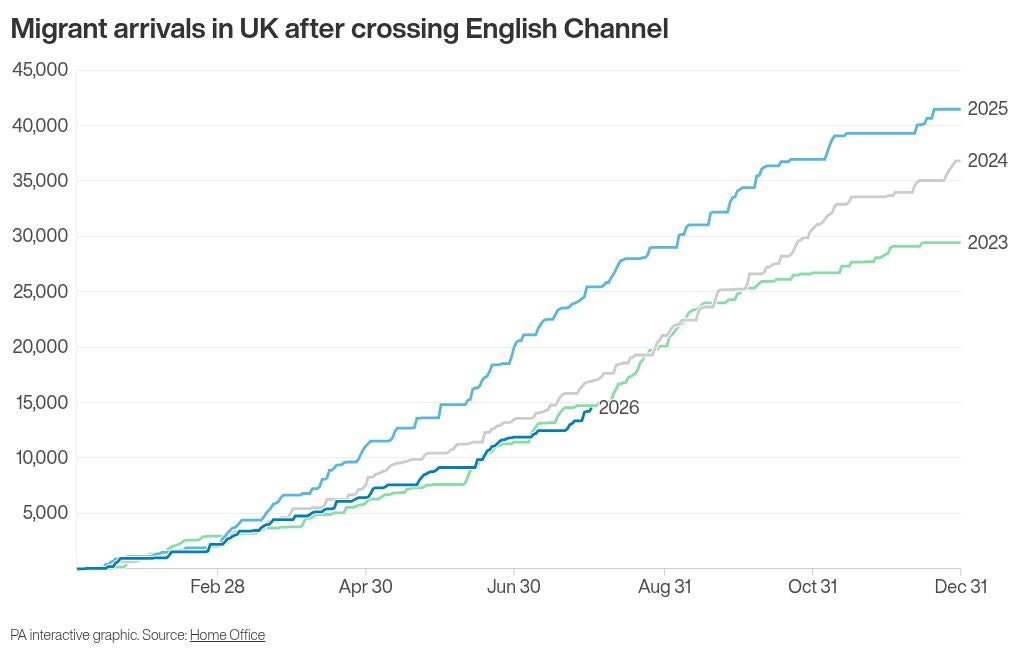
The number of migrants who have reached the UK after crossing the English Channel so far this year is more than 40 per cent lower than at this point in 2025.
This is despite a recent flurry of arrivals.
Here, The Independent looks at the latest available data for crossings and the long-term trends.
Year-on-year comparisons
Some 14,526 migrants have arrived in the UK by crossing the Channel in small boats this year as of August 1, according to provisional figures from the Home Office.
This is 43 per cent below the number of arrivals at this stage last year, which was 25,436.

It is also 14 per cent below the number at this point in 2024, which was 16,903.
Looking further back, this year’s total is only slightly below the number of migrants who had arrived by this stage in 2023, which was 14,732.
The record for the largest number of migrants to arrive in the UK in a calendar year is 45,774, which was set in 2022.
This year’s current total of 14,526 is 15 per cent below the figure at this point in 2022.
Overall, 207,159 migrants have arrived in the UK after crossing the Channel since data began on January 1 2018.
Of these, 127,919 (62 per cent) arrived under Conservative governments and 79,240 (38 per cent) came under the current Labour Government, including 2,057 (1 per cent) since Andy Burnham became Prime Minister.
Migrants per boat
While the number of migrants arriving in small boats is running at a lower level this year, the average number of people per boat is at a record high.
There were 2,316 arrivals in July, the lowest figure for the month since 2020.
Only 32 boats were used to make these crossings, however, giving an average of 72 migrants per boat.
This is the highest average for any month since data on Channel crossings began in 2018.
One of the boats that made the journey in July this year was a dinghy carrying 165 people.
This was the largest number of migrants to reach the UK in a single boat to date.
The average number of migrants per boat has increased each year since 2018.
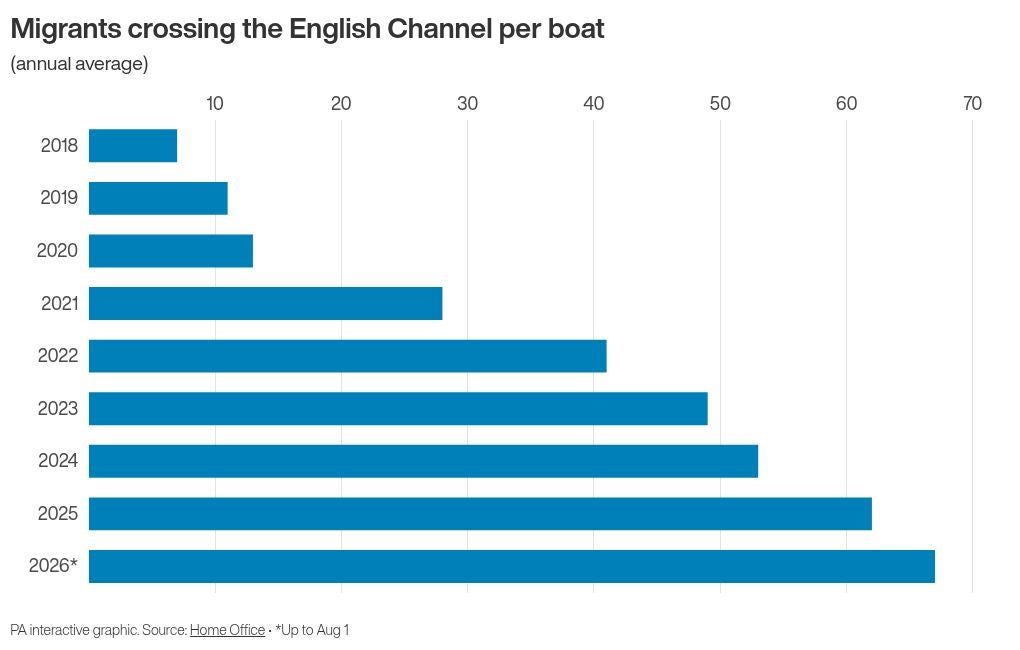
The figures were low to begin with, at seven per boat in 2018, 11 in 2019 and 13 in 2020.
The average then jumped to 28 per boat in 2021, 41 in 2022, 49 in 2023, 53 in 2024 and 62 in 2025.
So far this year the average is running at 67 per boat.
Nationality of arrivals
Data on the nationality of migrants crossing the Channel is published every three months.
The latest figures go up to the end of March 2026.
They show that four nationalities accounted for more than half of the arrivals in the year to March: Eritrean (17.9 per cent of the total), Afghan (11.4 per cent), Sudanese (11.2 per cent) and Iranian (11.1 per cent).
The next most common nationalities were Somali (9.5 per cent), Iraqi (4.1 per cent), Ethiopian (4.1 per cent) and Syrian (3.4 per cent).
It is the first time Eritrean has topped the list of nationalities for arrivals in a 12-month period ending in March.
Afghan was the most common nationality in 2024/25 and 2023/24, while Albanian was top in 2022/23 and Iranian was top in 2021/22, 2020/21, 2019/20 and 2018/19.
Asylum granted to arrivals
There is a greater lag with data for asylum granted to migrants arriving on small boats, because of the time it takes for claims to be processed, assessed and recorded.
The latest Home Office figures go up to the end of December 2025.
They show that of the 187,779 migrants who have arrived in the UK by this route since 2018, 178,845 (95 per cent) claimed asylum.

Of those who did claim asylum, 79,589 (44.5 per cent) had been granted refugee status or another type of leave by the end of 2025, 53,305 (29.8 per cent) had been refused, 33,413 (18.7 per cent) were classed as “withdrawn” – either by the Home Office or the claimant – and 12,538 (7.0 per cent) were still waiting a decision.
Separate figures just for asylum seekers show that 42 per cent of people who claimed asylum in the UK in the year to March 2026 had arrived in the country after crossing the Channel by small boat.
Age and sex of arrivals
The latest figures on the age and sex of migrants arriving by small boat across the Channel are for the year to March 2026.
Of the 39,271 arrivals during this period, 38 per cent (15,015) were men aged 25 to 39 and 28 per cent (11,053) were men aged 18 to 24.
Some 9 per cent (3,676) were boys aged 17 and under and 6 per cent (2,349) were men aged 40 and over.
Overall, males accounted for 82 per cent (32,093) of arrivals in 2025/26.
Females made up 15 per cent (5,875) of the total, with 3 per cent (1,221) being girls under 17.
For 3 per cent of arrivals (1,301) no data was recorded.