New Home Office figures reveal a sharp fall in the number of migrants crossing the English Channel into the UK during the first half of the year.
Some 11,884 people arrived between January and June, marking a 41 per cent decrease from the 19,982 recorded in the same period last year.
This total is also 12 per cent lower than the 13,489 who arrived in the first six months of 2024.
The steep decline is likely influenced by factors such as weather, the supply of small boat parts, government policy, and broader migrant flows into Europe.
In April, Home Secretary Shabana Mahmood signed a three-year, £662 million agreement with French authorities to support beach patrols, aiming to further reduce arrivals.
Ms Mahmood is also seeking to overhaul the asylum system to deter crossings and deport people easier, including proposed changes to make refugee status temporary.
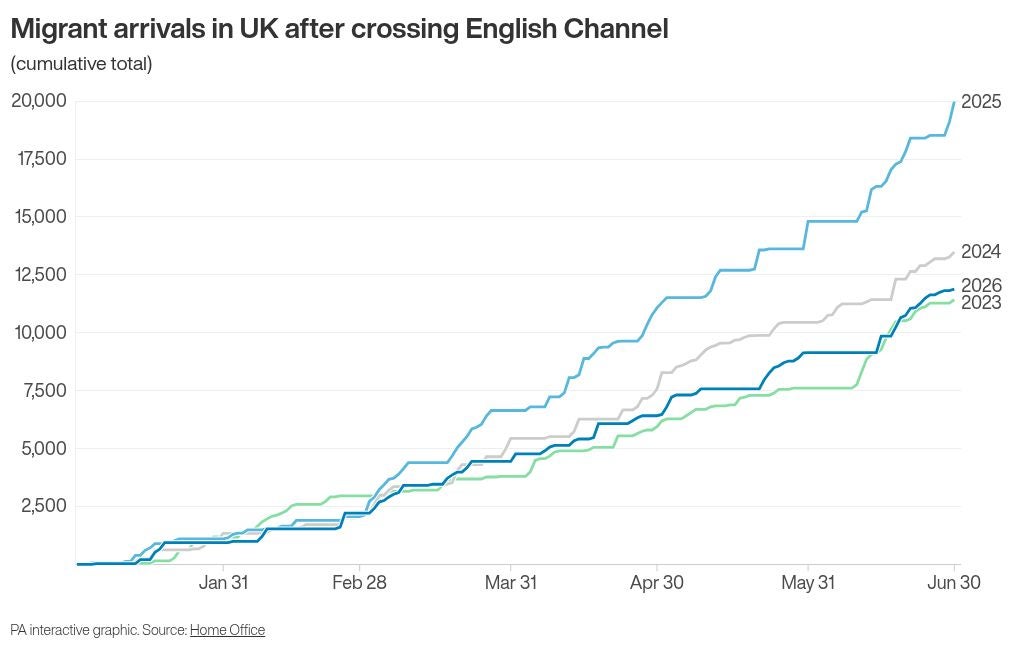
Looking further back, this year’s figure for January-June of 11,884 is 4 per cent higher than the equivalent number in 2023 (11,433) and 7 per cent below the figure in 2022 (12,747).
While the number of arrivals has fallen so far this year, the number of migrants arriving per boat has climbed to a new high, averaging 65 per craft over January to June.
The average across the whole of last year was 62 migrants per craft, while the figure for January-June 2025 was 58.
Some 2,742 migrants arrived last month after crossing the Channel, the lowest number for June since 2021.
New-build homes “should never house asylum seekers”, the Home Office has said, after it emerged that up to 83 migrants will be moved into a development in a rural Shropshire village.
The plans for Stoke Heath, first raised by Conservative MP Mark Pritchard in the House of Commons in June, have been met with strong opposition from residents who say the houses should be for locals.
The Home Office said it had introduced “robust processes” to ensure new-build sites like Stoke Heath can “never be considered again”.
Labour has pledged to stop using asylum hotels by the next election, moving towards housing asylum seekers in the community as well as in former military barracks.
Earlier this week, the Home Office announced that asylum seekers will be made to pay up to £10,000 towards the cost of their accommodation and support once they start earning.
It is one of a number of policies aimed at tackling migrants in the Immigration and Asylum Bill, which was introduced to Parliament on Tuesday.