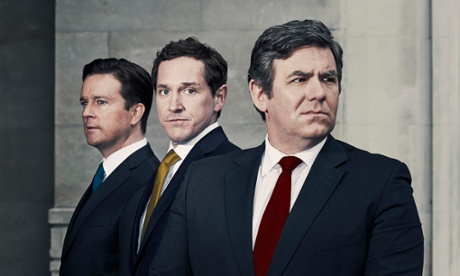
How exactly did we get into this state? It’s a question many people will be asking themselves right now; not least the Liberal Democrat leader, Nick Clegg, who has gone from Messiah to also-ran in just five years. In politics, the truth is often a moving target and a TV drama is as good a place to go looking for it as any. Channel 4’s Coalition retells the seven days in May 2010 between the general election and the Downing Street rose garden bromance. Its writer, James Graham, has form with hit plays such as Privacy and This House and is thorough with his research; for Coalition he interviewed many of the politicians involved in the negotiations, so it demands to be taken seriously.
Well, quite seriously. It starts almost as a light-hearted romp on the night of the election. Clegg is at home biting his nails while his wife, Miriam, strokes his hair soothingly. Gordon Brown is lying on the sofa in a darkened room being very tortured while his wife, Sarah, looks on desperately. Samantha Cameron is lying down with her head on her husband’s lap reading a copy of Vogue as he has a mini meltdown. It is the set up of an Ealing comedy in which three not particularly competent politicians find themselves scrabbling around to find a way of forming a government.
As I said, in fiction you sometimes find a greater truth; though for the country’s sake, you hope not.
The comedy is maintained almost throughout. Brown (Ian Grieve) is portrayed as a social incompetent who can’t even follow the simple cue card instructions, “Stop saying, Look” and “Don’t call them the Liberal party”, held up by Harriet Harman and Peter Mandelson – Mark Gatiss steals the show with his pitch-perfect portrayal – during his telephone negotiations with the Lib Dems. Only in his resignation is he accorded any gravitas or dignity. Clegg (Bertie Carvel) is mostly a forlorn Hugh Grant figure, wrestling with his ambition and conscience.
Cameron (an uncanny doppelgänger in Mark Dexter) comes across as a quite-nice-but-rather-dim posh boy who has a vague inkling that he is out of his depth but is trapped into being the front man for the George Osborne show. The chancellor was one of those who helped Graham with his research, so it’s possible this is also his view. Of the three leaders, Cameron is definitely the one who will cringe the most. Though he will be able to commiserate with Ed Balls, aka Harry Enfield’s Kevin.
There are some stunning details: the Lib Dems protesting against their party doing a deal with the Tories turn out to be trade union activists organised by Mandelson – Graham insists this is accurate. But Coalition is at its best when the humour is touched with pathos, when the political frailty becomes human frailty.
The look of panic that crossed Clegg’s face when the cabinet secretary, Gus O’Donnell, informed him the country was becoming more and more broke every hour that a decision wasn’t reached felt all too real. As did the obvious enjoyment with which O’Donnell said it. This felt like a familiar politics of confusion, personal advantage, getting by and living for the day; a politics where ideology and belief are only ever a starting point in negotiations.
Some bits rang less true. Clegg’s soliloquy about being damned for what he had done just before he joined Cameron in the rose garden had a revisionist feel. On the day itself, the Lib Dem leader looked all too happy to be at the centre of the action.
Paddy Ashdown’s instant final conversion from leftist to Cleggist seemed like convenient dramatic catharsis. But who knows? We can’t rely on the politicians to tell us what really happened, so why should we expect more of Graham? It’s enough to make you laugh. Or cry.
Coalition is on Channel 4 at 9pm on Thursday 26 March