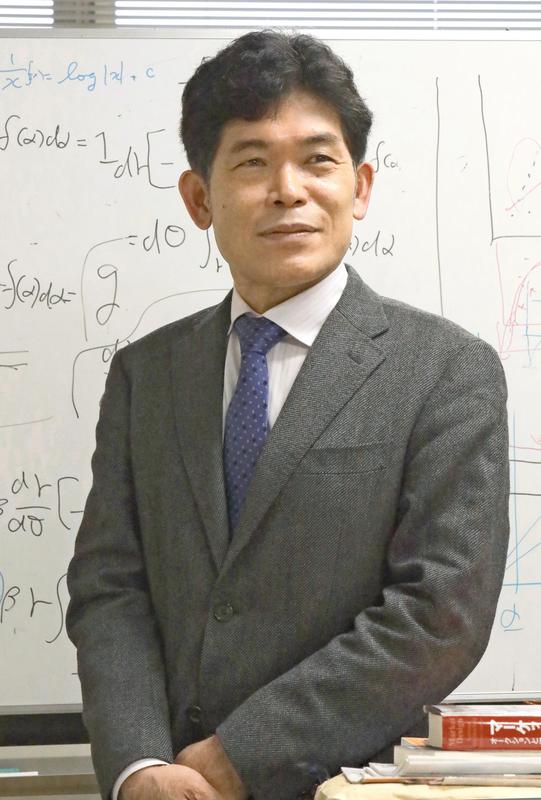
Teleworking is even spreading in Japan as a measure to contain the new coronavirus. How should we deal with the new way of working? I visited the Faculty of Economics at the University of Tokyo to seek a professor for some e on how to work and study at home. Prof. Noriyuki Yanagawa, 56, lived abroad for a lengthy advicamount of time as a youngster, passed the Japanese high school equivalency examination after being self-taught, and later entered the University of Tokyo's Graduate School of Economics.
Ukai: I feel uncomfortable with the term self-restraint from going out. What is required now is positive action to protect lives.
Yanagawa: The reality is that we cannot avoid the spread of infections unless we change our behavior. Therefore, it is important to positively change our lives and values so that our livelihoods become better, rather than simply accepting self-restraint passively.
Q: Working remotely and online learning are attracting attention.
A: If it had not been for IT, what kind of life would have in isolation? We would have had to force ourselves to go to the office or just stay home, so it must have been a pretty miserable situation. Because of this technology, we can work and study at home to some extent, order online and receive medical treatment.
Some people seem to think that they have no choice but to work online because they can't go to their offices. But we should consider it positively as an opportunity for change.
Q: How does working remotely change the way we work?
A: People who have thought that working means going to work have to change their mindset. If you're working from home, you're more likely to have to think for yourself about what each person needs to do.
Q: Those used to taking it out on and criticizing subordinates, or used to returning home late at night saying "I was busy at work" and then are just grumbling and hanging around the house, the truth about their work would likely be revealed.
A: There may be times when you need to get angry, but if you have an online meeting, you will only hold important meetings, so there will be fewer unnecessary sermons.
Q: When working from home, it is difficult to distinguish between public and private, so there are concerns that working hours could become longer. There are also concerns that cases of abuse and domestic violence could increase due to the accumulation of stress at home.
A: In the age of technological innovation, it has been said that Japan, which tries to build a system without failure before moving ahead with it, is slow to respond compared to the United States and China. However, as long as we have to promote teleworking as much as possible, we have no choice but to do it through trial and error.
Q: Since 10 years ago you have been advocating that we should "live life without depending on a company from the age of 40."
A: The evolution of technology has accelerated the cycle of industrial decline and development. Moreover, in the era of the 100-year life span, 40 is the equivalent of 20 in the past, which is not the age to worry about the limits of one's work. That's why I have been insisting on improving skills and adapting to change.
Q: With teleworking, you don't have to spend time commuting, which leaves you more time to improve yourself.
A: There won't be any nonessential, nonurgent drinking parties, so it's a chance to build up your abilities.
Q: After graduating from junior high school, you studied on your own in Brazil, where your father was transferred, passed the Japanese high school equivalency examination and then went on to study at a University of Tokyo graduate school. What's the secret to improving your skills at home?
A: Actually, I've had a series of setbacks, and only about 10% of my study plans were realized. But I didn't blame myself for being lazy -- I was defiant that it was no use being lazy.
There's a Japanese term "mikka-bozu" (quitting after three days), but if you write a diary for only three days from every New Year's Day, that will make for 30 days over 10 years. It's better than doing nothing, that's how became self-taught.
Q: I see! So, what should I study?
A: It's a good idea to start learning something from an introductory level so you can sort out your work experiences. If you are a salesperson, you can learn marketing theory or psychology to sort out what you can and cannot do, and it will be an opportunity to review your work and to become able to present your abilities to others. This ought to change your second career.
Q: We can also study what we like, right?
A: But when you think about what you like, it's hard to make a choice, so you should think lightly about what you are interested in and take the first step.
In an age when the future is uncertain, there is no telling where the goal is. There will be a big difference in the future between those who keep quiet until the fog clears and those who move forward little by little.
Q: You're saying that we should use our brain because we can't move around due to the new coronavirus outbreak.
A: Yes. It's no use worrying about what happened. Economically, it is called the sunk cost bias. If we are bound by the past, the future will not open to us.
When the plague broke out in the 17th century, Isaac Newton, who was at the University of Cambridge, returned home for a year and a half. This has been described as "creative leave" because during this time he is said to have conceived of calculus and gravitation. Thinking deeply in a different environment will give you a chance to formulate new ideas.
Q: What do people need to note when teaching themselves? In your books such as "Dokugaku to Iu Michi mo Aru" (There is a path to educating oneself), you proposed not making notes and not highlighting texts in books.
A: Highlighting and summarizing the contents of a book are a good way to organize the given information. Such abilities are required in an era when goals are clear. But in an era when goals cannot be seen, original thinking based on knowledge, rather than knowledge itself, is required. In the first place, our knowledge is no match for smartphones.
Q: "It's hard to tell a poor thinker from a sleeping one."
A: In future society, it is dangerous to believe the popular theories before the current coronavirus problem occurred. It is important to read books and make counterarguments to the author. You need to think seriously about some countermeasures in case something unpredictable happens. This is technically referred to as a contingency plan.
Q: Is there no absolutely right answer?
A: If you take an approach that seeks absoluteness, you can no longer handle unexpected fluctuations.
-- Yanagawa is an economist born in 1963. After graduating from the Correspondence Course of the Faculty of Economics at Keio University, he completed the doctoral course of the Graduate School of Economics at the University of Tokyo. He has written books such as "Ho to Kigyo Kodo no Keizai Bunseki" (Economic analysis of law and corporate behavior) and "Todai Yanagawa Zemi de Keizai to Jinsei wo Manabu" (Study economics and life in the Yanagawa seminar at the University of Tokyo). He is also a member of the government's Council on Economic and Fiscal Policy.
Read more from The Japan News at https://japannews.yomiuri.co.jp/