Should there be a ‘Korean Derby’ at the quarter or semi-final stage at this year’s Asian Cup, there would be much excitement. Organisers would be rubbing their hands at the prospect of major international interest, with journalists doing the same before pounding keyboards and cranking up the word count. It is not something, however, that would be welcomed in Seoul or Pyongyang for all kinds of reasons, not least the fact that games between the two tend to put the ‘turd’ into ‘turgid’ and ‘stale’ into ‘stalemate’. Against different opposition however, North Korea may be a little more entertaining than expected as football on the other side of the 38th parallel is going places.
It would be good to give the press some football to write about. As comparatively little is known about North Korea, there is a misplaced mystique to a country that is not quite as interesting as many think. That may explain why Western journalists secretly love being brushed aside by the grim-faced minders that accompany the DPRK team overseas, a warm reminder of the Cold War that, like tackles from behind and gloveless goalkeepers, has faded from the football world.
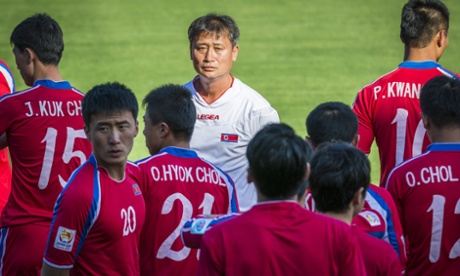
Being scowled at by the coach also provokes delighted disapproval. Yet it is hard not to feel sorry for these taciturn tacticians when they take a team to an international tournament. So rare is it that an official from this hermit kingdom is obliged to face the foreign media that he can become a spokesman for much more than football. Questions from well-attended press conferences are often not about the team or tactics but focus on whether the game will be televised at home, whether the leader – dear, great or young – has been involved in training and whether defeat will result in more than a bad result. Wary of, and unaccustomed to, foreign media to begin with, defensiveness is natural and grouchiness understandable.
The current team underwent a coaching change in December. Yun Jong Su was replaced by Jo Tong Seob in a move that had to be made after he was banned from stadiums during the Asian Cup. His crime was blasting biased officials after his Under-23 team lost the gold medal match of the Asian Games in October against South Korea in Incheon 1-0 thanks to a 120th minute goal.
It seems a little harsh and anyway, Yun was merely following a DPRK tradition of reacting badly to painful defeats. Back in 2009, Kim Jong Hun sat in front of the Seoul media after a 1-0 loss in qualification for the 2010 World Cup, refused to answer any questions and then accused local authorities of poisoning his players. The trench-coated tactician then stormed out, flanked by minders. A late and controversial Iranian penalty during qualification for the 2006 tournament ended in a riot outside the Pyongyang stadium with visiting players fearing for their lives. In the semi-final of the 2006 Women’s Asian Cup, North Korean players attacked the referee; one ran half the length of the pitch to give the official a hefty kick up the backside, after a last-minute equaliser was disallowed.
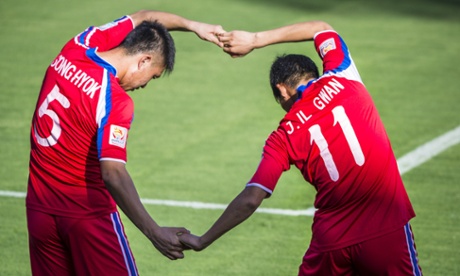
Yun liked to play 4-4-2, especially against Asian opposition, not that there are many games against teams from elsewhere. That may look dated but it is fluid and flexible, involving the midfielders and strikers comfortably rotating around the pitch to occupy different positions. Pak Sang Chol, often the creative force, drops deep in midfield to receive the ball and sees considerable movement ahead of him when he does, especially from the dangerous striker Jong Il Gwan and the two full-backs who are happy to get forward. Under Jo, assistant and the man who led the Under-19s to the 2010 continental championship, the same is expected but you never know. There was little evidence of such fluidity and movement in the 2011 Asian Cup when Jo presided over a flaccid first round exit.
The draw this time neither helps or hinders. China, Uzbekistan and Saudi Arabia make up a group that is a good deal more open in football terms than political. None of the quartet are expected to win but only, to an extent, China would be a surprise name in the semis. At least Yun has worked hard to help ensure that he won’t be missed and not just because he actually selected the squad. He has coached at various youth levels in the country, helping to lay the foundations of a long-term strategy aimed at ensuring continuity throughout the different age levels.
Attitudes are changing. There was a time when DPRK didn’t really bother with the Asian Cup. For most of its history, the team didn’t enter or it was barred for various reasons such as not granting qualification opponents visas to enter the country or simple late registration of players, but now authorities are keener than ever to engage in the search for more meaningful competition.
It’s not just about games but about experience. Four of the 23-strong Asian Cup squad play overseas (though 2010 star striker Jong Tae Se, now based in South Korea with Suwon Samsung Bluewings, has been left out), two in Japan and two in Switzerland. These days, as well as the international football school opened in Pyongyang in 2013 and that sometimes has Spanish coaches training the best talent there is, an increasing number of North Korean youngsters are heading abroad. Six of the starting 11 in the final of September’s Asia’s Under-16 championship, had spent time in Europe with the attackers going to Spain and the defenders to Italy. That tournament ended in victory, and, in October, North Korea got to the final of the Under-19 championship as well as the Under-23 Asian Games.
The Asian Cup may come a little too soon to reflect it completely, but the future for North Korean football is bright.