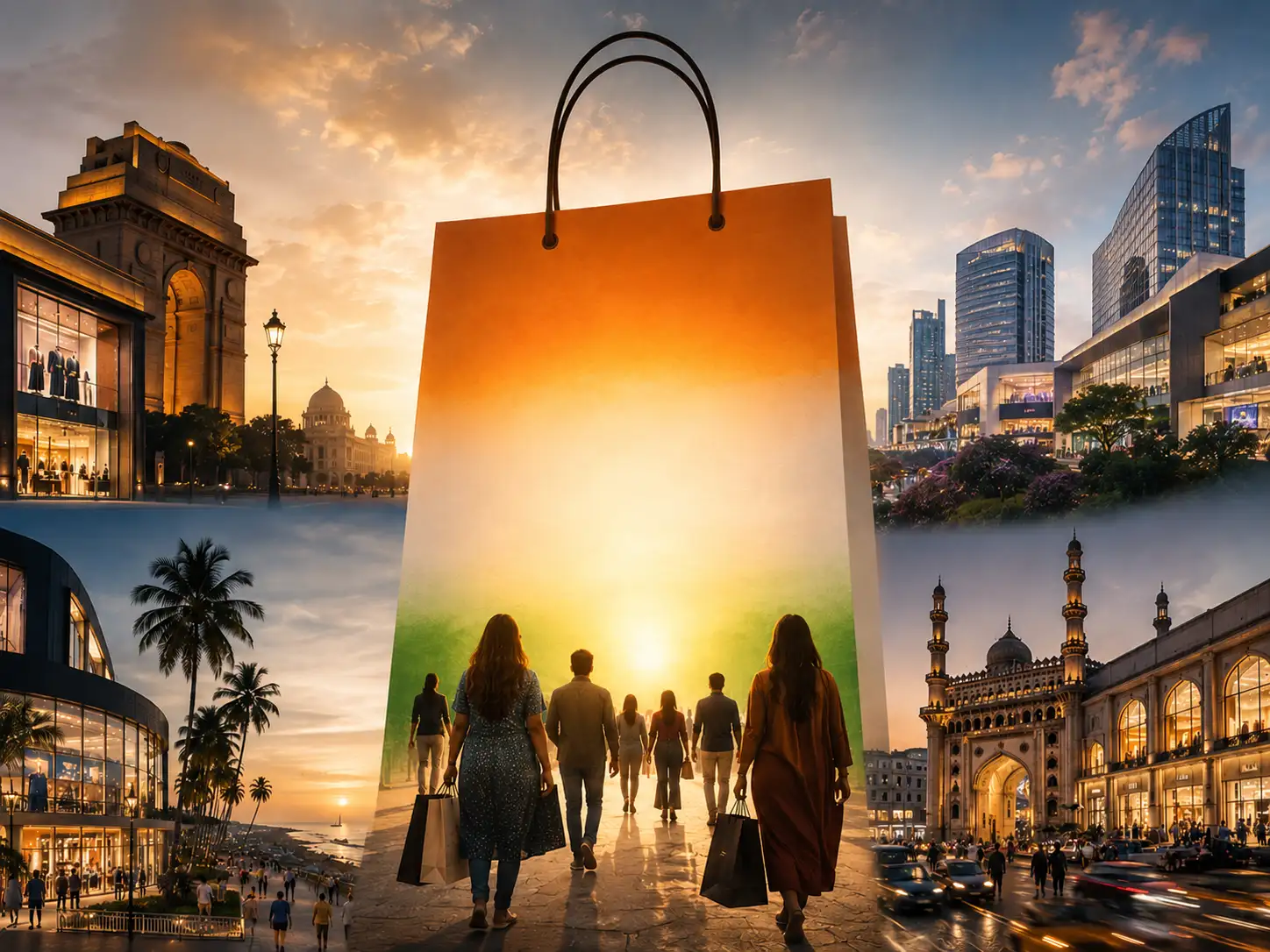
For decades, India’s retail story came with familiar landmarks. Delhi was where luxury announced itself loudly. Mumbai preferred quieter wealth. Bengaluru became the capital of startup and IT boom money and premium consumption. International brands entering India rarely looked much further.
Now look at Chandigarh, or Mangaluru and Lucknow.
Cities that once sat outside the core retail conversation are suddenly climbing ahead of much larger urban centres in attracting global brands, premium malls and institutional retail investment. India’s next shopping boom is no longer unfolding only inside metro skylines. It is spreading through smaller cities that global retailers once treated as secondary markets.
Also Read: Luxury in India is no longer defined by Delhi, Mumbai or Bengaluru
A new study by Knight Frank India suggests the shift is becoming structural.
The property consultancy’s International Brand Penetration Ranking 2026 mapped 24 Tier-2 cities using four measures, brand breadth, brand intensity, market readiness and consumption power. The findings point to what the firm describes as two parallel retail economies emerging across India - a mature metro market weighed down by ageing retail infrastructure and a younger Tier-2 market increasingly attracting international brands.
Some of the winners are unexpected.
Chandigarh topped the rankings despite having a population of just 1.3 million. The city outperformed much larger urban centres on consumption power, Grade A mall quality and international brand density.
Mangaluru emerged as India’s most brand-dense Tier-2 market, hosting more than 102 international brand stores per million people, nearly double of Chandigarh’s figure.
Lucknow, meanwhile, recorded the highest concentration of unique international brands among Tier-2 cities, with 112 brands spread across 5.6 million square feet of shopping centre stock.
That raises an obvious question. If smaller cities are surging ahead, what happened to the larger ones? The answer lies partly in infrastructure.
Knight Frank’s study said cities such as Surat, Jaipur and Nagpur, together representing roughly 16 million people and sizeable consumption expenditure, remain constrained not by demand, but by the lack of institutional-quality retail infrastructure capable of housing global brands.
Also Read: India's luxury promise hits a wall, not enough malls to shop in
These are markets where consumers are already spending, but modern retail supply has failed to keep pace.
The divide is becoming increasingly visible between India’s older retail ecosystems and newer ones.
While Tier-1 cities still account for 98 million square feet of organised retail stock, many continue to grapple with ageing malls built during the country’s first major retail expansion cycle between 2004 and 2013. According to the study, Tier-1 India currently has around 60 “ghost malls” operating with vacancy levels above 40%.
Tier-2 India presents a very different picture.
Its 36 million square feet of retail stock has largely been developed after 2010, and increasingly after 2018, creating newer and cleaner institutional-grade retail environments with lower vacancy levels and stronger operational efficiency.
That advantage is becoming powerful enough to alter the direction of international retail expansion.
Since 2020, Tier-2 India has added 5.9 million square feet of Grade A retail space, more than three times the equivalent addition in Tier-1 cities, according to the Knight Frank report. Tier-2 markets now hold 61% Grade A retail stock compared with 45% in Tier-1 cities.
The result is that global brands are beginning to treat smaller Indian cities less as experimental outposts and more as long-term consumption markets.
American companies dominate much of this internationalisation push. The study found that US brands account for 46% of all international stores across Tier-2 India and 91% of international food-and-beverage presence, driven largely by quick-service restaurant chains.
Asian brands, meanwhile, have emerged as dominant players in categories such as consumer durables and home and lifestyle products.
UAE-based retail groups hold nearly 79% of the department-store footprint across Tier-2 India.
Shishir Baijal, chairman and managing director of Knight Frank India, said the next phase of organised retail expansion would not be driven by metros alone.
“India’s next phase of organised retail expansion will not be led by the metros alone. What we are witnessing is the emergence of a parallel retail economy across Tier 2 India — one that is younger, more aspirational, digitally connected and increasingly capable of supporting international brands at scale,” he said.
“The findings of Bharat Internationalised – KF-IBPR 2026 demonstrate that population size is no longer the defining metric for retail success. Cities such as Chandigarh and Mangaluru are outperforming significantly larger urban centres because of stronger consumption intensity, superior retail infrastructure and sharper brand absorption capabilities.”
The report argues that consumption power is now replacing population as retail’s defining metric.
Urban monthly per-capita consumption expenditure ranges from ₹13,425 in Chandigarh to ₹5,114 in Chhattisgarh, revealing a near three-fold difference across emerging urban markets.
At the same time, smartphone penetration, UPI adoption and social media exposure have steadily erased what the study calls the “brand discovery gap” between metro and non-metro consumers.
Consumers in smaller cities are no longer waiting to discover trends years later. They are seeing the same products, influencers and campaigns at almost the same time as shoppers in Delhi or Mumbai.
That is changing behaviour quickly.
According to Cushman & Wakefield’s Q3 2025 Retail Market Beat report, leasing activity in Tier-2 and Tier-3 cities surged last year, pointing to stronger retailer confidence and shifting consumer preferences.
Fashion, food and beverage, and entertainment continue to drive leasing momentum in these markets, reflecting how consumers are increasingly prioritising experiences rather than purely transactional shopping.
Developers are responding by building retail formats that combine shopping, dining and entertainment in a single destination.
The transformation is also changing how luxury brands approach India itself.
For years, luxury executives broadly viewed the country through a metro lens: Delhi for display, Mumbai for quiet wealth and Bengaluru for technology money.
That map is beginning to blur.
Industry executives now describe three distinct consumer groups shaping luxury demand: aspirational buyers entering luxury for the first time, first-generation wealth creators building premium wardrobes and legacy wealthy consumers who remain the least convinced about shopping locally.
As wealth spreads geographically, brands are adjusting their strategies.
Many luxury companies are moving beyond traditional advertising and increasingly reaching wealthy consumers through private banks, invitation-only events and wealth management networks.
Weddings and milestone gifting continue to dominate categories such as jewellery and couture. But luxury consumption itself is becoming more everyday, more lifestyle-driven and increasingly less confined to India’s biggest cities.