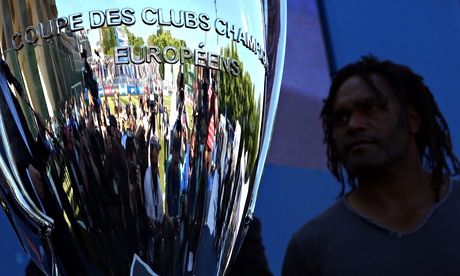
Football has not yet reached the same level of relentlessness as horse racing, where a new season seems to begin just as jockeys are leading their weary mounts back to the paddock following the end of the previous push, but the gap between campaigns is getting so very short that Cristiano Ronaldo would wear it if he could. So it is that at the end of this month the 2015-16 Champions League kicks off, with the leading sides from Wales and Northern Ireland among those contesting the first preliminary round of a tournament that will feature some intriguing new faces, big comeback clubs and the well-heeled regulars.
Not many people will be expecting Belfast’s Crusaders, who were crowned Northern Irish champions for the first time in 18 years in April, or the New Saints, Welsh champions for a fourth successive year, to be in the competition by the time Manchester United re-enter the European fray for August’s final play-off round. But both those sides will fancy their chances of progressing at least beyond the first round, which features the continent’s eight lowest-ranked domestic champions, including, for the second time, those of Gibraltar (yes, Lincoln Red Imps again).
The Danish champions, Midtjylland, one of the most innovative clubs on the continent, will be followed with particular curiosity when they make their Champions League debut in the second preliminary round, the same stage as sides such as Celtic, Steaua Bucharest, Partizan Belgrade and the rising Cypriot force Apoel Nicosia make their entrance.
Midtjylland won their national title for the first time thanks largely to their use of mathematical modelling for player recruitment and match tactics. Owned by Matthew Benham, the former hedge fund manager and professional gambler who also owns Brentford, and run by the 31-year-old Rasmus Ankersen, who will also serve as Brentford’s co-director of football next season, Midtjylland dominated Denmark, scoring more than 30% more goals than any other team, by using statistics and performance data to hone the efficiency of their play.
All top clubs use analytics and various motivational techniques, but few have applied them as purely as Midtjylland and the evidence suggests they are on the right track. It will be fascinating to see to what extent their extremely rationalised use of resources enables them to defy teams with far greater wealth.
United, for instance, will invest heavily again this summer in spite of (and because of) costly mis-steps in the transfer market last term. How closely could Midtjylland compete against a club that can afford to splurge on replacements for Radamel Falcao and, perhaps, David de Gea?
Other possible opponents for United in the play-off include Monaco, who knocked out Arsenal this season, CSKA Moscow, Sporting Lisbon or Lazio, who return to the competition after an eight-year absence.
Waiting in the group stages – for the first time – will be Gent, the newly crowned champions of Belgium, and Borussia Mönchengladbach, who were beaten by Liverpool in the 1977 European Cup final and in the semi-final the following year but have never reached the group stages of the modern Champions League.
Lyon’s presence in the group stages, a reward for running Paris Saint-Germain so close, is a sign that the club who were regulars in the competition until four years ago are re-establishing themselves. Their renaissance is due to shrewd player development, with the bulk of their squad being homegrown. How well they do next season will be influenced by their ability to fend off admirers of their young talent over the summer, with the striker Alexandre Lacazette and the gifted Nabil Fekir attracting interest from most of Europe’s giants.
On the home front, at least, Lyon, after several seasons of cost-cutting, are back in a position to prise players from most other Ligue 1 sides and they have already begun luring players from Marseille, with the full-back Jérémy Morel joining this last week.
If Lyon progress beyond the group stages they could host a knockout match in their new 59,000-seater stadium, which is scheduled to open in January, and promises to be an arena befitting a club that aspires to be classed among Europe’s elite.
As for the Premier League representatives in the group stages, a change to the seeding system means that from next season the champions of the continent’s top eight seeds will be ranked in Pot 1, thus avoiding the absurd situation that occurred this season when Arsenal were ranked higher than the reigning English champions, Manchester City. Next season, Arsenal will be alongside City and Real Madrid in Pot 2, with Chelsea in Pot 1. A daunting draw is still possible, though.