LAKESHORE, Calif. _ A low gargle echoes against granite cliffs and resounds in the wooded canyons.
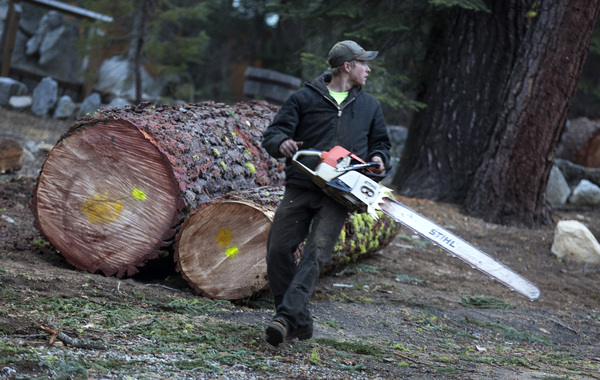
Each pull of a starter handle and squeeze of a throttle is punctuated by the crack of splintering wood as another dead tree falls in a forest that's changing all too rapidly.
Niles Kant stands at the base of a red fir. Its crown, a thatch of brown needles, rises nearly 175 feet above a collection of cabins in the national forest.
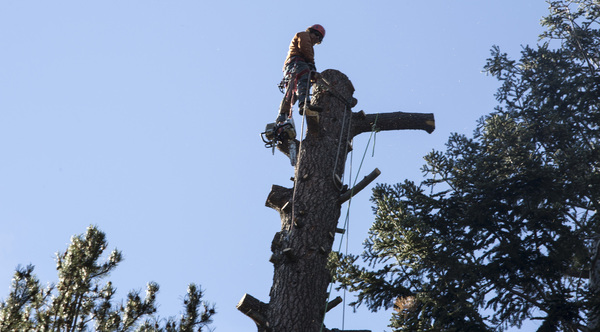
The fir, partially cut at its base and tethered to a rope that will direct its fall, is one of nearly 20 trees that Kant and his crew will drop today, a volume that can never keep pace with the need.
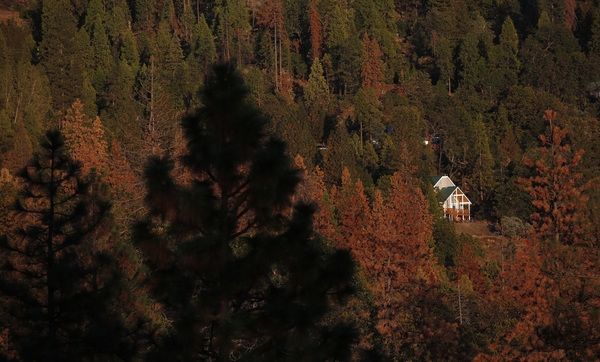
Estimates by the U.S. Forest Service put the number of dead trees in California forests at 102 million, broad swaths that are a wildfire and public safety risk. Declaring a state of emergency last fall when the count stood at 40 million, Gov. Jerry Brown ordered state agencies to clear these hazards.
The die-off has hit the southern half of the Sierra Nevada range _ Fresno and Tulare counties _ especially hard. The Forest Service estimates more than 24 million trees in this region are dead, and getting rid of them has become both a problem and an opportunity.
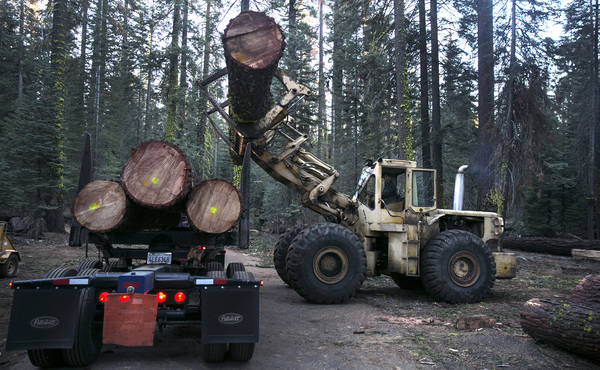
"There is a gold rush for those of us who are willing to bust ass," says Kant, who charges $1,700 a day for his services.
Kant, 49, owns the Huntington Lake Tree Service, one of more than two dozen outfits working along California 168, which begins just east of Fresno and ends at Huntington Lake, elevation 7,000 feet.
Since first arriving in these mountains in 1997 _ and starting a firewood company 15 years ago _ Kant has watched as drought, beetle infestation and warming temperatures, all symptoms of climate change, have transformed the mountains he loves.
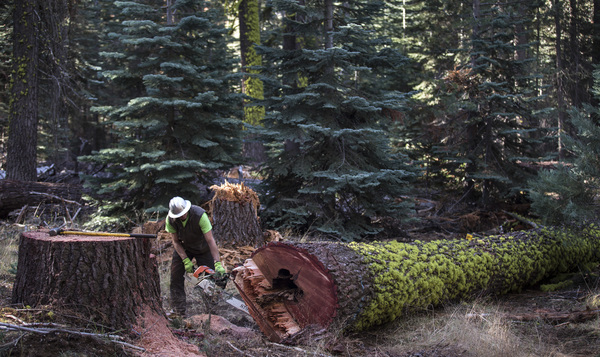
"I used to think that nothing could affect us in the forest, but between the fires and the drought, the forest is hurting," he says.
Today, he and his crews are rushing to beat the approach of winter, when storms and snowfall shut down the higher elevations and the income that this disaster has delivered to them, one tree at a time.
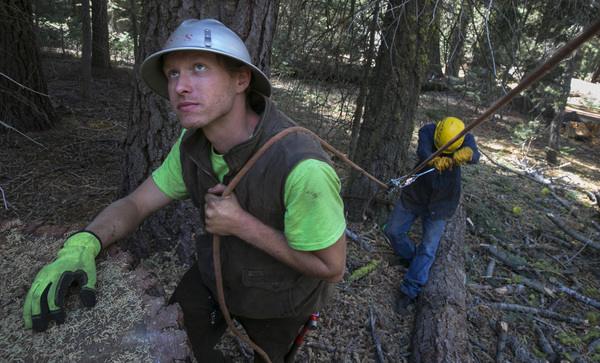
The fir's crown starts to tremble, and the back cut grows wider. Kant steps away. His son, Brock, kills the saw. The guide rope is cinched tight, and Garrett McGee delivers one final shot, his sledgehammer clinking against the wedge.
A terrible groaning from the stretching and tearing of wood fibers fills the campground.
Picking up speed, the fir crashes through the surrounding canopy, severing its limbs and those of neighboring trees. It lands with the force of a 10-ton truck hitting a wall at 90 mph, an explosion gauged to be the equivalent of four pounds of TNT.
The impact kicks up a gust of wind. Branches, bark and duff fly. The surrounding mountains capture the echo. Then there is silence.
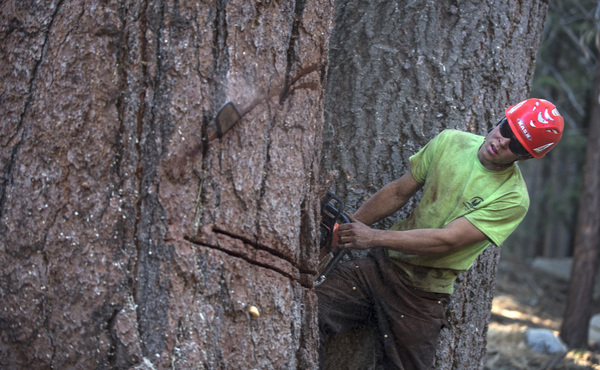
"Beautiful, Bubba," Kant shouts to his son.