
Numbers That Should Not Exist
Every eight minutes, an Indian woman dies of cervical cancer. That figure comes from ICMR data published in its National Cancer Registry Programme report, and it has not moved in the direction it should. India records roughly 1.25 lakh new cervical cancer cases annually and accounts for about 23 percent of all cervical cancer deaths worldwide, this in a country that is not the world's largest by population alone, but by the specific failure to deploy tools that already exist.
The disease is not mysterious. The biology is understood. The interventions work. A 2020 analysis published in The Lancet Oncology confirmed that a combination of HPV vaccination in adolescent girls and two rounds of cervical screening in a woman's lifetime could reduce cervical cancer mortality by more than 60 percent in low- and middle-income countries within a generation. India has both interventions available. The gap is in delivery, not discovery.
What HPV Does and When the Window Closes
Almost all cervical cancers, more than 99 percent, are caused by persistent infection with high-risk strains of human papillomavirus, or HPV. The virus is sexually transmitted and extremely common. Most infections clear on their own within two years. When they don't, certain strains, particularly HPV 16 and HPV 18, can cause cellular changes in the cervix that, left undetected, progress to cancer over 10 to 15 years.
That slow progression is the opening medicine has to work with. At the pre-cancerous stage, treatment is straightforward and curative. At stage one, five-year survival rates exceed 90 percent. By stage three or four, survival drops below 40 percent. The women dying of cervical cancer in India are not dying because the disease moved too fast. They are dying because no one looked in time.
The Vaccination Gap
HPV vaccination is most effective when given before sexual debut, which is why the recommended window is ages 9 to 14. India's government approved the HPV vaccine in 2008. It took until 2023 for the Centre to announce inclusion of the domestically produced Cervavac vaccine in the Universal Immunisation Programme, and rollout is still reaching states in phases.
Cervavac, developed by the Serum Institute of India, costs significantly less than imported alternatives and targets HPV strains 16 and 18, which together cause roughly 70 percent of cervical cancers in Indian women. The delay between approval and programme inclusion represents more than a decade of girls who aged through the optimal vaccination window without access. Private vaccination exists, but at costs that put it beyond reach for most families outside urban centres.
Awareness is a separate problem. In a 2019 survey conducted across six Indian states by the Public Health Foundation of India, fewer than 30 percent of women had heard of HPV as a cause of cervical cancer. Vaccination cannot be sought for a disease whose cause is unknown.
Why Screening Fails the Women Who Need It Most
A Pap smear or an HPV DNA test can catch pre-cancerous changes years before they become cancer. Neither requires sophisticated equipment. Both are available in government health facilities across India. The coverage numbers tell a different story: national surveys consistently show that fewer than 3 percent of Indian women have ever had a cervical screening test.
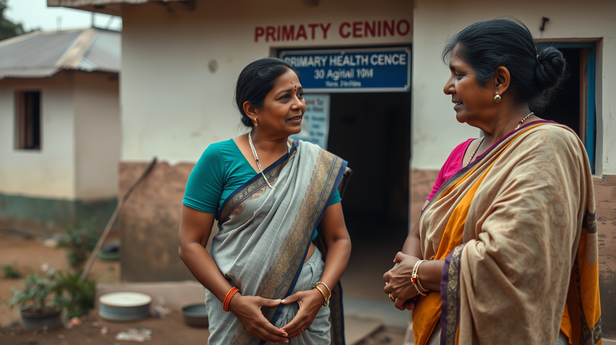
Several things drive this. Gynaecological examinations carry stigma in communities where a woman's body is considered a private matter, even from medical professionals. In many households, a woman cannot visit a clinic without her husband's knowledge or permission, and cervical screening requires explaining why the visit is necessary. Rural primary health centres often lack female doctors or trained female health workers for the procedure, and women who would accept the test from a woman refuse it from a male provider.
Distance compounds everything. A woman in a taluka town may need to travel two to three hours to reach a facility that offers HPV DNA testing. The test requires a follow-up visit if results are abnormal. Each visit means lost wages, childcare to arrange, and explanations to give. The system was not designed around her actual day.
What Early Detection Actually Requires
The clinical pathway is short. A single HPV DNA test, which can now be self-administered with a swab kit, identifies high-risk infection. If positive, a visual inspection with acetic acid (VIA), a procedure that takes minutes and requires no laboratory, can identify pre-cancerous lesions. Cryotherapy, a cold-treatment procedure, can then destroy those lesions in the same visit. This screen-and-treat approach, recommended by the WHO, requires no biopsy, no waiting for lab results, and no second appointment.
ASHA workers in several states have been trained to conduct VIA. Pilot programmes in Andhra Pradesh and Telangana have shown that community-level screening drives, when backed by consistent supply chains and genuine outreach, can reach women who would never walk into a hospital. The model scales. What it requires is sustained funding, trained personnel, and the political will to treat women's cancer prevention as a public health priority rather than a periodic campaign.
The Distance Between Knowing and Doing
India's cervical cancer burden is not a knowledge failure at the level of medicine. Researchers know the cause, the prevention, the treatment, and the cost of doing nothing. The burden persists because each layer of the system, policy timelines, facility design, community norms, household dynamics, adds friction at exactly the point where a woman might have been reached.
Vaccination protects the girl who hasn't been exposed yet. Screening catches the woman who was. Between those two interventions, there is almost no point at which cervical cancer cannot be stopped. The deaths that happen anyway are not the cost of medical complexity. They are the cost of ordinary, fixable delay.