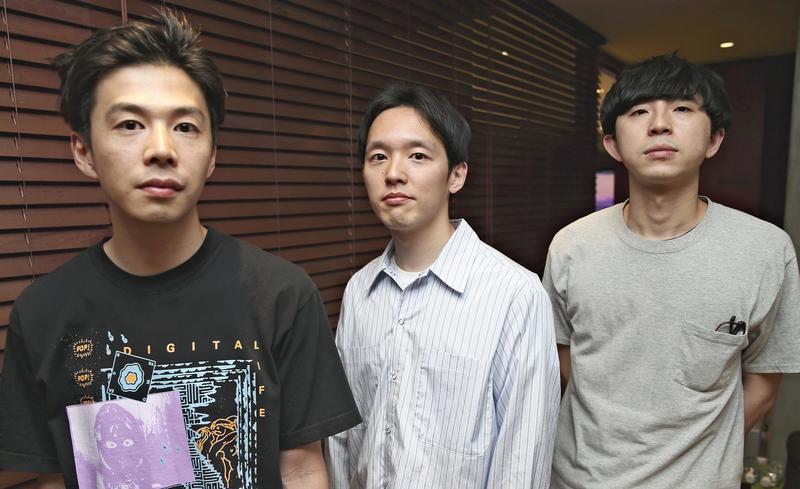
Cero's recently released new album -- "Poly Life Multi Soul" -- is a "variant" dance music collection, which mixes rhythms in a variety of genres, including Brazilian and African music as well as rock.
Pursuing a new form of pop music in every album, the trio band cero is drawing attention from other musicians.
The trio -- vocalist Shohei Takagi, keyboardist Yu Arauchi and guitarist Tsubasa Hashimoto -- produced "Poly Life Multi Soul," released on indie label kakubarhythm on May 16, in collaboration with other musicians who participated in the band's live performances in recent years.
"Sakana no Hone, Tori no Hane" (Fish bone, bird feather) is a song that symbolizes the uniqueness of the new album. This song features complex body-shaking percussion and distinctive scat singing that would be challenging to transcribe.
Arauchi, who composed the song, said, "I gave it an urban tone by using a method of rhythm that is often seen in the African ethnic music." "Sakana no hone, tori no hane" -- words evoking aboriginal life -- and "Kuruma no bane, yoru no ame" (Automotive spring, night rain) -- more urban phrases -- are rhymed and sung one after the other.
Another song, "Soko" (Going upstream), skillfully combines the opening chorus, main performance and different rhythms. Hashimoto, who composed the song, said: "It may be right to say various intertwined rhythms sound like misaligned music, but it is comfortable to listen to as well. The latest album is interesting in that it features this kind of feeling in an easy-to-understand way.
Creating a rhythm is never easy. What cero was seeking to produce is music people can dance to. In Japan, it is said that people easily accept songs using bizarre sound techniques if they are sung by idol singers, while people tend to consider songs that use somewhat unusual rhythms to be difficult to understand. "Our starting point was that there is still a lot of room for us to [work] in terms of rhythm," Takagi said.
Cero is not a band whose members gather before making an album and contemplate what it should be like. As Takagi explains it: "Someone in our band presents a song. This time it was Arauchi's 'Sakana no Hone, Tori no Hane.' We've been creating music that focuses on rhythms, but this time I realized that they [rhythms] finally became the main theme."
It is said that cero formed the foundation for a city-pop boom in the 2010s. "We do have such songs, but I would say they are just like curry and rice served in a soba noodle shop becoming popular," Arauchi said, smiling.
"We produced the first album [released in 2011] to bring together good parts of Japan-made music such as that created by [the Japanese band] Happy End and the new-style music in the United States called 'free folk.' So, I can understand why people call our music in early days city pop, but we are an ever-changing band," Takagi said. "I don't think we are leading [music], and that can't be said about us anytime soon, I think."
Read more from The Japan News at https://japannews.yomiuri.co.jp/